Meat, fish, and eggs
Sea bass
Sea bass provides 18.4 g of protein for 97 kcal per 100 g (3.5 oz), or 19 g of protein for every 100 kcal.
Estimated satietyHow it is calculated
Estimated satiety: 5 out of 5
| Starting point | +1 |
|---|---|
| Low energy density: 97 kcal/100 g | +1 |
| Protein: 19.0 g/100 kcal | +2 |
| Fiber: 0.0 g/100 kcal | 0 |
| Solid food with 78.3 g of water | +1 |
Our own estimate from the values per 100 g: useful for comparing foods with each other, not a measurement in people. Holt index (1995): this food was not measured.
- Prepared by
- Alex Gonzalez
- Last updated
- Next review
- Sources
- 13 primary
- Data
- USDA FDC 175142
No clinical review. No advertising from drug companies and no affiliate links.How we work
Nutrition facts
- Calories
- 146 kcal per serving
- 97 kcal per 100 g (3.5 oz)
- Protein
- 27.6 g per serving
- 18.4 g per 100 g (3.5 oz)
- Carbohydrates
- 0 g per serving
- 0 g per 100 g (3.5 oz)
- of which sugars
- 0 g per serving
- 0 g per 100 g (3.5 oz)
- Fiber
- 0 g per serving
- 0 g per 100 g (3.5 oz)
- Fat
- 3 g per serving
- 2 g per 100 g (3.5 oz)
- of which saturated
- 0.8 g per serving
- 0.5 g per 100 g (3.5 oz)
- Water
- 117.5 g per serving
- 78.3 g per 100 g (3.5 oz)
Source: USDA FoodData Central: Fish, sea bass, mixed species, raw (FDC ID 175142), accessed September 23, 2026.
A typical 150 g (5.5 oz) serving provides about 146 kcal, 27.6 g of protein, and 0 g of fiber.
What it is and how to eat it
In Spain, the official list of commercial names of fishery species admits "lubina o róbalo" for Dicentrarchus labrax (European sea bass), and the Dictionary of the Spanish Language gives lubina as a synonym of róbalo, a marine fish up to 80 cm long. In the Americas, the Dictionary of Americanisms uses róbalo for other fish: Centropomus nigrescens in Mexico, Nicaragua, Costa Rica, Venezuela, Ecuador, Peru and Uruguay, and Eleginops maclovinus in southern Chile. This page uses USDA's raw sea bass, which groups several species without naming them, with 97 kcal, 18.4 g of protein and 2 g of fat per 100 g.
A 150 g (5.3 oz) raw serving provides 27.6 g of protein and about 146 kcal with 3 g of fat. The 2025 nutrition advisory on GLP-1 therapy lists fish among the proteins to prioritize and suggests avoiding fatty foods in the first few days of treatment, so in those days it usually sits better baked, grilled or steamed than battered or fried. Once cooked its flesh separates easily, and in small pieces, with a little broth or mashed potato, it is easy to eat when appetite is low. If you eat little, start with the fish and leave the side dish for last.
What the evidence says
It has 595 mg of EPA and DHA per 100 g, well above the 80 mg per 100 g and per 100 kcal the EU requires for a "high in omega-3 fatty acids" claim, and a 150 g serving provides about 890 mg, more than three times the 250 mg a day with which, according to the EU, EPA and DHA contribute to the normal function of the heart (Regulations (EC) No 1924/2006 and (EU) No 432/2012). According to USDA it also has 5.6 µg of vitamin D and 36.5 µg of selenium per 100 g, 112% and 66% of the EU reference values, 5 µg and 55 µg (Regulation (EU) No 1169/2011). The FDA and EPA mercury advice does not list European sea bass: its Spanish version calls black sea bass "róbalo", among the best choices, and striped bass "lubina rayada", among the good choices, two different species. If it is eaten raw or marinated, as in ceviche or carpaccio, Spain's Ministry of Social Rights, Consumer Affairs and 2030 Agenda asks for it to be frozen at home first, at −20 °C (−4 °F) or below for five days, because of anisakis, and Royal Decree 1021/2022 requires bars and restaurants to ensure that fish they serve raw has been frozen beforehand, except marine farmed fish whose producer declares it was raised free of parasites.
Recipes with this food
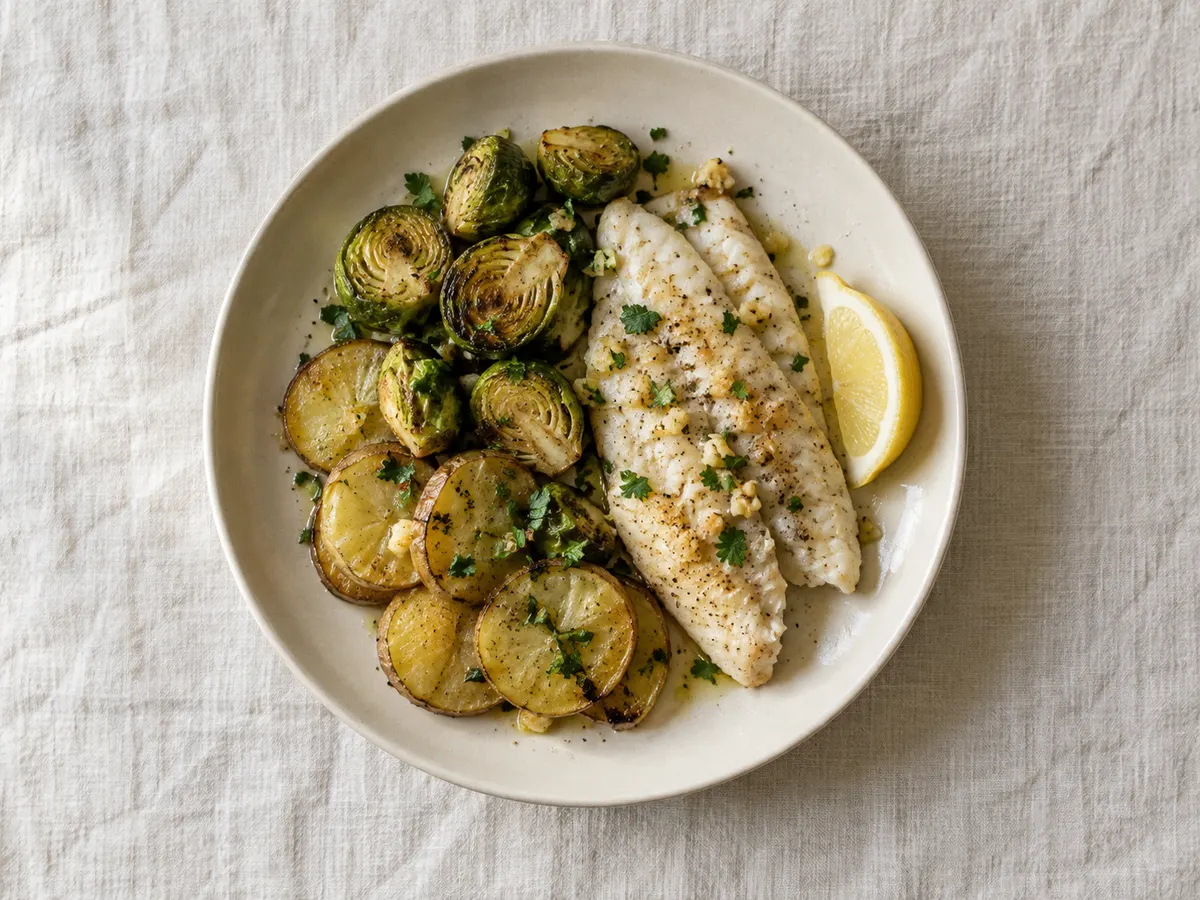 Baked sea bass with Brussels sprouts and potatoes32.8 g protein per serving
Satiety
The 1 to 5 score is our own estimate: it starts at 1 point, adds points for low energy density, for protein and fiber per 100 kcal, and for the water in solid foods, and subtracts points for drinks with calories. It is useful for comparing foods with each other; it is not a measurement in people.
What to keep in mind on a GLP-1 medication
Frequently asked questions about sea bass
How much protein is in a 150 g (5.5 oz) serving of sea bass?
100 g (3.5 oz) of sea bass has 18.4 g of protein. A typical 150 g (5.5 oz) serving has about 27.6 g of protein. That is 19 g of protein per 100 kcal, which is why it carries our “High in protein” tag.
How many calories does a 150 g (5.5 oz) serving of sea bass have?
100 g (3.5 oz) of sea bass has 97 kcal. A typical 150 g (5.5 oz) serving has about 146 kcal. That is a low energy density.
Is sea bass filling?
Yes, very filling for the calories it provides: our estimated satiety score is 5 out of 5. Calculation: 1 (base) + 1 (low energy density: 97 kcal/100 g) + 2 (protein: 19.0 g/100 kcal) + 0 (fiber: 0.0 g/100 kcal) + 1 (solid food with 78.3 g of water) = 5. It is an estimate based on its composition, not a measurement in people.
How does sea bass sit with nausea from a GLP-1 medication?
Based on our tags, this is what matters about sea bass on a GLP-1 medication. “High in protein”: plenty of protein per calorie; protein helps preserve muscle mass when you eat less. “Easy to digest”: a soft or low-fat food that many people tolerate well when they feel nauseous or get full quickly. “Low energy density”: plenty of volume for few calories; make sure it does not push protein foods off your plate. These are general guidelines, not medical advice: everyone tolerates foods differently.
What counts as a normal serving of sea bass?
We use 150 g (5.5 oz) as a typical serving. That amount provides about 146 kcal, 27.6 g of protein, and 0 g of fiber. It is a reference for calculations, not a recommendation of how much to eat.
Compare with…
Similar foods
Sources
Sources for the data on this page, with the access date.
- Official databaseU.S. Department of Agriculture, Agricultural Research Service.USDA FoodData Central: Fish, sea bass, mixed species, raw (FDC ID 175142).accessed .
- RegulatorOfficial State Gazette (BOE, Spain).Resolución de 25 de febrero de 2026, de la Secretaría General de Pesca (Resolution of 25 February 2026 of the General Secretariat for Fisheries publishing the list of commercial names of fishery and aquaculture species admitted in Spain; in Spanish).accessed .
- InstitutionRoyal Spanish Academy and Association of Academies of the Spanish Language (RAE-ASALE).Diccionario de la lengua española (Dictionary of the Spanish Language, 23rd ed., online version): "lubina" (in Spanish).accessed .
- InstitutionRoyal Spanish Academy and Association of Academies of the Spanish Language (RAE-ASALE).Diccionario de la lengua española (Dictionary of the Spanish Language, 23rd ed., online version): "róbalo" (in Spanish).accessed .
- InstitutionAssociation of Academies of the Spanish Language (ASALE).Diccionario de americanismos (Dictionary of Americanisms): "róbalo" (in Spanish).accessed .
- Clinical guidelineObesity (Wiley).Mozaffarian D, et al. Nutritional priorities to support GLP-1 therapy for obesity: A joint Advisory from the American College of Lifestyle Medicine, the American Society for Nutrition, the Obesity Medicine Association, and The Obesity Society. Obesity. 2025;33(8):1475-1503. doi:10.1002/oby.24336.accessed .
- RegulatorOfficial Journal of the European Union (EUR-Lex).Regulation (EC) No 1924/2006 on nutrition and health claims made on foods (Annex).accessed .
- RegulatorOfficial Journal of the European Union (EUR-Lex).Commission Regulation (EU) No 432/2012 establishing a list of permitted health claims made on foods.accessed .
- RegulatorOfficial Journal of the European Union (EUR-Lex).Regulation (EU) No 1169/2011 on the provision of food information to consumers (Annex XIII, nutrient reference values).accessed .
- RegulatorU.S. Food and Drug Administration (FDA) and U.S. Environmental Protection Agency (EPA).Advice about Eating Fish: For Those Who Might Become or Are Pregnant or Breastfeeding and Children Ages 1-11 Years.accessed .
- RegulatorU.S. Food and Drug Administration (FDA) and U.S. Environmental Protection Agency (EPA).Consejos sobre el consumo de pescado (Spanish translation of the FDA and EPA Advice About Eating Fish, revised October 2021; in Spanish).accessed .
- RegulatorMinistry of Social Rights, Consumer Affairs and 2030 Agenda (Spain).Anisakis (consumer advice; in Spanish).accessed .
- RegulatorOfficial State Gazette (BOE, Spain).Real Decreto 1021/2022, de 13 de diciembre (Royal Decree 1021/2022 on food hygiene requirements in retail and food-service establishments; consolidated text, article 8; in Spanish).accessed .