Meat, fish, and eggs
Smoked salmon
Smoked salmon provides 18.3 g of protein for 117 kcal per 100 g (3.5 oz), or 15.6 g of protein for every 100 kcal.
Estimated satietyHow it is calculated
Estimated satiety: 5 out of 5
| Starting point | +1 |
|---|---|
| Low energy density: 117 kcal/100 g | +1 |
| Protein: 15.6 g/100 kcal | +2 |
| Fiber: 0.0 g/100 kcal | 0 |
| Solid food with 72.0 g of water | +1 |
Our own estimate from the values per 100 g: useful for comparing foods with each other, not a measurement in people. Holt index (1995): this food was not measured.
- Prepared by
- Alex Gonzalez
- Last updated
- Next review
- Sources
- 7 primary
- Data
- USDA FDC 173687
No clinical review. No advertising from drug companies and no affiliate links.How we work
Nutrition facts
- Calories
- 59 kcal per serving
- 117 kcal per 100 g (3.5 oz)
- Protein
- 9.2 g per serving
- 18.3 g per 100 g (3.5 oz)
- Carbohydrates
- 0 g per serving
- 0 g per 100 g (3.5 oz)
- of which sugars
- 0 g per serving
- 0 g per 100 g (3.5 oz)
- Fiber
- 0 g per serving
- 0 g per 100 g (3.5 oz)
- Fat
- 2.2 g per serving
- 4.3 g per 100 g (3.5 oz)
- of which saturated
- 0.5 g per serving
- 0.9 g per 100 g (3.5 oz)
- Water
- 36 g per serving
- 72 g per 100 g (3.5 oz)
Source: USDA FoodData Central: Fish, salmon, chinook, smoked (FDC ID 173687), accessed September 23, 2026.
A typical 50 g (2 oz) serving provides about 59 kcal, 9.2 g of protein, and 0 g of fiber.
What it is and how to eat it
Smoked salmon is made by salting salmon fillets and smoking them, and it is sold mostly in thin, packaged slices that are kept in the fridge and eaten as they are, without cooking. This page uses USDA's smoked chinook (Pacific) salmon, with 117 kcal, 18.3 g of protein and 4.32 g of fat per 100 g; smoked Atlantic salmon may have somewhat different values.
A 50 g (1.8 oz) serving, two or three slices, provides about 9 g of protein and under 60 kcal with no cooking, so it is easy to start a meal with it, as the 2025 nutrition advisory on GLP-1 therapy suggests, for example in the cottage cheese toast with smoked salmon. It has 2.2 g of fat per serving, which fits the same advisory's suggestion to avoid fatty foods in the first few days of treatment; if the smell makes you queasy, one slice may be enough in those days. Because of the salt, it works better as a small complement than as a main course.
What the evidence says
According to USDA it has 672 mg of sodium per 100 g, so a 50 g serving provides about 336 mg, one sixth of the 2,000 mg a day that WHO recommends not exceeding; since the salt depends on the recipe, it is worth comparing labels. With 0.45 g of EPA and DHA per 100 g, a 50 g serving provides about 225 mg, a little less than the 250 mg a day that EFSA considers an adequate intake for adults, the same daily amount with which, according to the EU, the effect of the authorized claim "EPA and DHA contribute to the normal function of the heart" is obtained (Regulation (EU) No 432/2012). The CDC advises pregnant women, adults over 65 and people with weakened immune systems not to eat refrigerated smoked fish because of the risk of Listeria, unless it is cooked in a casserole or other cooked dish or comes in packaging that needs no refrigeration before opening, and Spain's Ministry of Social Rights, Consumer Affairs and 2030 Agenda also advises pregnant women to avoid refrigerated smoked fish.
Recipes with this food
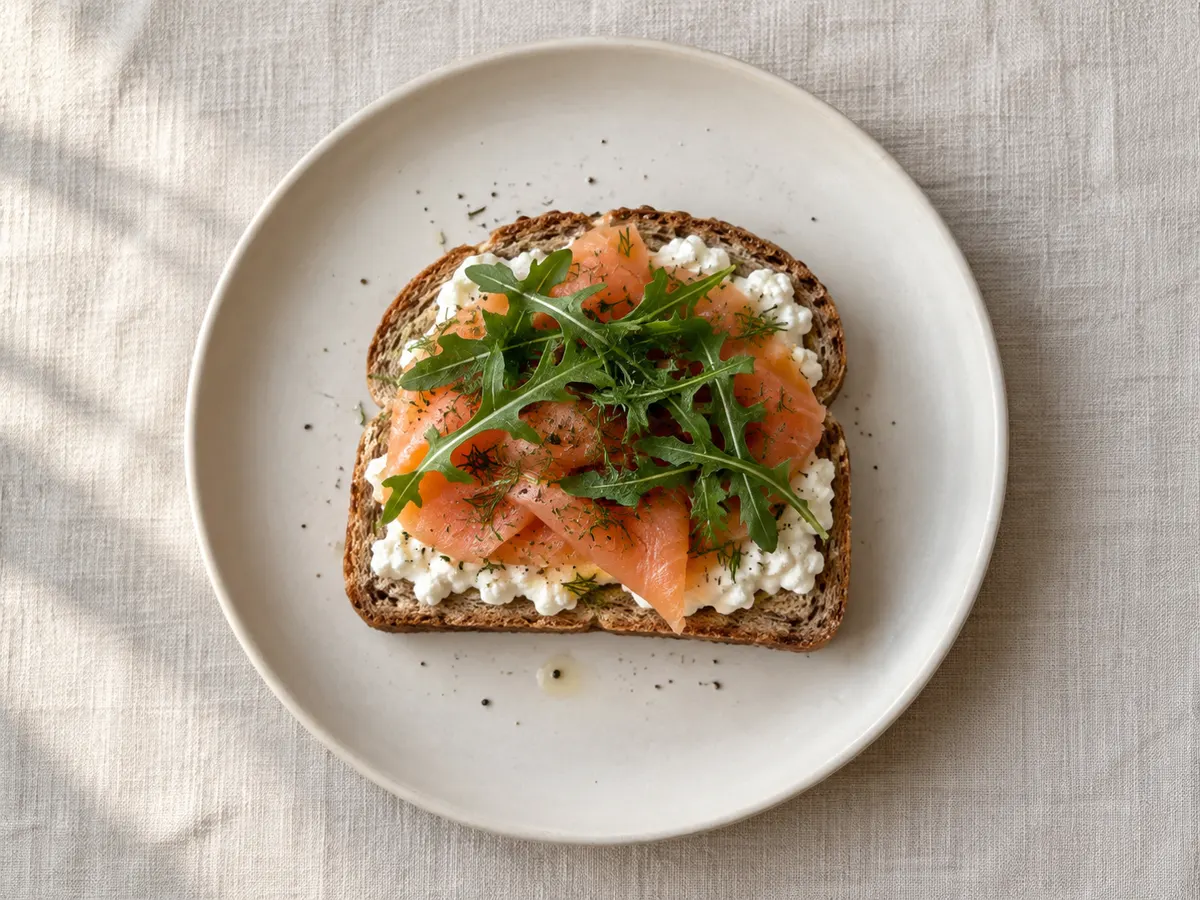 Cottage cheese toast with smoked salmon20.9 g protein per serving
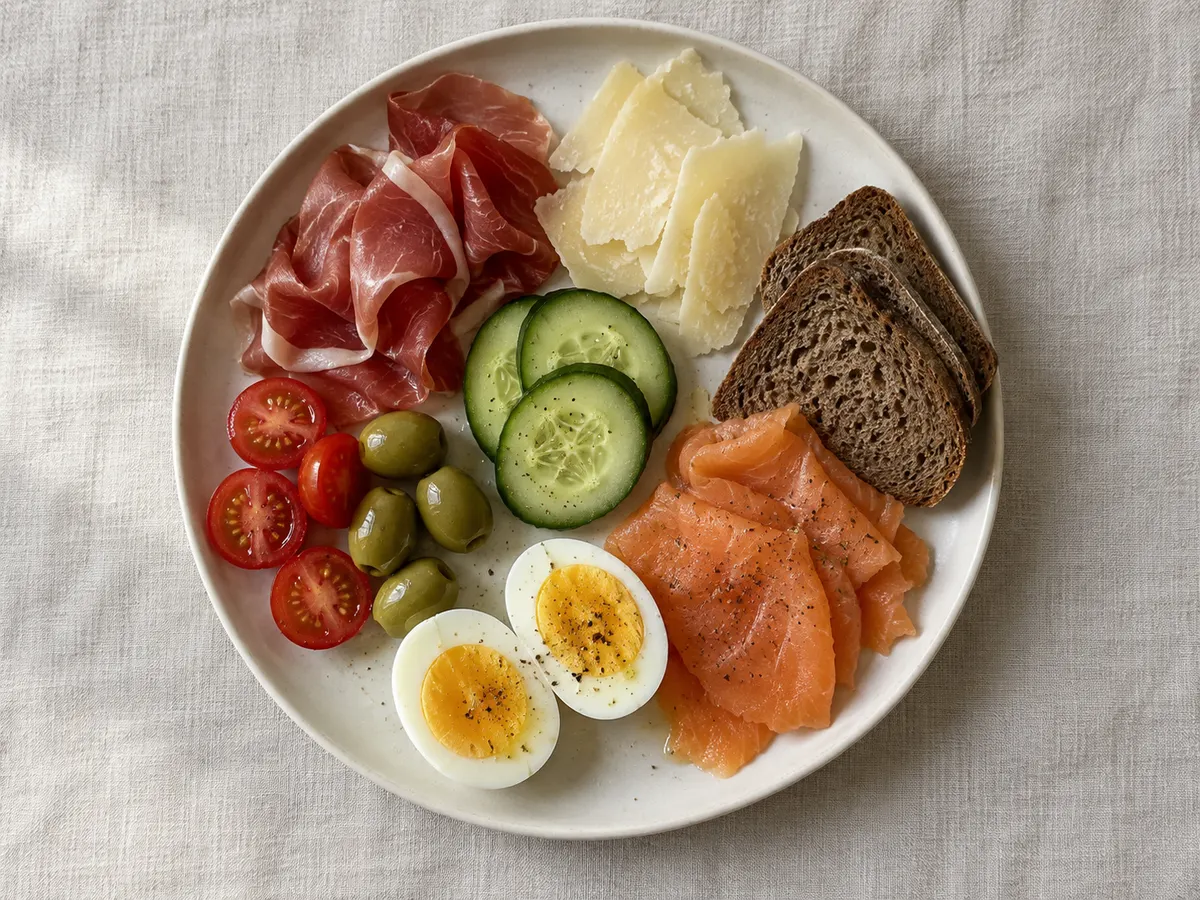 Holiday appetizer board with ham, smoked salmon, and eggs16.5 g protein per serving
Satiety
The 1 to 5 score is our own estimate: it starts at 1 point, adds points for low energy density, for protein and fiber per 100 kcal, and for the water in solid foods, and subtracts points for drinks with calories. It is useful for comparing foods with each other; it is not a measurement in people.
What to keep in mind on a GLP-1 medication
Frequently asked questions about smoked salmon
How much protein is in a 50 g (2 oz) serving of smoked salmon?
100 g (3.5 oz) of smoked salmon has 18.3 g of protein. A typical 50 g (2 oz) serving has about 9.2 g of protein. That is 15.6 g of protein per 100 kcal, which is why it carries our “High in protein” tag.
How many calories does a 50 g (2 oz) serving of smoked salmon have?
100 g (3.5 oz) of smoked salmon has 117 kcal. A typical 50 g (2 oz) serving has about 59 kcal. That is a low energy density.
Is smoked salmon filling?
Yes, very filling for the calories it provides: our estimated satiety score is 5 out of 5. Calculation: 1 (base) + 1 (low energy density: 117 kcal/100 g) + 2 (protein: 15.6 g/100 kcal) + 0 (fiber: 0.0 g/100 kcal) + 1 (solid food with 72.0 g of water) = 5. It is an estimate based on its composition, not a measurement in people.
What should I know about smoked salmon on a GLP-1 medication?
Based on our tags, this is what matters about smoked salmon on a GLP-1 medication. “High in protein”: plenty of protein per calorie; protein helps preserve muscle mass when you eat less. “Nutritious in small servings”: a lot of nutrition in a small volume, which is practical when you eat little. These are general guidelines, not medical advice: everyone tolerates foods differently.
What counts as a normal serving of smoked salmon?
We use 50 g (2 oz) as a typical serving. That amount provides about 59 kcal, 9.2 g of protein, and 0 g of fiber. It is a reference for calculations, not a recommendation of how much to eat.
Compare with…
Similar foods
Sources
Sources for the data on this page, with the access date.
- Official databaseU.S. Department of Agriculture, Agricultural Research Service.USDA FoodData Central: Fish, salmon, chinook, smoked (FDC ID 173687).accessed .
- Clinical guidelineObesity (Wiley).Mozaffarian D, et al. Nutritional priorities to support GLP-1 therapy for obesity: A joint Advisory from the American College of Lifestyle Medicine, the American Society for Nutrition, the Obesity Medicine Association, and The Obesity Society. Obesity. 2025;33(8):1475-1503. doi:10.1002/oby.24336.accessed .
- InstitutionWorld Health Organization.Sodium reduction.accessed .
- RegulatorEuropean Food Safety Authority (EFSA).EFSA NDA Panel. Scientific Opinion on Dietary Reference Values for fats, including saturated fatty acids, polyunsaturated fatty acids, monounsaturated fatty acids, trans fatty acids, and cholesterol. EFSA Journal. 2010;8(3):1461.accessed .
- RegulatorOfficial Journal of the European Union (EUR-Lex).Commission Regulation (EU) No 432/2012 establishing a list of permitted health claims made on foods.accessed .
- InstitutionU.S. Centers for Disease Control and Prevention.Preventing Listeria Infection.accessed .
- RegulatorMinistry of Social Rights, Consumer Affairs and 2030 Agenda (Spain).Alimentación segura durante el embarazo (Safe eating during pregnancy).accessed .