Drinks
Unsweetened soy milk
Each 100 ml (3.4 fl oz) of unsweetened soy milk has 33 kcal and 0.4 g of sugars, and as a drink those calories tend to fill you up less than the same calories from solid food.
Estimated satietyHow it is calculated
Estimated satiety: 4 out of 5
| Starting point | +1 |
|---|---|
| Very low energy density: 33 kcal/100 g | +2 |
| Protein: 8.7 g/100 kcal | +2 |
| Fiber: 1.5 g/100 kcal | 0 |
| Liquid, less filling than a solid; 0.4 g of sugars, under 8 | −1 |
Our own estimate from the values per 100 g: useful for comparing foods with each other, not a measurement in people. Holt index (1995): this food was not measured.
- Prepared by
- Alex Gonzalez
- Last updated
- Next review
- Sources
- 12 primary
- Data
- USDA FDC 175215
No clinical review. No advertising from drug companies and no affiliate links.How we work
Nutrition facts
- Calories
- 83 kcal per serving
- 33 kcal per 100 ml (3.4 fl oz)
- Protein
- 7.2 g per serving
- 2.9 g per 100 ml (3.4 fl oz)
- Carbohydrates
- 4.4 g per serving
- 1.7 g per 100 ml (3.4 fl oz)
- of which sugars
- 1 g per serving
- 0.4 g per 100 ml (3.4 fl oz)
- Fiber
- 1.3 g per serving
- 0.5 g per 100 ml (3.4 fl oz)
- Fat
- 4 g per serving
- 1.6 g per 100 ml (3.4 fl oz)
- of which saturated
- 0.5 g per serving
- 0.2 g per 100 ml (3.4 fl oz)
- Water
- 232.8 g per serving
- 93.1 g per 100 ml (3.4 fl oz)
Source: USDA FoodData Central: Soymilk (all flavors), unsweetened, with added calcium, vitamins A and D (FDC ID 175215), accessed September 23, 2026.
A typical 250 ml (8.5 fl oz, about 1 cup) serving provides about 83 kcal, 7.2 g of protein, and 1.3 g of fiber.
What it is and how to eat it
Soy milk is made by soaking and grinding soybeans with water and filtering the liquid; many brands add sugar, oil, calcium and vitamins. In the European Union it cannot be sold as "soy milk", because Regulation (EU) No 1308/2013 reserves the word "milk" for mammary secretion and the EU Court of Justice confirmed in 2017 that this applies to plant-based products, while in Latin America it is commonly called leche de soya. This page covers an unsweetened soy milk fortified with calcium and vitamins A and D, with 33 kcal, 2.86 g of protein and 124 mg of calcium per 100 g according to USDA.
A 250 ml (8.5 fl oz) glass provides about 83 kcal, 7.2 g of protein and 310 mg of calcium, close to the 7.9 g of protein in a glass of whole milk and more than four times the 1.7 g in a glass of oat milk according to USDA. The 2025 nutrition advisory on GLP-1 therapy suggests eating protein-rich foods first and having small, frequent meals when appetite is low, and since it is liquid it can be sipped when solid food is hard to eat. It contains no lactose, and the Greek yogurt, banana, and strawberry smoothie recipe suggests the unsweetened version in place of skim milk.
What the evidence says
Protein provides about 35% of its energy, above the 20% the EU requires for a "high protein" claim (Regulation (EC) No 1924/2006), although a glass has a little less than whole milk. Calcium depends on fortification: USDA lists 124 mg per 100 g for this drink and 25 mg for an unfortified soy milk, so check the label for added calcium, and USDA's MyPlate, which accompanied the 2020-2025 Dietary Guidelines, counted fortified soy milk in the dairy group. Soy isoflavones have no authorized health claim in the EU: in 2012 EFSA concluded that it had not been shown that they help maintain bone density or reduce menopausal hot flashes. In 2015 EFSA reviewed food supplements with isolated isoflavones and found no evidence of harmful effects on the breast, uterus or thyroid in post-menopausal women, but that assessment covered supplements, not foods such as this drink, and lacked enough data to assess women in the transition to menopause or those with a personal or family history of cancer.
Recipes with this food
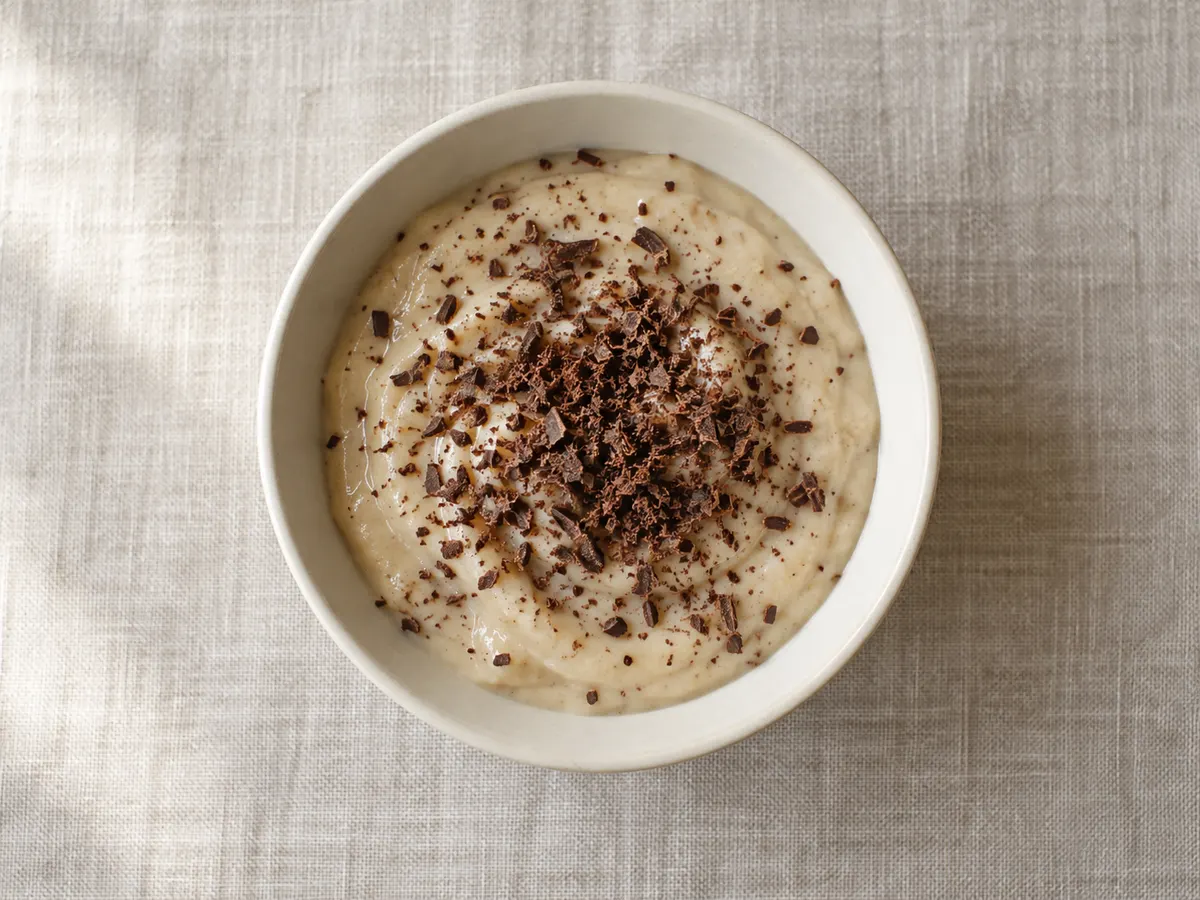 Tofu banana cream with grated dark chocolate13.4 g protein per serving
Satiety
The 1 to 5 score is our own estimate: it starts at 1 point, adds points for low energy density, for protein and fiber per 100 kcal, and for the water in solid foods, and subtracts points for drinks with calories. It is useful for comparing foods with each other; it is not a measurement in people.
What to keep in mind on a GLP-1 medication
Frequently asked questions about unsweetened soy milk
How much protein does a cup of soy milk have?
A cup of soy milk, our reference serving of 250 ml (8.5 fl oz), has about 7.2 g of protein. 100 ml (3.4 fl oz) of unsweetened soy milk has 2.9 g of protein. That is 8.7 g of protein per 100 kcal.
How many calories are in a cup of soy milk?
A cup of soy milk, our reference serving of 250 ml (8.5 fl oz), has about 83 kcal. 100 ml (3.4 fl oz) of unsweetened soy milk has 33 kcal. That is a very low energy density.
How many grams of fiber are in a cup of soy milk?
A cup of soy milk, our reference serving of 250 ml (8.5 fl oz), has about 1.3 g of fiber. 100 ml (3.4 fl oz) of unsweetened soy milk has 0.5 g of fiber.
How filling is unsweetened soy milk?
Fairly filling for the calories it provides: our estimated satiety score is 4 out of 5. Calculation: 1 (base) + 2 (very low energy density: 33 kcal/100 g) + 2 (protein: 8.7 g/100 kcal) + 0 (fiber: 1.5 g/100 kcal) − 1 (liquid, less filling than a solid; 0.4 g of sugars, under 8) = 4. It is an estimate based on its composition, not a measurement in people.
Is unsweetened soy milk a good choice on a GLP-1 medication?
Based on our tags, this is what matters about unsweetened soy milk on a GLP-1 medication. “Low energy density”: plenty of volume for few calories; make sure it does not push protein foods off your plate. “Hydrating”: a lot of water, which contributes to hydration when you eat and drink less. These are general guidelines, not medical advice: everyone tolerates foods differently.
How many milliliters or fluid ounces are in a serving of unsweetened soy milk?
We use 250 ml (8.5 fl oz) as a typical serving, roughly a cup of soy milk (1 ml is treated as about 1 g). That amount provides about 83 kcal, 7.2 g of protein, and 1.3 g of fiber. It is a reference for calculations, not a recommendation of how much to eat.
Compare with…
Similar foods
Sources
Sources for the data on this page, with the access date.
- Official databaseU.S. Department of Agriculture, Agricultural Research Service.USDA FoodData Central: Soymilk (all flavors), unsweetened, with added calcium, vitamins A and D (FDC ID 175215).accessed .
- RegulatorOfficial Journal of the European Union (EUR-Lex).Regulation (EU) No 1308/2013 establishing a common organisation of the markets in agricultural products (Annex VII, Part III, milk and milk products).accessed .
- RegulatorCourt of Justice of the European Union (EUR-Lex).Court of Justice of the EU. Judgment of 14 June 2017, case C-422/16, Verband Sozialer Wettbewerb v TofuTown.com.accessed .
- Official databaseU.S. Department of Agriculture, Agricultural Research Service.USDA FoodData Central: Milk, whole, 3.25% milkfat, with added vitamin D (FDC ID 171265).accessed .
- Official databaseU.S. Department of Agriculture, Agricultural Research Service.USDA FoodData Central (FNDDS 2021-2023): Oat milk (FDC ID 2705412).accessed .
- Clinical guidelineObesity (Wiley).Mozaffarian D, et al. Nutritional priorities to support GLP-1 therapy for obesity: A joint Advisory from the American College of Lifestyle Medicine, the American Society for Nutrition, the Obesity Medicine Association, and The Obesity Society. Obesity. 2025;33(8):1475-1503. doi:10.1002/oby.24336.accessed .
- RegulatorOfficial Journal of the European Union (EUR-Lex).Regulation (EC) No 1924/2006 on nutrition and health claims made on foods (Annex).accessed .
- Official databaseU.S. Department of Agriculture, Agricultural Research Service.USDA FoodData Central: Soymilk, original and vanilla, unfortified (FDC ID 172446).accessed .
- InstitutionU.S. Department of Agriculture.Dairy Group: One of the Five Food Groups (MyPlate; Internet Archive copy of 24 February 2026).accessed .
- RegulatorEFSA Journal.EFSA NDA Panel. Scientific Opinion on the substantiation of health claims related to soy isoflavones and maintenance of bone mineral density (ID 1655) and reduction of vasomotor symptoms associated with menopause (ID 1654, 1704, 2140, 3093, 3154, 3590) (further assessment) pursuant to Article 13(1) of Regulation (EC) No 1924/2006. EFSA Journal. 2012;10(8):2847. doi:10.2903/j.efsa.2012.2847.accessed .
- RegulatorEFSA Journal.EFSA ANS Panel. Risk assessment for peri- and post-menopausal women taking food supplements containing isolated isoflavones. EFSA Journal. 2015;13(10):4246. doi:10.2903/j.efsa.2015.4246.accessed .
- RegulatorEuropean Food Safety Authority.Isoflavones in food supplements for post-menopausal women: no evidence of harm (21 October 2015).accessed .