Vegetables and starchy roots
Eggplant
Eggplant is 92% water, so 100 g (3.5 oz) brings only 25 kcal and 3 g of fiber.
Estimated satietyHow it is calculated
Estimated satiety: 5 out of 5
| Starting point | +1 |
|---|---|
| Very low energy density: 25 kcal/100 g | +2 |
| Protein: 3.9 g/100 kcal | 0 |
| Fiber: 12.0 g/100 kcal | +2 |
| Solid food with 92.3 g of water | +1 |
| Sum | 6 |
| Capped at 5 | 5 |
Our own estimate from the values per 100 g: useful for comparing foods with each other, not a measurement in people. Holt index (1995): this food was not measured.
- Prepared by
- Alex Gonzalez
- Last updated
- Next review
- Sources
- 6 primary and 1 supporting
- Data
- USDA FDC 169228
No clinical review. No advertising from drug companies and no affiliate links.How we work
Nutrition facts
- Calories
- 38 kcal per serving
- 25 kcal per 100 g (3.5 oz)
- Protein
- 1.5 g per serving
- 1 g per 100 g (3.5 oz)
- Carbohydrates
- 8.8 g per serving
- 5.9 g per 100 g (3.5 oz)
- of which sugars
- 5.3 g per serving
- 3.5 g per 100 g (3.5 oz)
- Fiber
- 4.5 g per serving
- 3 g per 100 g (3.5 oz)
- Fat
- 0.3 g per serving
- 0.2 g per 100 g (3.5 oz)
- of which saturated
- 0.1 g per serving
- 0 g per 100 g (3.5 oz)
- Water
- 138.5 g per serving
- 92.3 g per 100 g (3.5 oz)
Source: USDA FoodData Central: Eggplant, raw (FDC ID 169228), accessed September 23, 2026.
A typical 150 g (5.5 oz, about 1 3/4 cups) serving provides about 38 kcal, 1.5 g of protein, and 4.5 g of fiber.
What it is and how to eat it
Eggplant (Solanum melongena) is the fruit of a plant in the same family as tomatoes and peppers, and it is almost always eaten cooked: roasted, baked, grilled, stewed or fried. It is called berenjena in both Spain and Latin America, and the most common kind is the long, dark purple one, although there are also round, white and striped varieties, such as Listada de Gandía. This page covers raw eggplant according to USDA, with 25 kcal and 3 g of fiber per 100 g; boiled and drained, it has 35 kcal and 2.5 g of fiber.
A 150 g (5.3 oz) serving provides about 38 kcal, 4.5 g of fiber and barely 1.5 g of protein, so it adds volume but is not the protein part of the plate; with eggs it covers both, as in the Spanish vegetable pisto with eggs. The 2025 nutrition advisory on GLP-1 therapy suggests starting meals with protein, notes that foods high in protein or fat can further slow gastric emptying and suggests avoiding fatty and high-fiber foods in the first few days of treatment. In those days, and after a dose increase, roasted or baked with little oil may sit better than fried or battered.
What the evidence says
Raw, at 25 kcal per 100 g, it has a very low energy density, and with 3 g of fiber per 100 g it meets the minimum for a "source of fibre" claim; boiled, it drops to 2.5 g, but at 7.1 g per 100 kcal it still exceeds the 3 g per 100 kcal of the EU criterion for a "high fibre" claim (Regulation (EC) No 1924/2006). A systematic review carried out for the 2010 Dietary Guidelines for Americans concluded that diets relatively low in energy density help adults lose weight and keep it off, although it refers to the diet as a whole and not to a single food (Journal of the Academy of Nutrition and Dietetics, 2012). Frying partly undoes that advantage: in a laboratory study of eggplant slices deep-fried in oil, the amount of oil they absorbed rose the longer they were fried, from 2 to 8 minutes (Food Science & Nutrition, 2023). "Eggplant water" is promoted for lowering cholesterol or losing weight, but I have not found trials that support it, and the EU has not authorized any health claim for eggplant.
Recipes with this food
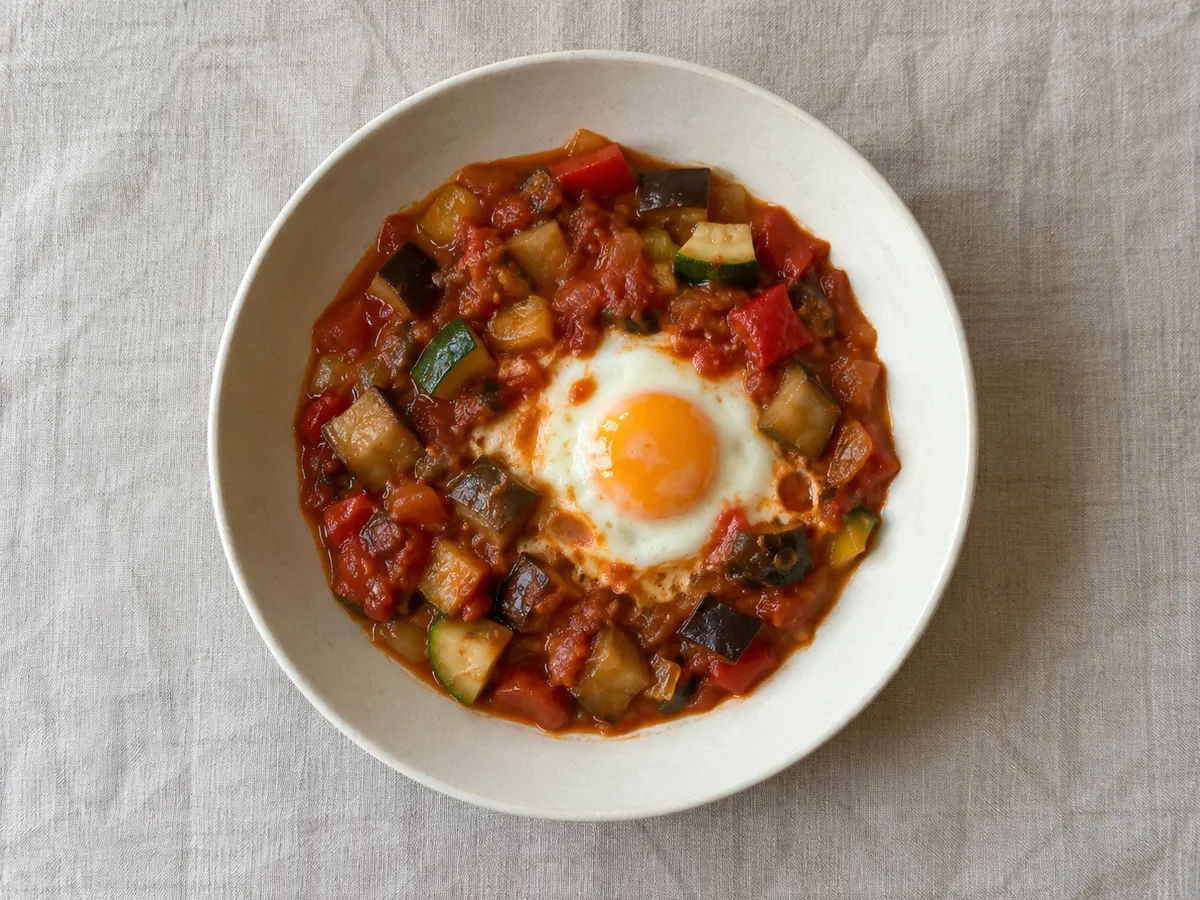 Spanish vegetable pisto with eggs17.8 g protein per serving
Satiety
The 1 to 5 score is our own estimate: it starts at 1 point, adds points for low energy density, for protein and fiber per 100 kcal, and for the water in solid foods, and subtracts points for drinks with calories. It is useful for comparing foods with each other; it is not a measurement in people.
What to keep in mind on a GLP-1 medication
Frequently asked questions about eggplant
How many grams of protein are in a 150 g (5.5 oz) serving of eggplant?
100 g (3.5 oz) of eggplant has 1 g of protein. A typical 150 g (5.5 oz) serving has about 1.5 g of protein. That is 3.9 g of protein per 100 kcal.
How many kcal are in a 150 g (5.5 oz) serving of eggplant?
100 g (3.5 oz) of eggplant has 25 kcal. A typical 150 g (5.5 oz) serving has about 38 kcal. That is a very low energy density.
How much fiber is in a 150 g (5.5 oz) serving of eggplant?
100 g (3.5 oz) of eggplant has 3 g of fiber. A typical 150 g (5.5 oz) serving has about 4.5 g of fiber. It carries our “High in fiber” tag.
Does eggplant keep you full?
Yes, very filling for the calories it provides: our estimated satiety score is 5 out of 5. Calculation: 1 (base) + 2 (very low energy density: 25 kcal/100 g) + 0 (protein: 3.9 g/100 kcal) + 2 (fiber: 12.0 g/100 kcal) + 1 (solid food with 92.3 g of water) = 6; capped at 5. It is an estimate based on its composition, not a measurement in people.
How does eggplant fit into eating on Ozempic, Wegovy, Mounjaro, or Zepbound?
Based on our tags, this is what matters about eggplant on a GLP-1 medication. “High in fiber”: a good amount of fiber, which helps keep you regular; it is easier to tolerate when you increase it gradually and drink enough water. “Low energy density”: plenty of volume for few calories; make sure it does not push protein foods off your plate. “Hydrating”: a lot of water, which contributes to hydration when you eat and drink less. These are general guidelines, not medical advice: everyone tolerates foods differently.
What is a typical serving of eggplant?
We use 150 g (5.5 oz) as a typical serving, about 1 3/4 cups. That amount provides about 38 kcal, 1.5 g of protein, and 4.5 g of fiber. It is a reference for calculations, not a recommendation of how much to eat.
Compare with…
Similar foods
Sources
Sources for the data on this page, with the access date.
- Official databaseU.S. Department of Agriculture, Agricultural Research Service.USDA FoodData Central: Eggplant, raw (FDC ID 169228).accessed .
- Official databaseU.S. Department of Agriculture, Agricultural Research Service.USDA FoodData Central: Eggplant, cooked, boiled, drained, without salt (FDC ID 169229).accessed .
- Clinical guidelineObesity (Wiley).Mozaffarian D, et al. Nutritional priorities to support GLP-1 therapy for obesity: A joint Advisory from the American College of Lifestyle Medicine, the American Society for Nutrition, the Obesity Medicine Association, and The Obesity Society. Obesity. 2025;33(8):1475-1503. doi:10.1002/oby.24336.accessed .
- RegulatorOfficial Journal of the European Union (EUR-Lex).Regulation (EC) No 1924/2006 on nutrition and health claims made on foods (Annex).accessed .
- Meta-analysisJournal of the Academy of Nutrition and Dietetics (Elsevier).Pérez-Escamilla R, Obbagy JE, Altman JM, et al. Dietary energy density and body weight in adults and children: a systematic review. J Acad Nutr Diet. 2012;112(5):671-684. doi:10.1016/j.jand.2012.01.020.accessed .
- Other sourceFood Science & Nutrition (Wiley).Varidi M, Ahmadzadeh-Hashemi S, Nooshkam M. Changes in fat uptake, color, texture, and sensory properties of Aloe vera gel-coated eggplant rings during deep-fat frying process. Food Sci Nutr. 2023;11(4):2027-2035. doi:10.1002/fsn3.3238.accessed .
- RegulatorEuropean Commission.EU Register of nutrition and health claims made on foods.accessed .