Meat, fish, and eggs
Lean ground beef
Lean ground beef provides 21.4 g of protein for 137 kcal per 100 g (3.5 oz), or 15.6 g of protein for every 100 kcal.
Estimated satietyHow it is calculated
Estimated satiety: 5 out of 5
| Starting point | +1 |
|---|---|
| Low energy density: 137 kcal/100 g | +1 |
| Protein: 15.6 g/100 kcal | +2 |
| Fiber: 0.0 g/100 kcal | 0 |
| Solid food with 73.2 g of water | +1 |
Our own estimate from the values per 100 g: useful for comparing foods with each other, not a measurement in people. Holt index (1995): this food was not measured.
- Prepared by
- Alex Gonzalez
- Last updated
- Next review
- Sources
- 9 primary
- Data
- USDA FDC 171790
No clinical review. No advertising from drug companies and no affiliate links.How we work
Nutrition facts
- Calories
- 164 kcal per serving
- 137 kcal per 100 g (3.5 oz)
- Protein
- 25.7 g per serving
- 21.4 g per 100 g (3.5 oz)
- Carbohydrates
- 0 g per serving
- 0 g per 100 g (3.5 oz)
- of which sugars
- 0 g per serving
- 0 g per 100 g (3.5 oz)
- Fiber
- 0 g per serving
- 0 g per 100 g (3.5 oz)
- Fat
- 6 g per serving
- 5 g per 100 g (3.5 oz)
- of which saturated
- 2.6 g per serving
- 2.2 g per 100 g (3.5 oz)
- Water
- 87.8 g per serving
- 73.2 g per 100 g (3.5 oz)
Source: USDA FoodData Central: Beef, ground, 95% lean meat / 5% fat, raw (FDC ID 171790), accessed September 23, 2026.
A typical 120 g (4 oz) serving provides about 164 kcal, 25.7 g of protein, and 0 g of fiber.
What it is and how to eat it
Ground beef (carne molida or picada in Spanish) is meat cut into very small pieces, and how much fat it has depends on the meat and fat that go into the grinder: USDA classifies it by the percentage of lean meat and fat, like the 95/5 on this page. This USDA entry, 95% lean beef, raw, has 137 kcal, 21.4 g of protein and 5 g of fat per 100 g, while 80/20 has 254 kcal and 20 g of fat. It is the base of picadillo, meatballs, burgers and many fillings.
A 120 g (4.2 oz) raw serving provides 25.7 g of protein and 164 kcal with 6 g of fat; the same amount of 80/20 beef would have 305 kcal and 24 g of fat. The 2025 nutrition advisory on GLP-1 therapy asks people to moderate red meat and suggests avoiding fatty foods in the first few days of treatment, so if you eat it, the lean version stewed with vegetables, as in the lean beef picadillo with vegetables, fits better than a fatty burger. In a sauce it turns soft and takes little effort to chew, which helps when appetite is low, and in the weeks after a dose increase half a serving may be enough. The USDA Food Safety and Inspection Service advises cooking ground meat until the center reaches 160 °F (71.1 °C).
What the evidence says
In 2015 the International Agency for Research on Cancer (IARC) classified red meat, which includes beef, as "probably carcinogenic to humans" (Group 2A) because of its association with colorectal cancer, and explains that if that association were causal, the risk could rise by 17% for every 100 g portion eaten daily. IARC itself notes that eating red meat has not yet been established as a cause of cancer and that the data did not allow it to conclude whether there is a safe level. With 5.09 mg of zinc and 2.24 µg of vitamin B12 per 100 g it exceeds 30% of the EU reference values (10 mg and 2.5 µg), the minimum for a "high" claim for both, and its 2.38 mg of iron exceeds the 2.1 mg for a "source of iron" claim (Regulations (EC) No 1924/2006 and (EU) No 1169/2011).
Recipes with this food
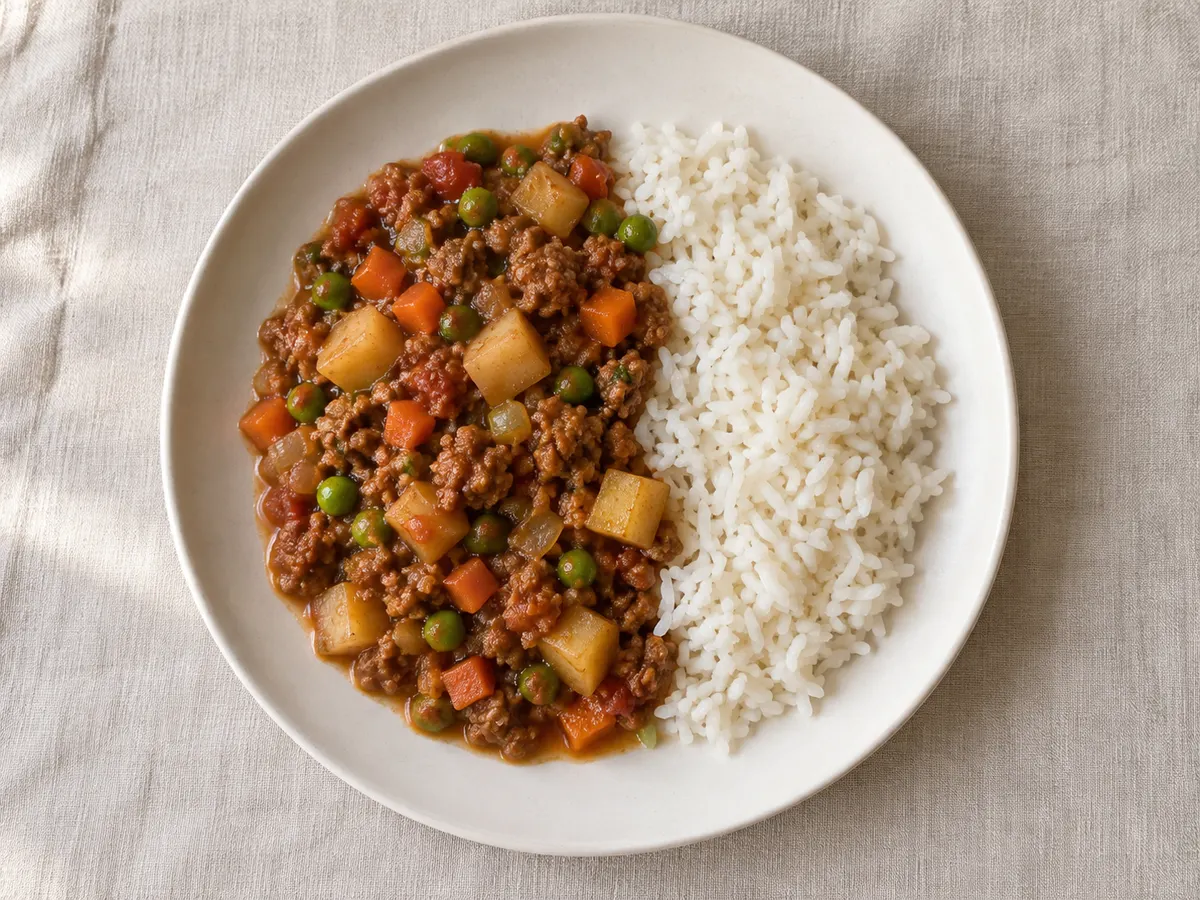 Lean beef picadillo with vegetables31.9 g protein per serving
Satiety
The 1 to 5 score is our own estimate: it starts at 1 point, adds points for low energy density, for protein and fiber per 100 kcal, and for the water in solid foods, and subtracts points for drinks with calories. It is useful for comparing foods with each other; it is not a measurement in people.
What to keep in mind on a GLP-1 medication
Frequently asked questions about lean ground beef
How much protein is in a 120 g (4 oz) serving of lean ground beef?
100 g (3.5 oz) of lean ground beef has 21.4 g of protein. A typical 120 g (4 oz) serving has about 25.7 g of protein. That is 15.6 g of protein per 100 kcal, which is why it carries our “High in protein” tag.
How many calories does a 120 g (4 oz) serving of lean ground beef have?
100 g (3.5 oz) of lean ground beef has 137 kcal. A typical 120 g (4 oz) serving has about 164 kcal. That is a low energy density.
Is lean ground beef filling?
Yes, very filling for the calories it provides: our estimated satiety score is 5 out of 5. Calculation: 1 (base) + 1 (low energy density: 137 kcal/100 g) + 2 (protein: 15.6 g/100 kcal) + 0 (fiber: 0.0 g/100 kcal) + 1 (solid food with 73.2 g of water) = 5. It is an estimate based on its composition, not a measurement in people.
What should I know about lean ground beef on a GLP-1 medication?
Based on our tags, this is what matters about lean ground beef on a GLP-1 medication. “High in protein”: plenty of protein per calorie; protein helps preserve muscle mass when you eat less. These are general guidelines, not medical advice: everyone tolerates foods differently.
What counts as a normal serving of lean ground beef?
We use 120 g (4 oz) as a typical serving. That amount provides about 164 kcal, 25.7 g of protein, and 0 g of fiber. It is a reference for calculations, not a recommendation of how much to eat.
Compare with…
Similar foods
Sources
Sources for the data on this page, with the access date.
- Official databaseU.S. Department of Agriculture, Agricultural Research Service.USDA FoodData Central: Beef, ground, 95% lean meat / 5% fat, raw (FDC ID 171790).accessed .
- InstitutionRoyal Spanish Academy and Association of Academies of the Spanish Language (RAE-ASALE).Diccionario de la lengua española (Dictionary of the Spanish Language, 23rd ed., online version): "picar" (in Spanish).accessed .
- Official databaseU.S. Department of Agriculture, Agricultural Research Service.USDA FoodData Central: Beef, ground, 80% lean meat / 20% fat, raw (FDC ID 174036).accessed .
- Clinical guidelineObesity (Wiley).Mozaffarian D, et al. Nutritional priorities to support GLP-1 therapy for obesity: A joint Advisory from the American College of Lifestyle Medicine, the American Society for Nutrition, the Obesity Medicine Association, and The Obesity Society. Obesity. 2025;33(8):1475-1503. doi:10.1002/oby.24336.accessed .
- RegulatorU.S. Department of Agriculture, Food Safety and Inspection Service (USDA FSIS).Safe Minimum Internal Temperature Chart.accessed .
- InstitutionThe Lancet Oncology.Bouvard V, Loomis D, Guyton KZ, et al. Carcinogenicity of consumption of red and processed meat. Lancet Oncol. 2015;16(16):1599-1600. doi:10.1016/S1470-2045(15)00444-1.accessed .
- InstitutionInternational Agency for Research on Cancer (IARC/WHO).Q&A on the carcinogenicity of the consumption of red meat and processed meat (IARC Monographs, Volume 114).accessed .
- RegulatorOfficial Journal of the European Union (EUR-Lex).Regulation (EC) No 1924/2006 on nutrition and health claims made on foods (Annex).accessed .
- RegulatorOfficial Journal of the European Union (EUR-Lex).Regulation (EU) No 1169/2011 on the provision of food information to consumers (Annex XIII, nutrient reference values).accessed .