Meat, fish, and eggs
Pork loin
Pork loin provides 21.4 g of protein for 143 kcal per 100 g (3.5 oz), or 15 g of protein for every 100 kcal.
Estimated satietyHow it is calculated
Estimated satiety: 5 out of 5
| Starting point | +1 |
|---|---|
| Low energy density: 143 kcal/100 g | +1 |
| Protein: 15.0 g/100 kcal | +2 |
| Fiber: 0.0 g/100 kcal | 0 |
| Solid food with 72.2 g of water | +1 |
Our own estimate from the values per 100 g: useful for comparing foods with each other, not a measurement in people. Holt index (1995): this food was not measured.
- Prepared by
- Alex Gonzalez
- Last updated
- Next review
- Sources
- 6 primary
- Data
- USDA FDC 168230
No clinical review. No advertising from drug companies and no affiliate links.How we work
Nutrition facts
- Calories
- 172 kcal per serving
- 143 kcal per 100 g (3.5 oz)
- Protein
- 25.7 g per serving
- 21.4 g per 100 g (3.5 oz)
- Carbohydrates
- 0 g per serving
- 0 g per 100 g (3.5 oz)
- of which sugars
- 0 g per serving
- 0 g per 100 g (3.5 oz)
- Fiber
- 0 g per serving
- 0 g per 100 g (3.5 oz)
- Fat
- 6.8 g per serving
- 5.7 g per 100 g (3.5 oz)
- of which saturated
- 2.3 g per serving
- 2 g per 100 g (3.5 oz)
- Water
- 86.6 g per serving
- 72.2 g per 100 g (3.5 oz)
Source: USDA FoodData Central: Pork, fresh, loin, whole, separable lean only, raw (FDC ID 168230), accessed September 23, 2026.
A typical 120 g (4 oz) serving provides about 172 kcal, 25.7 g of protein, and 0 g of fiber.
What it is and how to eat it
Pork loin is the lean cut that runs along the pig's back, sold fresh as chops, as a boneless strip or as a roast; in Mexico it is called lomo de puerco, and in Argentina and Uruguay it is also sold as carré de cerdo. In Spain, the quality standard for meat products (Real Decreto 474/2014) allows cured loin, lomo embuchado or caña de lomo, to be sold simply as "lomo" as well, so at the deli counter it is worth telling it apart from the fresh cut. This page covers fresh pork loin from USDA, lean only and raw, with 143 kcal, 21.4 g of protein and 5.66 g of fat per 100 g.
A 120 g (4.2 oz) raw serving provides 25.7 g of protein and 172 kcal with 6.8 g of fat. The 2025 nutrition advisory on GLP-1 therapy prioritizes legumes, dairy, seafood, eggs and lean poultry and asks people to moderate or minimize red and processed meats, so pork loin fits better as one option during the week than as your everyday protein. The same advisory suggests avoiding fatty foods in the first few days of treatment, so in those days thin chops grilled or baked, as in the roast pork loin with sweet potato and green beans, usually sit better than fried or breaded pork; overcooked, it dries out and is harder to chew.
What the evidence says
It meets the US Department of Agriculture's "lean" definition for meat labels, which requires less than 10 g of fat, 4.5 g or less of saturated fat and less than 95 mg of cholesterol per 100 g, because it has 5.66 g, 1.95 g and 59 mg, but not the "extra lean" one, which requires less than 5 g of fat. The International Agency for Research on Cancer (IARC) counts pork as red meat, which it classified in 2015 as "probably carcinogenic to humans" (Group 2A) because of its association with colorectal cancer, and explains that, if that association were causal, the risk could rise by 17% for every 100 g portion eaten daily. IARC itself notes that there is not enough information to say whether the risk differs by type of red meat, such as beef or pork. Lomo embuchado, by contrast, is cured, and IARC classified processed meat as carcinogenic to humans (Group 1).
Recipes with this food
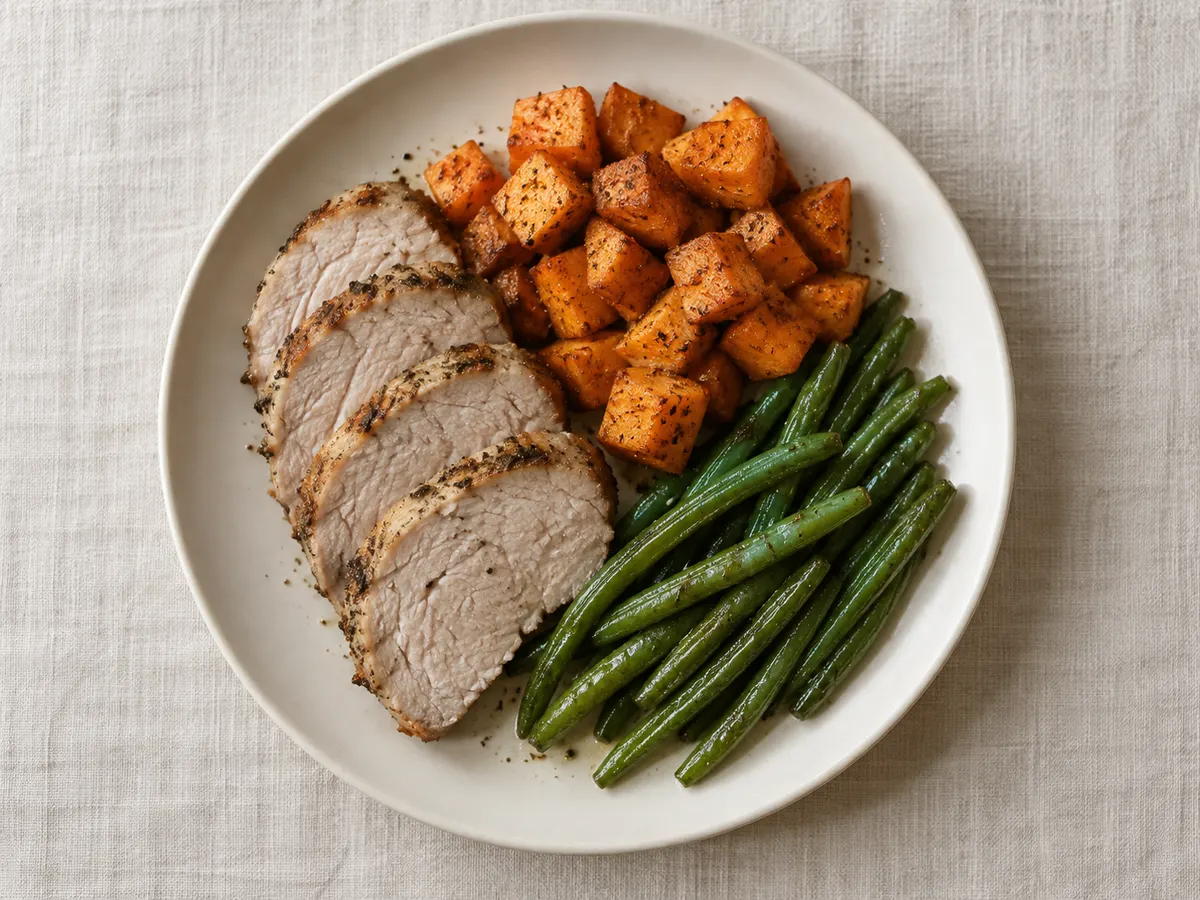 Roast pork loin with sweet potato and green beans30.3 g protein per serving
Satiety
The 1 to 5 score is our own estimate: it starts at 1 point, adds points for low energy density, for protein and fiber per 100 kcal, and for the water in solid foods, and subtracts points for drinks with calories. It is useful for comparing foods with each other; it is not a measurement in people.
What to keep in mind on a GLP-1 medication
Frequently asked questions about pork loin
How much protein is in a 120 g (4 oz) serving of pork loin?
100 g (3.5 oz) of pork loin has 21.4 g of protein. A typical 120 g (4 oz) serving has about 25.7 g of protein. That is 15 g of protein per 100 kcal, which is why it carries our “High in protein” tag.
How many calories does a 120 g (4 oz) serving of pork loin have?
100 g (3.5 oz) of pork loin has 143 kcal. A typical 120 g (4 oz) serving has about 172 kcal. That is a low energy density.
Is pork loin filling?
Yes, very filling for the calories it provides: our estimated satiety score is 5 out of 5. Calculation: 1 (base) + 1 (low energy density: 143 kcal/100 g) + 2 (protein: 15.0 g/100 kcal) + 0 (fiber: 0.0 g/100 kcal) + 1 (solid food with 72.2 g of water) = 5. It is an estimate based on its composition, not a measurement in people.
How does pork loin sit with nausea from a GLP-1 medication?
Based on our tags, this is what matters about pork loin on a GLP-1 medication. “High in protein”: plenty of protein per calorie; protein helps preserve muscle mass when you eat less. “Easy to digest”: a soft or low-fat food that many people tolerate well when they feel nauseous or get full quickly. These are general guidelines, not medical advice: everyone tolerates foods differently.
What counts as a normal serving of pork loin?
We use 120 g (4 oz) as a typical serving. That amount provides about 172 kcal, 25.7 g of protein, and 0 g of fiber. It is a reference for calculations, not a recommendation of how much to eat.
Compare with…
Similar foods
Sources
Sources for the data on this page, with the access date.
- Official databaseU.S. Department of Agriculture, Agricultural Research Service.USDA FoodData Central: Pork, fresh, loin, whole, separable lean only, raw (FDC ID 168230).accessed .
- RegulatorBoletín Oficial del Estado (Spain).Real Decreto 474/2014, de 13 de junio, por el que se aprueba la norma de calidad de derivados cárnicos (Spain's quality standard for meat products; Article 21(3), name of lomo embuchado).accessed .
- Clinical guidelineObesity (Wiley).Mozaffarian D, et al. Nutritional priorities to support GLP-1 therapy for obesity: A joint Advisory from the American College of Lifestyle Medicine, the American Society for Nutrition, the Obesity Medicine Association, and The Obesity Society. Obesity. 2025;33(8):1475-1503. doi:10.1002/oby.24336.accessed .
- RegulatorU.S. Department of Agriculture, Food Safety and Inspection Service (Electronic Code of Federal Regulations).9 CFR 317.362, Nutrient content claims for fat, fatty acids, and cholesterol content (paragraph (e), "lean" and "extra lean" claims).accessed .
- InstitutionThe Lancet Oncology.Bouvard V, Loomis D, Guyton KZ, et al. Carcinogenicity of consumption of red and processed meat. Lancet Oncol. 2015;16(16):1599-1600. doi:10.1016/S1470-2045(15)00444-1.accessed .
- InstitutionInternational Agency for Research on Cancer (IARC/WHO).Q&A on the carcinogenicity of the consumption of red meat and processed meat (IARC Monographs, Volume 114).accessed .