Fruits
Raspberries
Raspberries is 86% water, so 100 g (3.5 oz) brings only 52 kcal and 6.5 g of fiber.
Estimated satietyHow it is calculated
Estimated satiety: 5 out of 5
| Starting point | +1 |
|---|---|
| Very low energy density: 52 kcal/100 g | +2 |
| Protein: 2.3 g/100 kcal | 0 |
| Fiber: 12.5 g/100 kcal | +2 |
| Solid food with 85.8 g of water | +1 |
| Sum | 6 |
| Capped at 5 | 5 |
Our own estimate from the values per 100 g: useful for comparing foods with each other, not a measurement in people. Holt index (1995): this food was not measured.
- Prepared by
- Alex Gonzalez
- Last updated
- Next review
- Sources
- 7 primary
- Data
- USDA FDC 167755
No clinical review. No advertising from drug companies and no affiliate links.How we work
Nutrition facts
- Calories
- 31 kcal per serving
- 52 kcal per 100 g (3.5 oz)
- Protein
- 0.7 g per serving
- 1.2 g per 100 g (3.5 oz)
- Carbohydrates
- 7.1 g per serving
- 11.9 g per 100 g (3.5 oz)
- of which sugars
- 2.7 g per serving
- 4.4 g per 100 g (3.5 oz)
- Fiber
- 3.9 g per serving
- 6.5 g per 100 g (3.5 oz)
- Fat
- 0.4 g per serving
- 0.7 g per 100 g (3.5 oz)
- of which saturated
- 0 g per serving
- 0 g per 100 g (3.5 oz)
- Water
- 51.5 g per serving
- 85.8 g per 100 g (3.5 oz)
Source: USDA FoodData Central: Raspberries, raw (FDC ID 167755), accessed September 23, 2026.
A typical 60 g (2 oz) serving provides about 31 kcal, 0.7 g of protein, and 3.9 g of fiber.
What it is and how to eat it
The raspberry (Rubus idaeus) is a red berry, hollow inside and made up of many small drupelets, and it is called frambuesa in Spain and throughout Latin America. It is very delicate, so fresh raspberries do not keep long and are sold in small containers, while frozen ones are available all year. This page covers raw raspberries, with 52 kcal, 6.5 g of fiber and 26.2 mg of vitamin C per 100 g according to USDA.
A 60 g (2.1 oz) serving, half a cup according to USDA, provides 31 kcal, 3.9 g of fiber and 0.7 g of protein, so the protein part has to come from another food, as in the overnight oats with Greek yogurt and raspberries; the 2025 nutrition advisory on GLP-1 therapy lists berries among the fruits to encourage and suggests starting meals with protein. They pack a lot of fiber into a small volume, and the same advisory advises avoiding very high-fiber foods in the first few days of treatment and, for constipation, increasing fiber gradually, so in those days, and after a dose increase, a handful may be enough.
What the evidence says
With 6.5 g of fiber per 100 g they exceed the 6 g the EU requires for a "high fibre" claim, and the 60 g serving provides 3.9 g (Regulation (EC) No 1924/2006); the US National Institutes of Health list berries among the high-fiber foods they advise eating for constipation. With 26.2 mg of vitamin C per 100 g they also exceed the 24 mg for a "high vitamin C" claim, although the 60 g serving provides 15.7 mg, 20% of the 80 mg reference value, and they could carry the authorized claim "vitamin C contributes to the normal function of the immune system" (Regulations (EC) No 1924/2006, (EU) No 1169/2011 and (EU) No 432/2012). The EU register lists as non-authorized the assessed claims for a raspberry extract that said it helped control appetite, increased the feeling of fullness after a meal and helped with weight loss, and the EU has not authorized any health claim specific to raspberries.
Recipes with this food
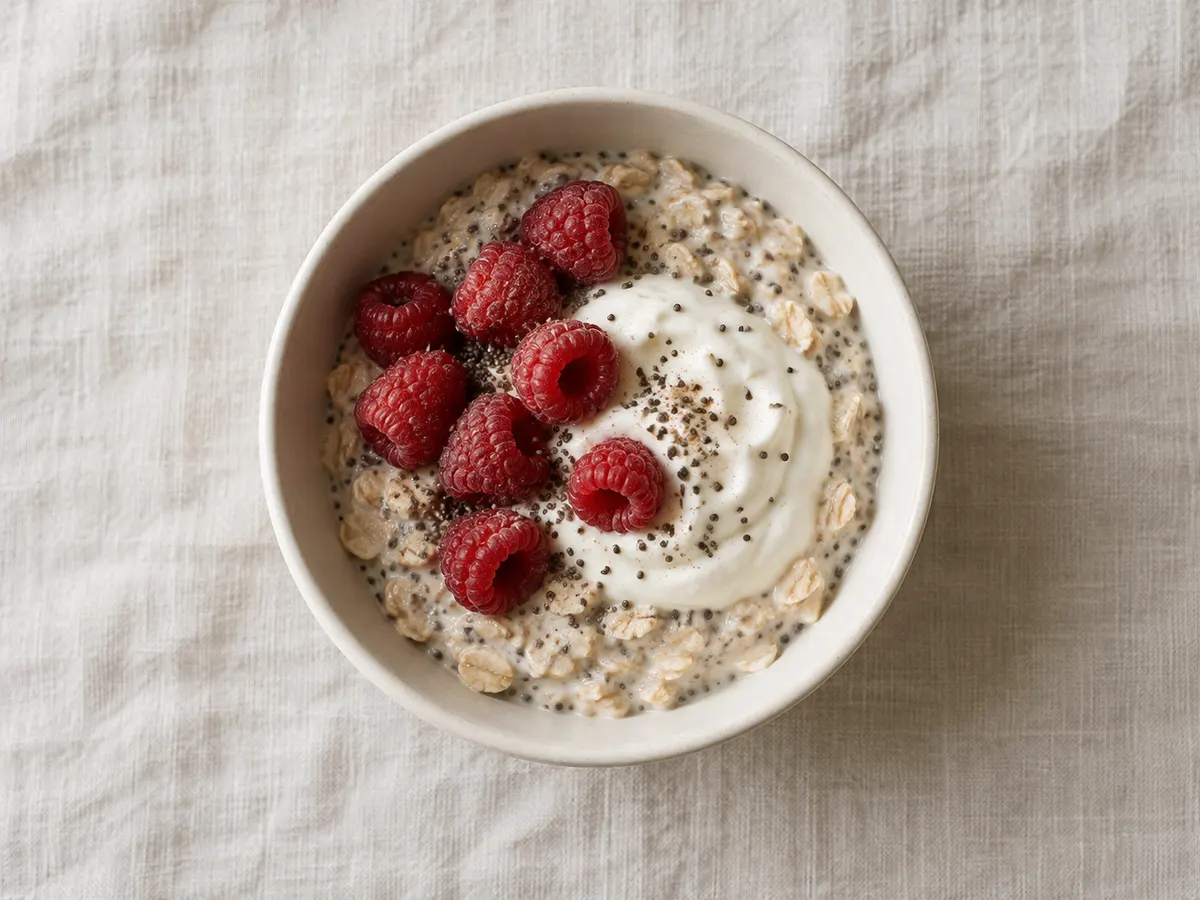 Overnight oats with Greek yogurt and raspberries20.4 g protein per serving
Satiety
The 1 to 5 score is our own estimate: it starts at 1 point, adds points for low energy density, for protein and fiber per 100 kcal, and for the water in solid foods, and subtracts points for drinks with calories. It is useful for comparing foods with each other; it is not a measurement in people.
What to keep in mind on a GLP-1 medication
Frequently asked questions about raspberries
How much protein does a 60 g (2 oz) serving of raspberries have?
100 g (3.5 oz) of raspberries has 1.2 g of protein. A typical 60 g (2 oz) serving has about 0.7 g of protein. That is 2.3 g of protein per 100 kcal.
How many calories are in a 60 g (2 oz) serving of raspberries?
100 g (3.5 oz) of raspberries has 52 kcal. A typical 60 g (2 oz) serving has about 31 kcal. That is a very low energy density.
How many grams of fiber are in a 60 g (2 oz) serving of raspberries?
100 g (3.5 oz) of raspberries has 6.5 g of fiber. A typical 60 g (2 oz) serving has about 3.9 g of fiber. It carries our “High in fiber” tag.
How filling is raspberries?
Very filling for the calories it provides: our estimated satiety score is 5 out of 5. Calculation: 1 (base) + 2 (very low energy density: 52 kcal/100 g) + 0 (protein: 2.3 g/100 kcal) + 2 (fiber: 12.5 g/100 kcal) + 1 (solid food with 85.8 g of water) = 6; capped at 5. It is an estimate based on its composition, not a measurement in people.
Is raspberries a good choice on a GLP-1 medication?
Based on our tags, this is what matters about raspberries on a GLP-1 medication. “High in fiber”: a good amount of fiber, which helps keep you regular; it is easier to tolerate when you increase it gradually and drink enough water. “Low energy density”: plenty of volume for few calories; make sure it does not push protein foods off your plate. “Hydrating”: a lot of water, which contributes to hydration when you eat and drink less. These are general guidelines, not medical advice: everyone tolerates foods differently.
How many grams or ounces are in a serving of raspberries?
We use 60 g (2 oz) as a typical serving. That amount provides about 31 kcal, 0.7 g of protein, and 3.9 g of fiber. It is a reference for calculations, not a recommendation of how much to eat.
Compare with…
Similar foods
Sources
Sources for the data on this page, with the access date.
- Official databaseU.S. Department of Agriculture, Agricultural Research Service.USDA FoodData Central: Raspberries, raw (FDC ID 167755).accessed .
- Clinical guidelineObesity (Wiley).Mozaffarian D, et al. Nutritional priorities to support GLP-1 therapy for obesity: A joint Advisory from the American College of Lifestyle Medicine, the American Society for Nutrition, the Obesity Medicine Association, and The Obesity Society. Obesity. 2025;33(8):1475-1503. doi:10.1002/oby.24336.accessed .
- RegulatorOfficial Journal of the European Union (EUR-Lex).Regulation (EC) No 1924/2006 on nutrition and health claims made on foods (Annex).accessed .
- InstitutionNational Institute of Diabetes and Digestive and Kidney Diseases (NIH).Eating, Diet, & Nutrition for Constipation.accessed .
- RegulatorOfficial Journal of the European Union (EUR-Lex).Regulation (EU) No 1169/2011 on the provision of food information to consumers (Annex XIII, nutrient reference values).accessed .
- RegulatorOfficial Journal of the European Union (EUR-Lex).Commission Regulation (EU) No 432/2012 establishing a list of permitted health claims made on foods.accessed .
- RegulatorEuropean Commission.EU Register of nutrition and health claims made on foods.accessed .