Meat, fish, and eggs
Sliced ham
Sliced ham provides 16.6 g of protein for 164 kcal per 100 g (3.5 oz), or 10.1 g of protein for every 100 kcal.
Estimated satietyHow it is calculated
Estimated satiety: 3 out of 5
| Starting point | +1 |
|---|---|
| Moderate energy density | 0 |
| A lot of protein per calorie | +2 |
Our own estimate from the values per 100 g: useful for comparing foods with each other, not a measurement in people. Holt index (1995): this food was not measured.
- Prepared by
- Alex Gonzalez
- Last updated
- Next review
- Sources
- 7 primary
- Data
- USDA FDC 173864
No clinical review. No advertising from drug companies and no affiliate links.How we work
Nutrition facts
- Calories
- 66 kcal per serving
- 164 kcal per 100 g (3.5 oz)
- Protein
- 6.6 g per serving
- 16.6 g per 100 g (3.5 oz)
- Carbohydrates
- 1.5 g per serving
- 3.6 g per 100 g (3.5 oz)
- of which sugars
- 0.4 g per serving
- 1 g per 100 g (3.5 oz)
- Fiber
- 0.5 g per serving
- 1.3 g per 100 g (3.5 oz)
- Fat
- 3.5 g per serving
- 8.8 g per 100 g (3.5 oz)
- of which saturated
- 0.2 g per serving
- 0.5 g per 100 g (3.5 oz)
- Water
- 26.9 g per serving
- 67.3 g per 100 g (3.5 oz)
Source: USDA FoodData Central: Ham, sliced, regular (approximately 11% fat) (FDC ID 173864), accessed September 23, 2026.
A typical 40 g (1.5 oz) serving provides about 66 kcal, 6.6 g of protein, and 0.5 g of fiber.
What it is and how to eat it
Cooked ham is the pig's hind leg, boned, brine-cured, shaped and cooked, and it is sold mostly in thin slices; in Spain it is also called jamón York or jamón de York, in Argentina and Uruguay jamón cocido, and in Mexico jamón de pierna or simply jamón. In Spain, the quality standard for meat products (Real Decreto 474/2014) reserves "jamón cocido extra" for ham with no added protein and at most 1.5 g of sugars per 100 g, and ham with added starch can no longer be called cooked ham but "fiambre de jamón" (ham luncheon meat). This page uses USDA's regular sliced ham, with 164 kcal, 16.6 g of protein and 8.8 g of fat per 100 g.
A 40 g (1.4 oz) serving, two or three slices, provides 6.6 g of protein and 66 kcal with no cooking and makes it easy to start with protein, as the 2025 nutrition advisory on GLP-1 therapy suggests, for example in the ham roll-ups with queso fresco and cucumber, although the same advisory notes that, when appetite is low, cold cuts are often less appealing than yogurt, cottage cheese or soup. It is mild, eaten cold and has 3.5 g of fat per serving, so it is usually well tolerated in the first few days of treatment, when the same advisory suggests avoiding very fatty foods, and after a dose increase. The same advisory asks people to limit processed meats, so, also because of the salt, it works better as a complement to other proteins, such as eggs, yogurt, legumes or fish, than as your main daily source.
What the evidence says
In 2015 the International Agency for Research on Cancer (IARC) classified processed meat, ham included, as carcinogenic to humans (Group 1) because of its link with colorectal cancer, and estimated that each 50 g portion eaten daily increases that risk by about 18%; the classification describes the strength of the evidence, not the size of the risk. According to USDA it has 814 mg of sodium per 100 g, so a 40 g serving provides about 326 mg, one sixth of the 2,000 mg a day WHO recommends not exceeding. In the EU, the label must state the percentage of ham when ham appears in the product name, and if added water makes up more than 5% of the finished product, the name must mention it (Regulation (EU) No 1169/2011, Article 22 and Annexes VI and VIII), so both figures help compare brands.
Recipes with this food
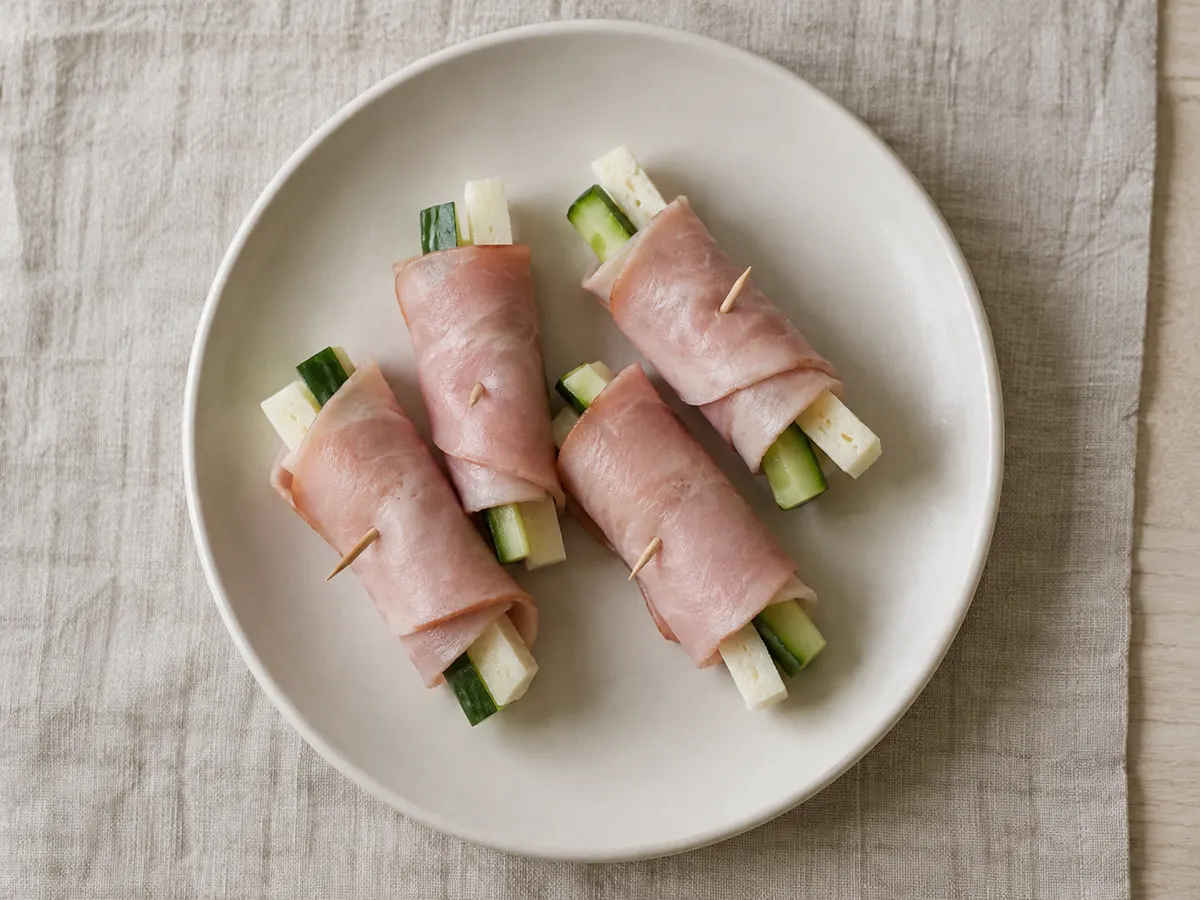 Ham roll-ups with queso fresco and cucumber12.5 g protein per serving
Satiety
The 1 to 5 score is our own estimate: it starts at 1 point, adds points for low energy density, for protein and fiber per 100 kcal, and for the water in solid foods, and subtracts points for drinks with calories. It is useful for comparing foods with each other; it is not a measurement in people.
What to keep in mind on a GLP-1 medication
Frequently asked questions about sliced ham
How much protein is in a 40 g (1.5 oz) serving of sliced ham?
100 g (3.5 oz) of sliced ham has 16.6 g of protein. A typical 40 g (1.5 oz) serving has about 6.6 g of protein. That is 10.1 g of protein per 100 kcal, which is why it carries our “High in protein” tag.
How many calories does a 40 g (1.5 oz) serving of sliced ham have?
100 g (3.5 oz) of sliced ham has 164 kcal. A typical 40 g (1.5 oz) serving has about 66 kcal. That is a moderate energy density.
Does sliced ham have fiber?
100 g (3.5 oz) of sliced ham has 1.3 g of fiber. A typical 40 g (1.5 oz) serving has about 0.5 g of fiber.
Is sliced ham filling?
Moderately: our estimated satiety score is 3 out of 5. It is based on: moderate energy density; a lot of protein per calorie. It is an estimate based on its composition, not a measurement in people.
What should I know about sliced ham on a GLP-1 medication?
Based on our tags, this is what matters about sliced ham on a GLP-1 medication. “High in protein”: plenty of protein per calorie; protein helps preserve muscle mass when you eat less. “Nutritious in small servings”: a lot of nutrition in a small volume, which is practical when you eat little. These are general guidelines, not medical advice: everyone tolerates foods differently.
What counts as a normal serving of sliced ham?
We use 40 g (1.5 oz) as a typical serving. That amount provides about 66 kcal, 6.6 g of protein, and 0.5 g of fiber. It is a reference for calculations, not a recommendation of how much to eat.
Compare with…
Similar foods
Sources
Sources for the data on this page, with the access date.
- Official databaseU.S. Department of Agriculture, Agricultural Research Service.USDA FoodData Central: Ham, sliced, regular (approximately 11% fat) (FDC ID 173864).accessed .
- RegulatorBoletín Oficial del Estado (Spain).Real Decreto 474/2014, de 13 de junio, por el que se aprueba la norma de calidad de derivados cárnicos (Spain's quality standard for meat products; Annex I, cooked ham, and Article 20).accessed .
- Clinical guidelineObesity (Wiley).Mozaffarian D, et al. Nutritional priorities to support GLP-1 therapy for obesity: A joint Advisory from the American College of Lifestyle Medicine, the American Society for Nutrition, the Obesity Medicine Association, and The Obesity Society. Obesity. 2025;33(8):1475-1503. doi:10.1002/oby.24336.accessed .
- InstitutionThe Lancet Oncology.Bouvard V, Loomis D, Guyton KZ, et al. Carcinogenicity of consumption of red and processed meat. Lancet Oncol. 2015;16(16):1599-1600. doi:10.1016/S1470-2045(15)00444-1.accessed .
- InstitutionInternational Agency for Research on Cancer (IARC/WHO).Q&A on the carcinogenicity of the consumption of red meat and processed meat (IARC Monographs, Volume 114).accessed .
- InstitutionWorld Health Organization.Sodium reduction.accessed .
- RegulatorOfficial Journal of the European Union (EUR-Lex).Regulation (EU) No 1169/2011 on the provision of food information to consumers (Article 22 and Annexes VI, VII and VIII).accessed .