Dairy
Reduced-fat milk (2%)
Each 100 ml (3.4 fl oz) of reduced-fat milk (2%) has 50 kcal and 3.3 g of protein, and as a drink those calories tend to fill you up less than the same calories from solid food.
Estimated satietyHow it is calculated
Estimated satiety: 3 out of 5
| Starting point | +1 |
|---|---|
| Very low energy density: 50 kcal/100 g | +2 |
| Protein: 6.6 g/100 kcal | +1 |
| Fiber: 0.0 g/100 kcal | 0 |
| Liquid, less filling than a solid; 5.1 g of sugars, under 8 | −1 |
Our own estimate from the values per 100 g: useful for comparing foods with each other, not a measurement in people. Holt index (1995): this food was not measured.
- Prepared by
- Alex Gonzalez
- Last updated
- Next review
- Sources
- 9 primary
- Data
- USDA FDC 171267
No clinical review. No advertising from drug companies and no affiliate links.How we work
Nutrition facts
- Calories
- 125 kcal per serving
- 50 kcal per 100 ml (3.4 fl oz)
- Protein
- 8.3 g per serving
- 3.3 g per 100 ml (3.4 fl oz)
- Carbohydrates
- 12 g per serving
- 4.8 g per 100 ml (3.4 fl oz)
- of which sugars
- 12.7 g per serving
- 5.1 g per 100 ml (3.4 fl oz)
- Fiber
- 0 g per serving
- 0 g per 100 ml (3.4 fl oz)
- Fat
- 5 g per serving
- 2 g per 100 ml (3.4 fl oz)
- of which saturated
- 3.2 g per serving
- 1.3 g per 100 ml (3.4 fl oz)
- Water
- 223 g per serving
- 89.2 g per 100 ml (3.4 fl oz)
Source: USDA FoodData Central: Milk, reduced fat, fluid, 2% milkfat, with added vitamin A and vitamin D (FDC ID 171267), accessed September 23, 2026.
A typical 250 ml (8.5 fl oz, about 1 cup) serving provides about 125 kcal, 8.3 g of protein, and 0 g of fiber.
What it is and how to eat it
In the European Union, semi-skimmed milk must contain between 1.50% and 1.80% fat (Regulation (EU) No 1308/2013); in Latin America it is sold as leche semidescremada or parcialmente descremada, with fat levels that vary by country. Removing part of the fat lowers the calories but keeps the protein, calcium and lactose. This page uses USDA's 2% reduced-fat milk, with 50 kcal, 3.3 g of protein and 120 mg of calcium per 100 g, so it has a little more fat and a few more calories than European semi-skimmed milk.
A 250 ml (8.5 fl oz) glass provides 125 kcal, 8.3 g of protein and 300 mg of calcium, with about 5 g of fat, versus 8.1 g in the same glass of whole milk and 0.6 g in skim milk according to USDA. It is liquid and can be sipped when solid food is hard to eat, and the 2025 nutrition advisory on GLP-1 therapy suggests small, frequent meals when appetite is low and avoiding fatty foods in the first few days of treatment. In those days, and after a dose increase, if fat does not sit well, skim milk provides a little more protein with almost no fat. It works as a base for adding protein, as in the overnight oats with Greek yogurt and raspberries.
What the evidence says
About 26% of its energy comes from protein, so it meets the EU's 20% threshold for a "high protein" claim, and with 120 mg of calcium per 100 g it exceeds the 60 mg per 100 ml a drink needs to be a "source of calcium" (Regulations (EC) No 1924/2006 and (EU) No 1169/2011). That means it can carry the authorized claims "protein contributes to the maintenance of muscle mass" and "calcium is needed for the maintenance of normal bones", which only require the food to be at least a source of those nutrients (Regulation (EU) No 432/2012); a glass provides almost 38% of the 800 mg calcium reference value. A glass contains 12.7 g of sugars, which in milk are lactose, and according to EFSA the vast majority of people who digest lactose poorly tolerate up to 12 g at once with minor or no symptoms, so half a glass stays below that amount.
Recipes with this food
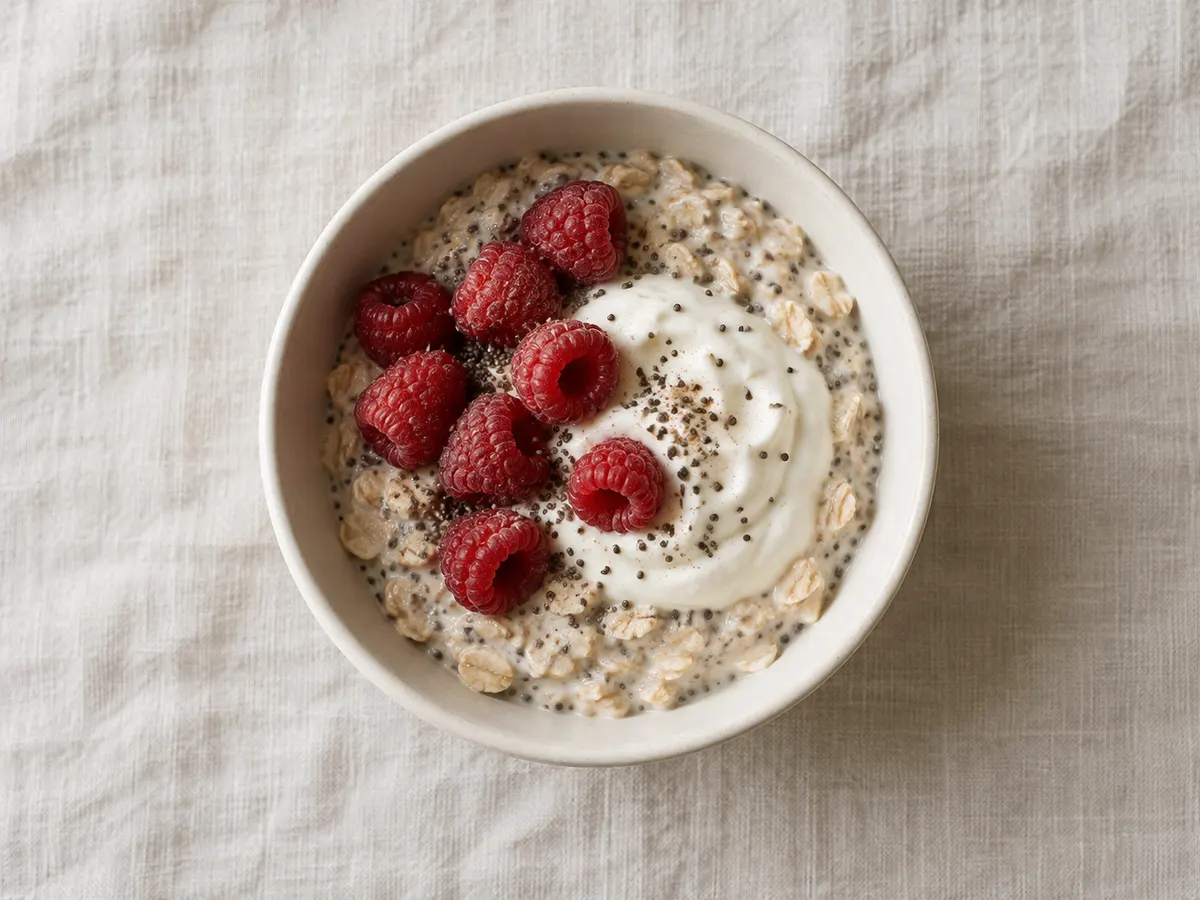 Overnight oats with Greek yogurt and raspberries20.4 g protein per serving
Satiety
The 1 to 5 score is our own estimate: it starts at 1 point, adds points for low energy density, for protein and fiber per 100 kcal, and for the water in solid foods, and subtracts points for drinks with calories. It is useful for comparing foods with each other; it is not a measurement in people.
What to keep in mind on a GLP-1 medication
Frequently asked questions about reduced-fat milk (2%)
How many grams of protein are in a 250 ml (8.5 fl oz) serving of reduced-fat milk (2%)?
100 ml (3.4 fl oz) of reduced-fat milk (2%) has 3.3 g of protein. A typical 250 ml (8.5 fl oz) serving has about 8.3 g of protein. That is 6.6 g of protein per 100 kcal.
How many kcal are in a 250 ml (8.5 fl oz) serving of reduced-fat milk (2%)?
100 ml (3.4 fl oz) of reduced-fat milk (2%) has 50 kcal. A typical 250 ml (8.5 fl oz) serving has about 125 kcal. That is a very low energy density.
Does reduced-fat milk (2%) keep you full?
Moderately: our estimated satiety score is 3 out of 5. Calculation: 1 (base) + 2 (very low energy density: 50 kcal/100 g) + 1 (protein: 6.6 g/100 kcal) + 0 (fiber: 0.0 g/100 kcal) − 1 (liquid, less filling than a solid; 5.1 g of sugars, under 8) = 3. It is an estimate based on its composition, not a measurement in people.
How does reduced-fat milk (2%) fit into eating on Ozempic, Wegovy, Mounjaro, or Zepbound?
Based on our tags, this is what matters about reduced-fat milk (2%) on a GLP-1 medication. “Low energy density”: plenty of volume for few calories; make sure it does not push protein foods off your plate. “Hydrating”: a lot of water, which contributes to hydration when you eat and drink less. These are general guidelines, not medical advice: everyone tolerates foods differently.
What is a typical serving of reduced-fat milk (2%)?
We use 250 ml (8.5 fl oz) as a typical serving, about 1 cup (1 ml is treated as about 1 g). That amount provides about 125 kcal, 8.3 g of protein, and 0 g of fiber. It is a reference for calculations, not a recommendation of how much to eat.
Compare with…
Similar foods
Sources
Sources for the data on this page, with the access date.
- Official databaseU.S. Department of Agriculture, Agricultural Research Service.USDA FoodData Central: Milk, reduced fat, fluid, 2% milkfat, with added vitamin A and vitamin D (FDC ID 171267).accessed .
- RegulatorOfficial Journal of the European Union (EUR-Lex).Regulation (EU) No 1308/2013 establishing a common organisation of the markets in agricultural products (Annex VII, Part IV, milk for human consumption).accessed .
- Official databaseU.S. Department of Agriculture, Agricultural Research Service.USDA FoodData Central: Milk, whole, 3.25% milkfat, with added vitamin D (FDC ID 171265).accessed .
- Official databaseU.S. Department of Agriculture, Agricultural Research Service.USDA FoodData Central: Milk, nonfat, fluid, with added nonfat milk solids, vitamin A and vitamin D (fat free or skim) (FDC ID 171270).accessed .
- Clinical guidelineObesity (Wiley).Mozaffarian D, et al. Nutritional priorities to support GLP-1 therapy for obesity: A joint Advisory from the American College of Lifestyle Medicine, the American Society for Nutrition, the Obesity Medicine Association, and The Obesity Society. Obesity. 2025;33(8):1475-1503. doi:10.1002/oby.24336.accessed .
- RegulatorOfficial Journal of the European Union (EUR-Lex).Regulation (EC) No 1924/2006 on nutrition and health claims made on foods (Annex).accessed .
- RegulatorOfficial Journal of the European Union (EUR-Lex).Regulation (EU) No 1169/2011 on the provision of food information to consumers (Annex XIII, nutrient reference values).accessed .
- RegulatorOfficial Journal of the European Union (EUR-Lex).Commission Regulation (EU) No 432/2012 establishing a list of permitted health claims made on foods.accessed .
- RegulatorEFSA Journal.EFSA NDA Panel. Scientific Opinion on lactose thresholds in lactose intolerance and galactosaemia. EFSA Journal. 2010;8(9):1777. doi:10.2903/j.efsa.2010.1777.accessed .