Dairy
Part-skim mozzarella
Part-skim mozzarella provides 24.3 g of protein for 254 kcal per 100 g (3.5 oz), or 9.6 g of protein for every 100 kcal.
Estimated satietyHow it is calculated
Estimated satiety: 3 out of 5
| Starting point | +1 |
|---|---|
| Moderate energy density | 0 |
| A lot of protein per calorie | +2 |
Our own estimate from the values per 100 g: useful for comparing foods with each other, not a measurement in people. Holt index (1995): this food was not measured.
- Prepared by
- Alex Gonzalez
- Last updated
- Next review
- Sources
- 10 primary
- Data
- USDA FDC 170847
No clinical review. No advertising from drug companies and no affiliate links.How we work
Nutrition facts
- Calories
- 76 kcal per serving
- 254 kcal per 100 g (3.5 oz)
- Protein
- 7.3 g per serving
- 24.3 g per 100 g (3.5 oz)
- Carbohydrates
- 0.8 g per serving
- 2.8 g per 100 g (3.5 oz)
- of which sugars
- 0.3 g per serving
- 1.1 g per 100 g (3.5 oz)
- Fiber
- 0 g per serving
- 0 g per 100 g (3.5 oz)
- Fat
- 4.8 g per serving
- 15.9 g per 100 g (3.5 oz)
- of which saturated
- 3 g per serving
- 10.1 g per 100 g (3.5 oz)
- Water
- 16.1 g per serving
- 53.8 g per 100 g (3.5 oz)
Source: USDA FoodData Central: Cheese, mozzarella, part skim milk (FDC ID 170847), accessed September 23, 2026.
A typical 30 g (1 oz) serving provides about 76 kcal, 7.3 g of protein, and 0 g of fiber.
What it is and how to eat it
Mozzarella is an Italian pasta filata (stretched-curd) cheese: the curd is heated, kneaded and stretched until smooth and elastic, and the Codex Alimentarius distinguishes high-moisture mozzarella, which is soft, from low-moisture mozzarella, which is firmer and easy to shred. In the EU, plain "mozzarella" can be used by any producer; the protected names are "Mozzarella Tradizionale", as a traditional speciality guaranteed, and "Mozzarella di Bufala Campana", made from buffalo milk, as a designation of origin, and in Argentina and Uruguay the name muzzarella is very common. This page uses USDA's part-skim mozzarella, with 254 kcal, 24.3 g of protein and 15.9 g of fat per 100 g.
A 30 g (1 oz) serving provides 7.3 g of protein and 76 kcal, but also 4.8 g of fat, so it works better as a protein add-on to a dish than as its main protein, as in the caprese salad with mozzarella and arugula. The 2025 nutrition advisory on GLP-1 therapy suggests starting meals with protein and avoiding very fatty foods in the first few days of treatment, so in those days and after a dose increase it usually sits better in small amounts than melted generously over a pizza or a gratin.
What the evidence says
With 782 mg of calcium per 100 g according to USDA it exceeds the 240 mg the EU requires for a "high calcium" claim, and a 30 g serving provides 235 mg, almost 30% of the 800 mg reference value; that means it can carry the authorized claim "calcium is needed for the maintenance of normal bones" (Regulations (EC) No 1924/2006, (EU) No 1169/2011 and (EU) No 432/2012). It has 619 mg of sodium per 100 g, about 186 mg per serving, less than a tenth of the 2,000 mg a day WHO recommends not exceeding. USDA lists 1.13 g of sugars per 100 g, so a serving contains at most about 0.3 g of lactose, far below the 12 g that, according to EFSA, the vast majority of people who digest lactose poorly tolerate at once.
Recipes with this food
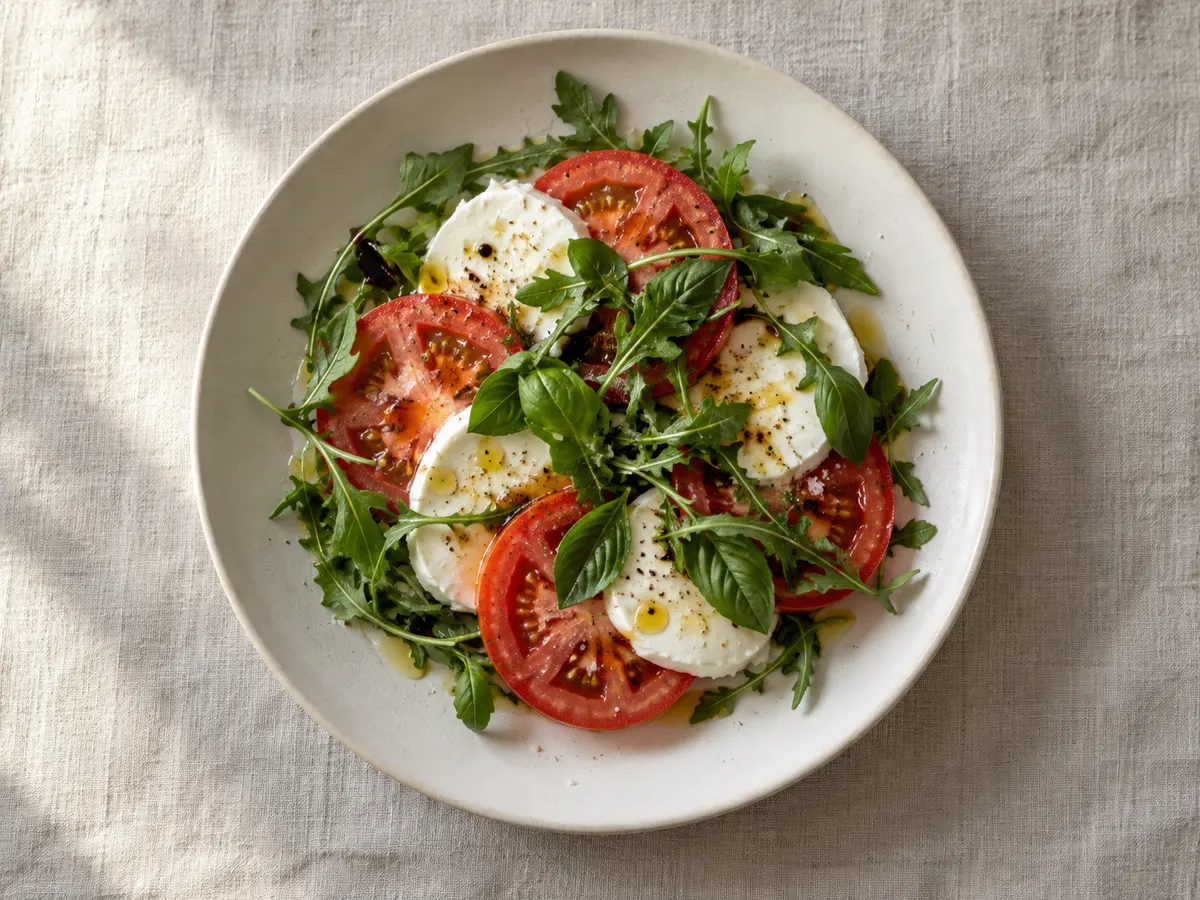 Caprese salad with mozzarella and arugula27.1 g protein per serving
Satiety
The 1 to 5 score is our own estimate: it starts at 1 point, adds points for low energy density, for protein and fiber per 100 kcal, and for the water in solid foods, and subtracts points for drinks with calories. It is useful for comparing foods with each other; it is not a measurement in people.
What to keep in mind on a GLP-1 medication
Frequently asked questions about part-skim mozzarella
How many grams of protein are in a 30 g (1 oz) serving of part-skim mozzarella?
100 g (3.5 oz) of part-skim mozzarella has 24.3 g of protein. A typical 30 g (1 oz) serving has about 7.3 g of protein. That is 9.6 g of protein per 100 kcal, which is why it carries our “High in protein” tag.
How many kcal are in a 30 g (1 oz) serving of part-skim mozzarella?
100 g (3.5 oz) of part-skim mozzarella has 254 kcal. A typical 30 g (1 oz) serving has about 76 kcal. That is a moderate energy density.
Does part-skim mozzarella keep you full?
Moderately: our estimated satiety score is 3 out of 5. It is based on: moderate energy density; a lot of protein per calorie. It is an estimate based on its composition, not a measurement in people.
How does part-skim mozzarella fit into eating on Ozempic, Wegovy, Mounjaro, or Zepbound?
Based on our tags, this is what matters about part-skim mozzarella on a GLP-1 medication. “High in protein”: plenty of protein per calorie; protein helps preserve muscle mass when you eat less. “Nutritious in small servings”: a lot of nutrition in a small volume, which is practical when you eat little. These are general guidelines, not medical advice: everyone tolerates foods differently.
What is a typical serving of part-skim mozzarella?
We use 30 g (1 oz) as a typical serving. That amount provides about 76 kcal, 7.3 g of protein, and 0 g of fiber. It is a reference for calculations, not a recommendation of how much to eat.
Compare with…
Similar foods
Sources
Sources for the data on this page, with the access date.
- Official databaseU.S. Department of Agriculture, Agricultural Research Service.USDA FoodData Central: Cheese, mozzarella, part skim milk (FDC ID 170847).accessed .
- InstitutionCodex Alimentarius (FAO/WHO).Standard for Mozzarella (CXS 262-2006).accessed .
- RegulatorOfficial Journal of the European Union (EUR-Lex).Commission Implementing Regulation (EU) 2022/1291 approving a non-minor amendment to the product specification for the name 'Mozzarella' (TSG), now registered as 'Mozzarella Tradizionale'.accessed .
- RegulatorOfficial Journal of the European Union (EUR-Lex).Commission Regulation (EC) No 1107/96 on the registration of geographical indications and designations of origin (Annex, 'Mozzarella di Bufala Campana' PDO).accessed .
- Clinical guidelineObesity (Wiley).Mozaffarian D, et al. Nutritional priorities to support GLP-1 therapy for obesity: A joint Advisory from the American College of Lifestyle Medicine, the American Society for Nutrition, the Obesity Medicine Association, and The Obesity Society. Obesity. 2025;33(8):1475-1503. doi:10.1002/oby.24336.accessed .
- RegulatorOfficial Journal of the European Union (EUR-Lex).Regulation (EC) No 1924/2006 on nutrition and health claims made on foods (Annex).accessed .
- RegulatorOfficial Journal of the European Union (EUR-Lex).Regulation (EU) No 1169/2011 on the provision of food information to consumers (Annex XIII, nutrient reference values).accessed .
- RegulatorOfficial Journal of the European Union (EUR-Lex).Commission Regulation (EU) No 432/2012 establishing a list of permitted health claims made on foods.accessed .
- InstitutionWorld Health Organization.Sodium reduction.accessed .
- RegulatorEFSA Journal.EFSA NDA Panel. Scientific Opinion on lactose thresholds in lactose intolerance and galactosaemia. EFSA Journal. 2010;8(9):1777. doi:10.2903/j.efsa.2010.1777.accessed .