Fruits
Mango
Mango is 84% water, so 100 g (3.5 oz) brings only 60 kcal and 1.6 g of fiber.
Estimated satietyHow it is calculated
Estimated satiety: 5 out of 5
| Starting point | +1 |
|---|---|
| Very low energy density | +2 |
| Moderate fiber per calorie | +1 |
| High water content | +1 |
Our own estimate from the values per 100 g: useful for comparing foods with each other, not a measurement in people. Holt index (1995): this food was not measured.
- Prepared by
- Alex Gonzalez
- Last updated
- Next review
- Sources
- 5 primary
- Data
- USDA FDC 169910
No clinical review. No advertising from drug companies and no affiliate links.How we work
Nutrition facts
- Calories
- 90 kcal per serving
- 60 kcal per 100 g (3.5 oz)
- Protein
- 1.2 g per serving
- 0.8 g per 100 g (3.5 oz)
- Carbohydrates
- 22.5 g per serving
- 15 g per 100 g (3.5 oz)
- of which sugars
- 20.6 g per serving
- 13.7 g per 100 g (3.5 oz)
- Fiber
- 2.4 g per serving
- 1.6 g per 100 g (3.5 oz)
- Fat
- 0.6 g per serving
- 0.4 g per 100 g (3.5 oz)
- of which saturated
- 0.1 g per serving
- 0.1 g per 100 g (3.5 oz)
- Water
- 125.3 g per serving
- 83.5 g per 100 g (3.5 oz)
Source: USDA FoodData Central: Mangos, raw (FDC ID 169910), accessed September 23, 2026.
A typical 150 g (5.5 oz, about 1 cup) serving provides about 90 kcal, 1.2 g of protein, and 2.4 g of fiber.
What it is and how to eat it
Mango is a tropical fruit with many varieties: in Mexico the small yellow Ataulfo and the Manila are very common, and in Spain it is grown mainly on the coast of Málaga and Granada, with varieties such as Osteen. It is sold fresh, as frozen chunks, dried, or as juice or nectar, and in Mexico and Central America it is also eaten green, with lime, salt and chili. This page covers fresh mango, with 60 kcal, 13.7 g of sugars and 1.6 g of fiber per 100 g according to USDA.
A 150 g (5.3 oz) serving provides 90 kcal, 2.4 g of fiber and barely 1.2 g of protein. The 2025 nutrition advisory on GLP-1 therapy lists fruit among the foods to encourage, but if you eat very little, have it with or after the protein, as in the kefir bowl with mango, strawberries, and oats. It is soft and sweet and usually goes down well when you feel queasy; dried mango, on the other hand, packs the sugar and calories into little volume and it is easy to eat a lot.
What the evidence says
With 13.7 g of sugars per 100 g, a 150 g serving provides 20.6 g, but these are sugars in whole fruit: WHO's definition of free sugars, which it recommends keeping below 10% of daily energy, covers added sugars and those in honey, syrups and fruit juices, not those in fresh fruit. With 1.6 g of fiber per 100 g it falls short of the 3 g the EU requires for a "source of fibre" claim, but because it has few calories, its 2.7 g per 100 kcal meet the other criterion, 1.5 g per 100 kcal; it does not reach "high fibre", which requires 3 g per 100 kcal (Regulation (EC) No 1924/2006). It also has 36.4 mg of vitamin C per 100 g, so a serving provides 54.6 mg, 68% of the EU's 80 mg reference value (Regulation (EU) No 1169/2011).
Recipes with this food
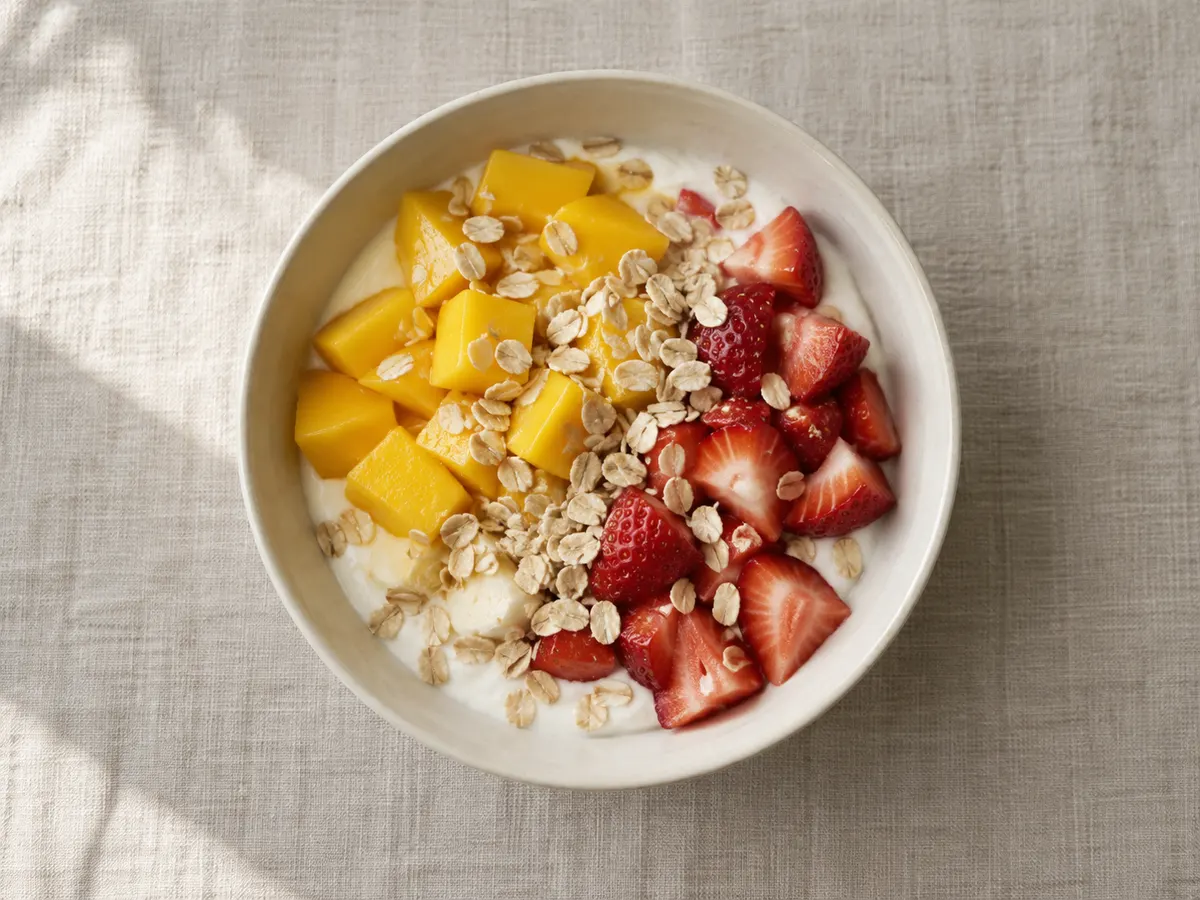 Kefir bowl with mango, strawberries, and oats15.9 g protein per serving
Satiety
The 1 to 5 score is our own estimate: it starts at 1 point, adds points for low energy density, for protein and fiber per 100 kcal, and for the water in solid foods, and subtracts points for drinks with calories. It is useful for comparing foods with each other; it is not a measurement in people.
What to keep in mind on a GLP-1 medication
Frequently asked questions about mango
How much protein does a 150 g (5.5 oz) serving of mango have?
100 g (3.5 oz) of mango has 0.8 g of protein. A typical 150 g (5.5 oz) serving has about 1.2 g of protein. That is 1.4 g of protein per 100 kcal.
How many calories are in a 150 g (5.5 oz) serving of mango?
100 g (3.5 oz) of mango has 60 kcal. A typical 150 g (5.5 oz) serving has about 90 kcal. That is a very low energy density.
How many grams of fiber are in a 150 g (5.5 oz) serving of mango?
100 g (3.5 oz) of mango has 1.6 g of fiber. A typical 150 g (5.5 oz) serving has about 2.4 g of fiber.
How filling is mango?
Very filling for the calories it provides: our estimated satiety score is 5 out of 5. It is based on: very low energy density; moderate fiber per calorie; high water content. It is an estimate based on its composition, not a measurement in people.
Is mango a good choice on a GLP-1 medication?
Based on our tags, this is what matters about mango on a GLP-1 medication. “Low energy density”: plenty of volume for few calories; make sure it does not push protein foods off your plate. These are general guidelines, not medical advice: everyone tolerates foods differently.
How many grams or ounces are in a serving of mango?
We use 150 g (5.5 oz) as a typical serving, about 1 cup. That amount provides about 90 kcal, 1.2 g of protein, and 2.4 g of fiber. It is a reference for calculations, not a recommendation of how much to eat.
Compare with…
Similar foods
Sources
Sources for the data on this page, with the access date.
- Official databaseU.S. Department of Agriculture, Agricultural Research Service.USDA FoodData Central: Mangos, raw (FDC ID 169910).accessed .
- Clinical guidelineObesity (Wiley).Mozaffarian D, et al. Nutritional priorities to support GLP-1 therapy for obesity: A joint Advisory from the American College of Lifestyle Medicine, the American Society for Nutrition, the Obesity Medicine Association, and The Obesity Society. Obesity. 2025;33(8):1475-1503. doi:10.1002/oby.24336.accessed .
- InstitutionWorld Health Organization.Healthy diet (fact sheet, section on free sugars).accessed .
- RegulatorOfficial Journal of the European Union (EUR-Lex).Regulation (EC) No 1924/2006 on nutrition and health claims made on foods (Annex).accessed .
- RegulatorOfficial Journal of the European Union (EUR-Lex).Regulation (EU) No 1169/2011 on the provision of food information to consumers (Annex XIII, nutrient reference values).accessed .