Fruits
Blueberries
Blueberries is 84% water, so 100 g (3.5 oz) brings only 57 kcal and 2.4 g of fiber.
Estimated satietyHow it is calculated
Estimated satiety: 5 out of 5
| Starting point | +1 |
|---|---|
| Very low energy density: 57 kcal/100 g | +2 |
| Protein: 1.3 g/100 kcal | 0 |
| Fiber: 4.2 g/100 kcal | +2 |
| Solid food with 84.2 g of water | +1 |
| Sum | 6 |
| Capped at 5 | 5 |
Our own estimate from the values per 100 g: useful for comparing foods with each other, not a measurement in people. Holt index (1995): this food was not measured.
- Prepared by
- Alex Gonzalez
- Last updated
- Next review
- Sources
- 7 primary
- Data
- USDA FDC 171711
No clinical review. No advertising from drug companies and no affiliate links.How we work
Nutrition facts
- Calories
- 43 kcal per serving
- 57 kcal per 100 g (3.5 oz)
- Protein
- 0.6 g per serving
- 0.7 g per 100 g (3.5 oz)
- Carbohydrates
- 10.9 g per serving
- 14.5 g per 100 g (3.5 oz)
- of which sugars
- 7.5 g per serving
- 10 g per 100 g (3.5 oz)
- Fiber
- 1.8 g per serving
- 2.4 g per 100 g (3.5 oz)
- Fat
- 0.2 g per serving
- 0.3 g per 100 g (3.5 oz)
- of which saturated
- 0 g per serving
- 0 g per 100 g (3.5 oz)
- Water
- 63.2 g per serving
- 84.2 g per 100 g (3.5 oz)
Source: USDA FoodData Central: Blueberries, raw (FDC ID 171711), accessed September 23, 2026.
A typical 75 g (2.5 oz) serving provides about 43 kcal, 0.6 g of protein, and 1.8 g of fiber.
What it is and how to eat it
The blueberries sold fresh come mostly from cultivated highbush plants (Vaccinium corymbosum and its hybrids); they are called arándanos in Spain and most of Latin America. They are sold fresh, frozen and dried, and should not be confused with cranberries (Vaccinium macrocarpon), called arándanos rojos in Spanish, which are more tart and usually sold dried with added sugar or as juice. This page covers raw blueberries, with 57 kcal, 9.96 g of sugars and 2.4 g of fiber per 100 g according to USDA.
A 75 g (2.6 oz) serving, half a cup according to USDA, provides 43 kcal, 7.5 g of sugars, 1.8 g of fiber and barely 0.6 g of protein, so they are best eaten with a high-protein dairy food, as in the ricotta with blueberries and flaxseed; the 2025 nutrition advisory on GLP-1 therapy lists berries among the fruits to encourage and suggests starting meals with protein. They are small and soft and need no preparation, and fresh or frozen work just as well on yogurt or oatmeal. They have less fiber per serving than this database's blackberries (3.7 g) or raspberries (3.9 g), worth bearing in mind in the first few days of treatment, when the same advisory advises avoiding very high-fiber foods.
What the evidence says
The EU register lists as non-authorized the assessed claims that credited blueberries, their extracts or their juice with antioxidant action, maintaining night vision, slowing aging or supporting the urinary tract, and the EU has not authorized any health claim for blueberries. With 9.7 mg of vitamin C per 100 g they fall short of the 12 mg for a "source of vitamin C" claim, and with 2.4 g of fiber they fall short of the 3 g for a "source of fibre" claim, but their 4.2 g per 100 kcal meet the 3 g per 100 kcal criterion the EU sets for a "high fibre" claim (Regulations (EC) No 1924/2006 and (EU) No 1169/2011). On blood glucose, the evidence is limited and mixes forms and fruits: a 2021 meta-analysis, with 12 trials that compared blueberry powder, extract, fruit, juice or frozen berries with placebo, found no differences in glucose markers or body measurements, and another from 2022, which pooled 22 trials of blueberries or cranberries, found fasting glucose 17.7 mg/dl lower and glycated hemoglobin 0.32 percentage points lower in people with diabetes, but no significant results in the general population.
Recipes with this food
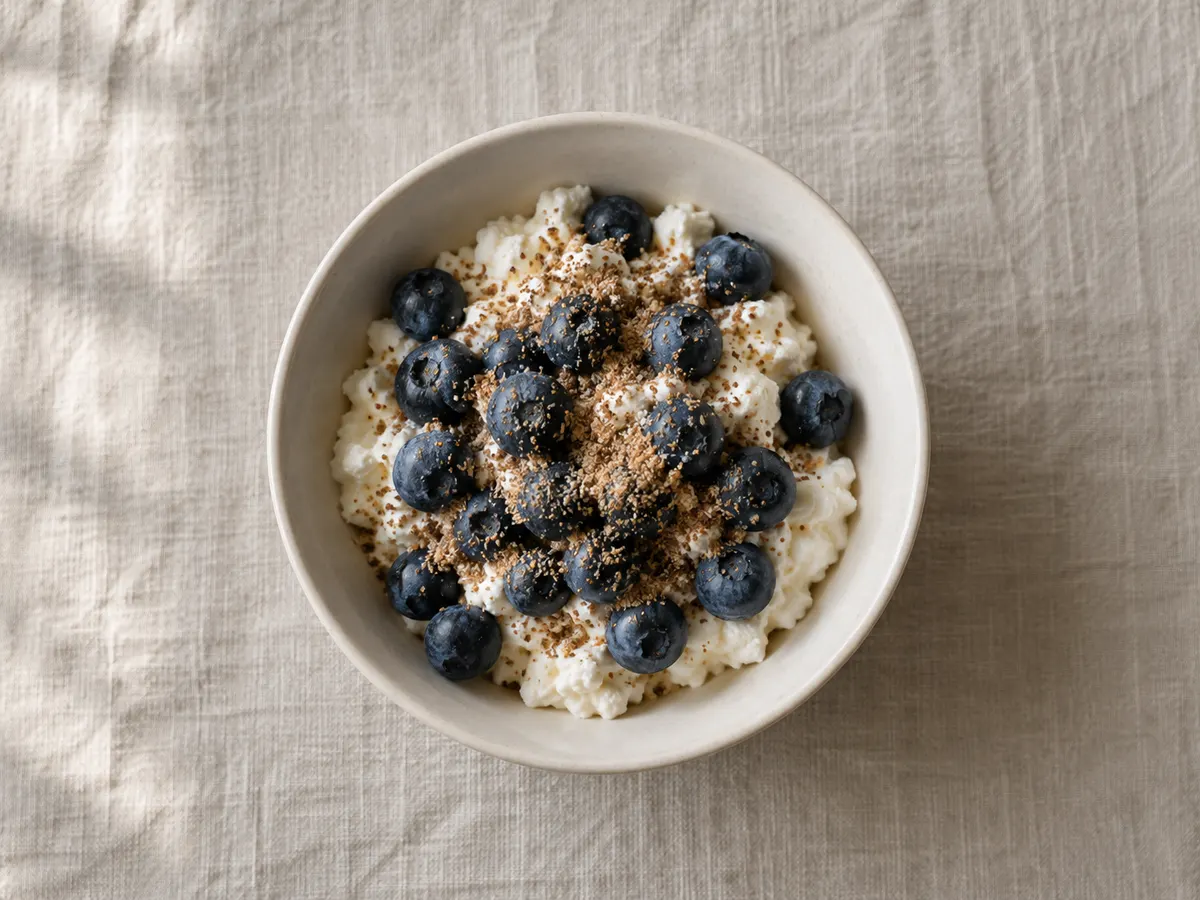 Ricotta with blueberries and flaxseed15.4 g protein per serving
Satiety
The 1 to 5 score is our own estimate: it starts at 1 point, adds points for low energy density, for protein and fiber per 100 kcal, and for the water in solid foods, and subtracts points for drinks with calories. It is useful for comparing foods with each other; it is not a measurement in people.
What to keep in mind on a GLP-1 medication
Frequently asked questions about blueberries
How much protein does a 75 g (2.5 oz) serving of blueberries have?
100 g (3.5 oz) of blueberries has 0.7 g of protein. A typical 75 g (2.5 oz) serving has about 0.6 g of protein. That is 1.3 g of protein per 100 kcal.
How many calories are in a 75 g (2.5 oz) serving of blueberries?
100 g (3.5 oz) of blueberries has 57 kcal. A typical 75 g (2.5 oz) serving has about 43 kcal. That is a very low energy density.
How many grams of fiber are in a 75 g (2.5 oz) serving of blueberries?
100 g (3.5 oz) of blueberries has 2.4 g of fiber. A typical 75 g (2.5 oz) serving has about 1.8 g of fiber.
How filling is blueberries?
Very filling for the calories it provides: our estimated satiety score is 5 out of 5. Calculation: 1 (base) + 2 (very low energy density: 57 kcal/100 g) + 0 (protein: 1.3 g/100 kcal) + 2 (fiber: 4.2 g/100 kcal) + 1 (solid food with 84.2 g of water) = 6; capped at 5. It is an estimate based on its composition, not a measurement in people.
Is blueberries a good choice on a GLP-1 medication?
Based on our tags, this is what matters about blueberries on a GLP-1 medication. “Low energy density”: plenty of volume for few calories; make sure it does not push protein foods off your plate. These are general guidelines, not medical advice: everyone tolerates foods differently.
How many grams or ounces are in a serving of blueberries?
We use 75 g (2.5 oz) as a typical serving. That amount provides about 43 kcal, 0.6 g of protein, and 1.8 g of fiber. It is a reference for calculations, not a recommendation of how much to eat.
Compare with…
Similar foods
Sources
Sources for the data on this page, with the access date.
- Official databaseU.S. Department of Agriculture, Agricultural Research Service.USDA FoodData Central: Blueberries, raw (FDC ID 171711).accessed .
- Clinical guidelineObesity (Wiley).Mozaffarian D, et al. Nutritional priorities to support GLP-1 therapy for obesity: A joint Advisory from the American College of Lifestyle Medicine, the American Society for Nutrition, the Obesity Medicine Association, and The Obesity Society. Obesity. 2025;33(8):1475-1503. doi:10.1002/oby.24336.accessed .
- RegulatorEuropean Commission.EU Register of nutrition and health claims made on foods.accessed .
- RegulatorOfficial Journal of the European Union (EUR-Lex).Regulation (EC) No 1924/2006 on nutrition and health claims made on foods (Annex).accessed .
- RegulatorOfficial Journal of the European Union (EUR-Lex).Regulation (EU) No 1169/2011 on the provision of food information to consumers (Annex XIII, nutrient reference values).accessed .
- Meta-analysisNutrition Research.Carvalho MF, Lucca ABA, Ribeiro E Silva VR, Macedo LR, Silva M. Blueberry intervention improves metabolic syndrome risk factors: systematic review and meta-analysis. Nutr Res. 2021;91:67-80. doi:10.1016/j.nutres.2021.04.006.accessed .
- Meta-analysisNutrition, Metabolism and Cardiovascular Diseases.Delpino FM, Figueiredo LM, Gonçalves da Silva T, Flores TR. Effects of blueberry and cranberry on type 2 diabetes parameters in individuals with or without diabetes: A systematic review and meta-analysis of randomized clinical trials. Nutr Metab Cardiovasc Dis. 2022;32(5):1093-1109. doi:10.1016/j.numecd.2022.02.004.accessed .