Fruits
Peach
Peaches are 89% water, so 100 g (3.5 oz) brings only 39 kcal and 1.5 g of fiber.
Estimated satietyHow it is calculated
Estimated satiety: 5 out of 5
| Starting point | +1 |
|---|---|
| Very low energy density: 39 kcal/100 g | +2 |
| Protein: 2.3 g/100 kcal | 0 |
| Fiber: 3.8 g/100 kcal | +1 |
| Solid food with 88.9 g of water | +1 |
Our own estimate from the values per 100 g: useful for comparing foods with each other, not a measurement in people. Holt index (1995): this food was not measured.
- Prepared by
- Alex Gonzalez
- Last updated
- Next review
- Sources
- 7 primary
- Data
- USDA FDC 169928
No clinical review. No advertising from drug companies and no affiliate links.How we work
Nutrition facts
- Calories
- 59 kcal per serving
- 39 kcal per 100 g (3.5 oz)
- Protein
- 1.4 g per serving
- 0.9 g per 100 g (3.5 oz)
- Carbohydrates
- 14.3 g per serving
- 9.5 g per 100 g (3.5 oz)
- of which sugars
- 12.6 g per serving
- 8.4 g per 100 g (3.5 oz)
- Fiber
- 2.3 g per serving
- 1.5 g per 100 g (3.5 oz)
- Fat
- 0.4 g per serving
- 0.3 g per 100 g (3.5 oz)
- of which saturated
- 0 g per serving
- 0 g per 100 g (3.5 oz)
- Water
- 133.4 g per serving
- 88.9 g per 100 g (3.5 oz)
Source: USDA FoodData Central: Peaches, yellow, raw (FDC ID 169928), accessed September 23, 2026.
A typical 150 g (5.5 oz) serving provides about 59 kcal, 1.4 g of protein, and 2.3 g of fiber.
What it is and how to eat it
The peach (Prunus persica) is called melocotón in Spain and durazno in Mexico and much of South America, such as Argentina, Chile, Colombia or Peru; it is a summer stone fruit with fuzzy skin and yellow or white flesh. The smooth-skinned nectarine and the flat peach, called paraguayo in Spain, are varieties of the same species, and peaches are also sold in syrup, canned or jarred. This page covers raw yellow peaches, with 39 kcal, 8.39 g of sugars and 1.5 g of fiber per 100 g according to USDA.
A 150 g (5.3 oz) serving provides about 59 kcal, 12.6 g of sugars, 2.3 g of fiber and barely 1.4 g of protein, so it is a light dessert but not the protein part of the meal. With a high-protein dairy food it covers both, as in the cottage cheese with peach and walnuts, and the 2025 nutrition advisory on GLP-1 therapy suggests starting meals with protein, so if you eat little, have it afterward. The US National Institutes of Health list peaches among the fruits that can cause gas, a common effect of semaglutide (Wegovy) in its 68-week trials, according to its label; if it happens to you, try half a serving.
What the evidence says
With 8.39 g of sugars per 100 g, a 150 g serving provides 12.6 g, but these are intrinsic sugars in whole fruit, which WHO's 2015 guideline leaves out of its recommendation to keep free sugars below 10% of energy. Canned peaches in heavy syrup have 74 kcal and 18.6 g of sugars per 100 g, counting the syrup, according to USDA, and the sugar added to the syrup does count as free sugar for WHO. With 1.5 g of fiber per 100 g it falls short of the 3 g for a "source of fibre" claim, but because it has few calories, its 3.8 g per 100 kcal meet the EU's other criterion for a "high fibre" claim, 3 g per 100 kcal (Regulation (EC) No 1924/2006). I have not found trials showing that peaches themselves help with weight loss more than other whole fruits.
Recipes with this food
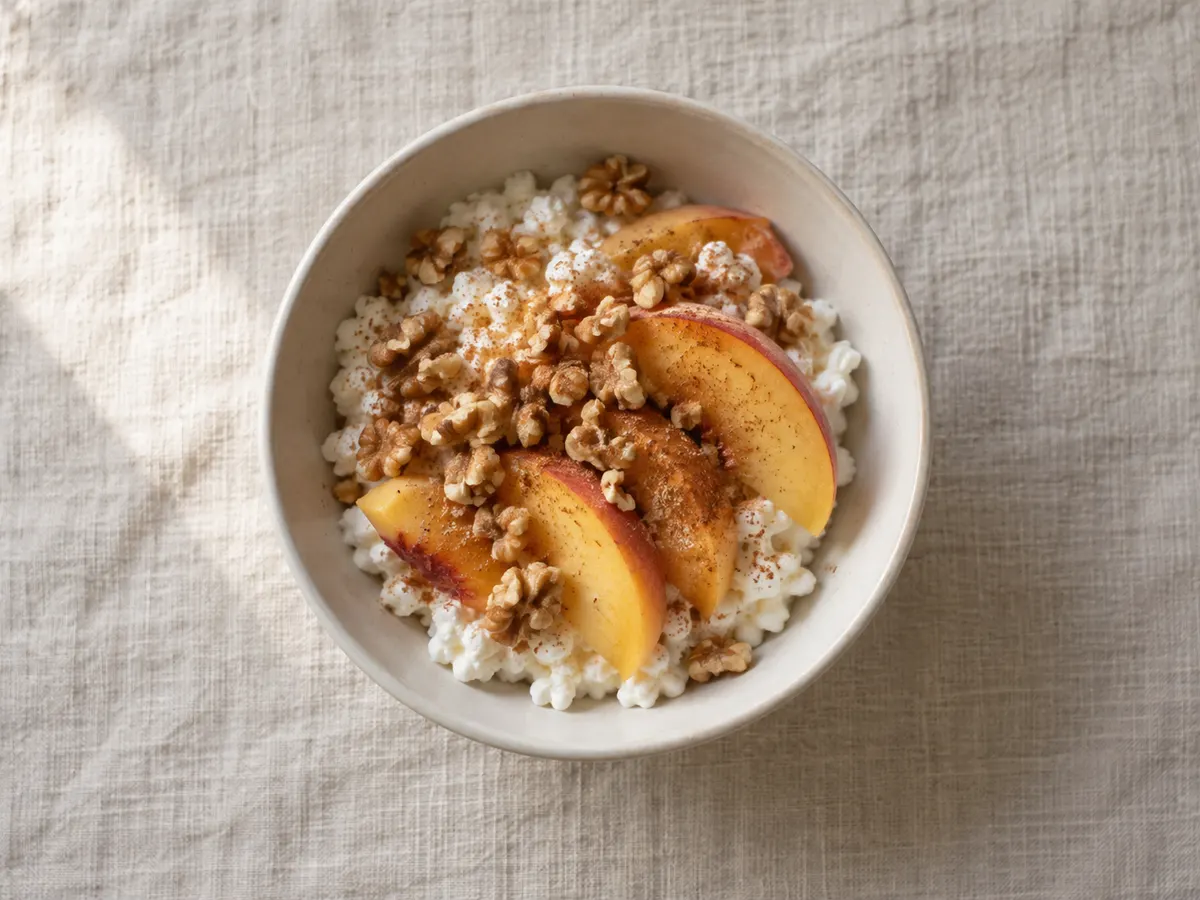 Cottage cheese with peach and walnuts18.2 g protein per serving
Satiety
The 1 to 5 score is our own estimate: it starts at 1 point, adds points for low energy density, for protein and fiber per 100 kcal, and for the water in solid foods, and subtracts points for drinks with calories. It is useful for comparing foods with each other; it is not a measurement in people.
What to keep in mind on a GLP-1 medication
Frequently asked questions about peaches
How much protein does a medium peach have?
A medium peach, our reference serving of 150 g (5.5 oz), has about 1.4 g of protein. 100 g (3.5 oz) of peaches has 0.9 g of protein. That is 2.3 g of protein per 100 kcal.
How many calories are in a medium peach?
A medium peach, our reference serving of 150 g (5.5 oz), has about 59 kcal. 100 g (3.5 oz) of peaches has 39 kcal. That is a very low energy density.
How many grams of fiber are in a medium peach?
A medium peach, our reference serving of 150 g (5.5 oz), has about 2.3 g of fiber. 100 g (3.5 oz) of peaches has 1.5 g of fiber.
How filling are peaches?
Very filling for the calories they provide: our estimated satiety score is 5 out of 5. Calculation: 1 (base) + 2 (very low energy density: 39 kcal/100 g) + 0 (protein: 2.3 g/100 kcal) + 1 (fiber: 3.8 g/100 kcal) + 1 (solid food with 88.9 g of water) = 5. It is an estimate based on its composition, not a measurement in people.
Are peaches a good choice on a GLP-1 if I have nausea?
Based on our tags, this is what matters about peaches on a GLP-1 medication. “Easy to digest”: a soft or low-fat food that many people tolerate well when they feel nauseous or get full quickly. “Low energy density”: plenty of volume for few calories; make sure it does not push protein foods off your plate. “Hydrating”: a lot of water, which contributes to hydration when you eat and drink less. These are general guidelines, not medical advice: everyone tolerates foods differently.
How many grams or ounces are in a serving of peaches?
We use 150 g (5.5 oz) as a typical serving, roughly a medium peach. That amount provides about 59 kcal, 1.4 g of protein, and 2.3 g of fiber. It is a reference for calculations, not a recommendation of how much to eat.
Similar foods
Sources
Sources for the data on this page, with the access date.
- Official databaseU.S. Department of Agriculture, Agricultural Research Service.USDA FoodData Central: Peaches, yellow, raw (FDC ID 169928).accessed .
- Official databaseU.S. Department of Agriculture, Agricultural Research Service.USDA FoodData Central: Peaches, canned, heavy syrup pack, solids and liquids (FDC ID 169112).accessed .
- Clinical guidelineObesity (Wiley).Mozaffarian D, et al. Nutritional priorities to support GLP-1 therapy for obesity: A joint Advisory from the American College of Lifestyle Medicine, the American Society for Nutrition, the Obesity Medicine Association, and The Obesity Society. Obesity. 2025;33(8):1475-1503. doi:10.1002/oby.24336.accessed .
- InstitutionNational Institute of Diabetes and Digestive and Kidney Diseases (NIH).Eating, Diet, & Nutrition for Gas in the Digestive Tract.accessed .
- Drug labelEuropean Medicines Agency.Wegovy (semaglutide): EU Summary of Product Characteristics, section 4.8 (undesirable effects), current version.accessed .
- Clinical guidelineWorld Health Organization.Guideline: sugars intake for adults and children (2015).accessed .
- RegulatorOfficial Journal of the European Union (EUR-Lex).Regulation (EC) No 1924/2006 on nutrition and health claims made on foods (Annex).accessed .