Nuts and seeds
Chia seeds
Chia seeds packs 486 kcal into 100 g (3.5 oz), so a typical 15 g (0.5 oz) serving already adds up to about 73 kcal.
Estimated satietyHow it is calculated
Estimated satiety: 2 out of 5
| Starting point | +1 |
|---|---|
| High energy density: 486 kcal/100 g | −1 |
| Protein: 3.4 g/100 kcal | 0 |
| Fiber: 7.1 g/100 kcal | +2 |
| Solid food with 5.8 g of water, under 70 | 0 |
Our own estimate from the values per 100 g: useful for comparing foods with each other, not a measurement in people. Holt index (1995): this food was not measured.
- Prepared by
- Alex Gonzalez
- Last updated
- Next review
- Sources
- 9 primary
- Data
- USDA FDC 170554
No clinical review. No advertising from drug companies and no affiliate links.How we work
Nutrition facts
- Calories
- 73 kcal per serving
- 486 kcal per 100 g (3.5 oz)
- Protein
- 2.5 g per serving
- 16.5 g per 100 g (3.5 oz)
- Carbohydrates
- 6.3 g per serving
- 42.1 g per 100 g (3.5 oz)
- of which sugars
- 0.2 g per serving
- 1.6 g per 100 g (3.5 oz)
- Fiber
- 5.2 g per serving
- 34.4 g per 100 g (3.5 oz)
- Fat
- 4.6 g per serving
- 30.7 g per 100 g (3.5 oz)
- of which saturated
- 0.5 g per serving
- 3.3 g per 100 g (3.5 oz)
- Water
- 0.9 g per serving
- 5.8 g per 100 g (3.5 oz)
Source: USDA FoodData Central: Seeds, chia seeds, dried (FDC ID 170554), accessed September 23, 2026.
A typical 15 g (0.5 oz) serving provides about 73 kcal, 2.5 g of protein, and 5.2 g of fiber.
What it is and how to eat it
Chia (Salvia hispanica) is a plant of the same genus as sage, native to Mexico and Central America, where its seeds have been eaten for centuries, for example in agua de chía, a drink with lime. The seeds are small, black, gray or white, and when soaked they absorb liquid and form a gel; in the EU they are a "novel food" with authorized, regulated uses (Implementing Regulation (EU) 2020/24). This page covers dried seeds, with 486 kcal, 34.4 g of fiber, 16.5 g of protein and 30.7 g of fat per 100 g according to USDA.
A 15 g (0.5 oz) tablespoon provides 73 kcal, 5.2 g of fiber and about 2.5 g of protein, so it adds fiber but does not replace the protein part of the plate. It works mixed into protein foods, as in the overnight oats with Greek yogurt and raspberries, and is better soaked or stirred into liquid than eaten dry by the spoonful. The 2025 nutrition advisory on GLP-1 therapy suggests avoiding very high-fiber foods in the first few days of treatment and, for constipation, increasing fiber gradually, so in those days, and after each dose increase, a 5 g teaspoon may be enough, with water through the day.
What the evidence says
In a crossover trial with 24 healthy adults, a mid-morning yogurt with 7 or 14 g of chia reduced hunger, increased fullness and lowered how much they ate at the next meal, compared with the same yogurt without chia (Nutrition Research and Practice, 2017). By contrast, in a trial with 76 adults with overweight or obesity, taking 25 g of chia in water before the first and last meals of the day, 50 g a day for 12 weeks, did not change body weight or body composition compared with placebo (Nutrition Research, 2009). With 34.4 g of fiber per 100 g, chia easily meets the EU minimum of 6 g for a "high fibre" claim, and a 15 g tablespoon provides 2.7 g of alpha-linolenic acid (ALA), more than the 2 g a day with which, according to the EU, the effect of the authorized claim "ALA contributes to the maintenance of normal blood cholesterol levels" is obtained (Regulations (EC) No 1924/2006 and (EU) No 432/2012). Since 2020 the EU no longer requires packaged seeds to state a maximum intake of 15 g a day, after EFSA concluded in 2019 that their use in foods not heated to 120 °C (248 °F) or above was safe without limits on amounts (Implementing Regulation (EU) 2020/24).
Recipes with this food
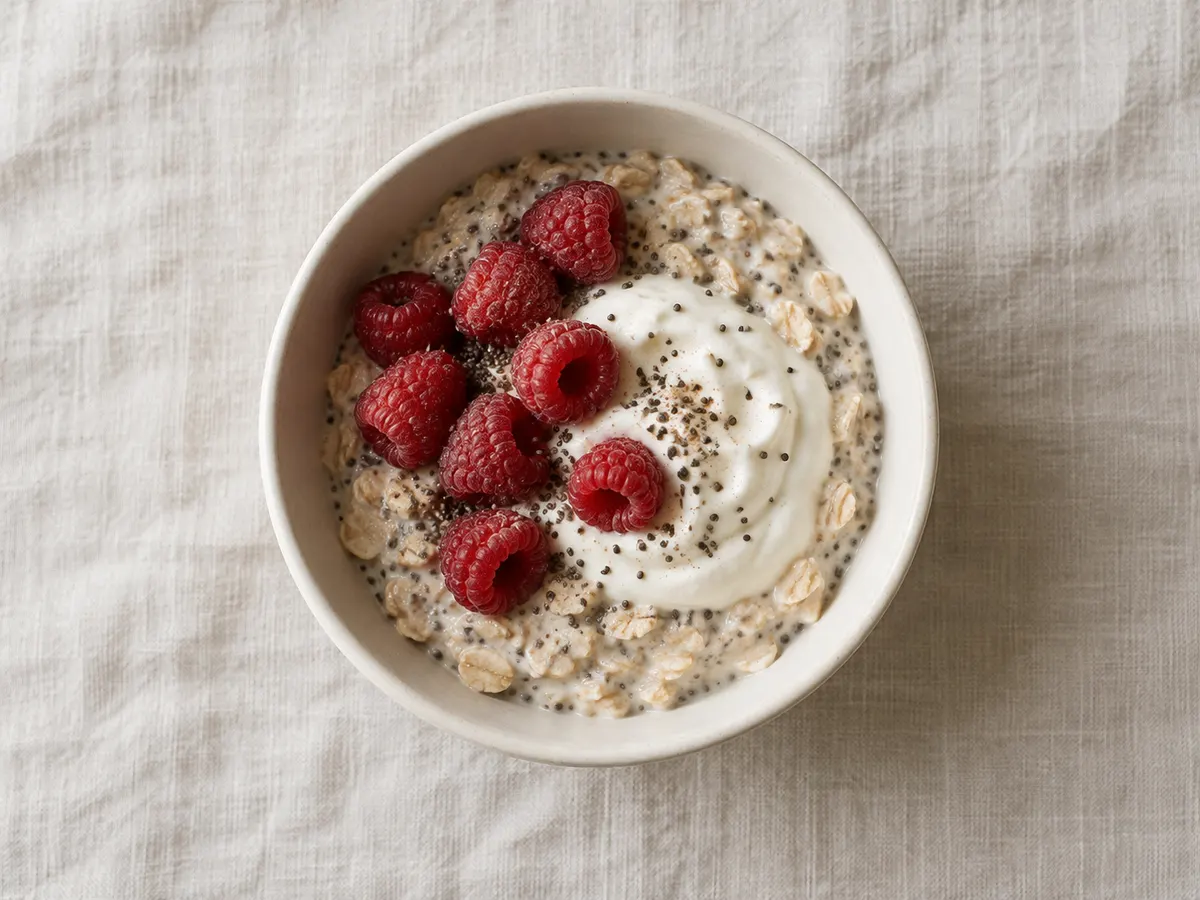 Overnight oats with Greek yogurt and raspberries20.4 g protein per serving
Satiety
The 1 to 5 score is our own estimate: it starts at 1 point, adds points for low energy density, for protein and fiber per 100 kcal, and for the water in solid foods, and subtracts points for drinks with calories. It is useful for comparing foods with each other; it is not a measurement in people.
What to keep in mind on a GLP-1 medication
Frequently asked questions about chia seeds
How much protein is in a 15 g (0.5 oz) serving of chia seeds?
100 g (3.5 oz) of chia seeds has 16.5 g of protein. A typical 15 g (0.5 oz) serving has about 2.5 g of protein. That is 3.4 g of protein per 100 kcal.
How many calories does a 15 g (0.5 oz) serving of chia seeds have?
100 g (3.5 oz) of chia seeds has 486 kcal. A typical 15 g (0.5 oz) serving has about 73 kcal. That is a high energy density.
Does chia seeds have fiber?
100 g (3.5 oz) of chia seeds has 34.4 g of fiber. A typical 15 g (0.5 oz) serving has about 5.2 g of fiber. It carries our “High in fiber” tag.
Is chia seeds filling?
Not very filling for the calories it provides: our estimated satiety score is 2 out of 5. Calculation: 1 (base) − 1 (high energy density: 486 kcal/100 g) + 0 (protein: 3.4 g/100 kcal) + 2 (fiber: 7.1 g/100 kcal) + 0 (solid food with 5.8 g of water, under 70) = 2. It is an estimate based on its composition, not a measurement in people.
What should I know about chia seeds on a GLP-1 medication?
Based on our tags, this is what matters about chia seeds on a GLP-1 medication. “High in fiber”: a good amount of fiber, which helps keep you regular; it is easier to tolerate when you increase it gradually and drink enough water. “Nutritious in small servings”: a lot of nutrition in a small volume, which is practical when you eat little. “High energy density”: a lot of energy in a small volume; when your appetite is very low, a small serving can help you meet your needs. These are general guidelines, not medical advice: everyone tolerates foods differently.
What counts as a normal serving of chia seeds?
We use 15 g (0.5 oz) as a typical serving. That amount provides about 73 kcal, 2.5 g of protein, and 5.2 g of fiber. It is a reference for calculations, not a recommendation of how much to eat.
Compare with…
Similar foods
Sources
Sources for the data on this page, with the access date.
- Official databaseU.S. Department of Agriculture, Agricultural Research Service.USDA FoodData Central: Seeds, chia seeds, dried (FDC ID 170554).accessed .
- U.S. Department of Agriculture, Agricultural Research Service.USDA FoodData Central (FNDDS 2021-2023): Chia seeds (FDC ID 2707590), sugars value.accessed .
- Clinical guidelineObesity (Wiley).Mozaffarian D, et al. Nutritional priorities to support GLP-1 therapy for obesity: A joint Advisory from the American College of Lifestyle Medicine, the American Society for Nutrition, the Obesity Medicine Association, and The Obesity Society. Obesity. 2025;33(8):1475-1503. doi:10.1002/oby.24336.accessed .
- Clinical trialNutrition Research and Practice.Ayaz A, Akyol A, Inan-Eroglu E, Kabasakal Cetin A, Samur G, Akbiyik F. Chia seed (Salvia Hispanica L.) added yogurt reduces short-term food intake and increases satiety: randomised controlled trial. Nutr Res Pract. 2017;11(5):412-418. doi:10.4162/nrp.2017.11.5.412.accessed .
- Clinical trialNutrition Research (Elsevier).Nieman DC, Cayea EJ, Austin MD, Henson DA, McAnulty SR, Jin F. Chia seed does not promote weight loss or alter disease risk factors in overweight adults. Nutr Res. 2009;29(6):414-418. doi:10.1016/j.nutres.2009.05.011.accessed .
- RegulatorOfficial Journal of the European Union (EUR-Lex).Regulation (EC) No 1924/2006 on nutrition and health claims made on foods (Annex).accessed .
- RegulatorOfficial Journal of the European Union (EUR-Lex).Commission Regulation (EU) No 432/2012 establishing a list of permitted health claims made on foods.accessed .
- RegulatorOfficial Journal of the European Union (EUR-Lex).Commission Implementing Regulation (EU) 2020/24 authorising an extension of use of chia seeds (Salvia hispanica) as a novel food and the change of the conditions of use and the specific labelling requirements of chia seeds.accessed .
- RegulatorEFSA Journal.EFSA NDA Panel. Safety of chia seeds (Salvia hispanica L.) as a novel food for extended uses pursuant to Regulation (EU) 2015/2283. EFSA Journal. 2019;17(4):5657. doi:10.2903/j.efsa.2019.5657.accessed .