Nuts and seeds
Sesame seeds
Sesame seeds packs 573 kcal into 100 g (3.5 oz), so a typical 9 g (0.3 oz) serving already adds up to about 52 kcal.
Estimated satietyHow it is calculated
Estimated satiety: 1 out of 5
| Starting point | +1 |
|---|---|
| Very high energy density: 573 kcal/100 g | −2 |
| Protein: 3.1 g/100 kcal | 0 |
| Fiber: 2.1 g/100 kcal | +1 |
| Solid food with 4.7 g of water, under 70 | 0 |
| Sum | 0 |
| Raised to the minimum of 1 | 1 |
Our own estimate from the values per 100 g: useful for comparing foods with each other, not a measurement in people. Holt index (1995): this food was not measured.
- Prepared by
- Alex Gonzalez
- Last updated
- Next review
- Sources
- 10 primary
- Data
- USDA FDC 170150
No clinical review. No advertising from drug companies and no affiliate links.How we work
Nutrition facts
- Calories
- 52 kcal per serving
- 573 kcal per 100 g (3.5 oz)
- Protein
- 1.6 g per serving
- 17.7 g per 100 g (3.5 oz)
- Carbohydrates
- 2.1 g per serving
- 23.4 g per 100 g (3.5 oz)
- of which sugars
- 0 g per serving
- 0.3 g per 100 g (3.5 oz)
- Fiber
- 1.1 g per serving
- 11.8 g per 100 g (3.5 oz)
- Fat
- 4.5 g per serving
- 49.7 g per 100 g (3.5 oz)
- of which saturated
- 0.6 g per serving
- 7 g per 100 g (3.5 oz)
- Water
- 0.4 g per serving
- 4.7 g per 100 g (3.5 oz)
Source: USDA FoodData Central: Seeds, sesame seeds, whole, dried (FDC ID 170150), accessed September 23, 2026.
A typical 9 g (0.3 oz) serving provides about 52 kcal, 1.6 g of protein, and 1.1 g of fiber.
What it is and how to eat it
The Dictionary of the Spanish Language gives ajonjolí and sésamo as synonyms for sesame and defines ajonjolí as an annual herbaceous plant whose fruit holds many small, yellowish, oily, edible seeds. The seeds are sold whole or hulled, raw or toasted, and ground they make tahini, the paste in hummus. This page covers whole dried seeds according to USDA, with 573 kcal, 11.8 g of fiber, 17.7 g of protein, 49.7 g of fat and 975 mg of calcium per 100 g.
A 9 g (0.3 oz) tablespoon, USDA's measure, provides 52 kcal, 1.1 g of fiber, 1.6 g of protein and 4.5 g of fat, so it adds flavor and texture more than protein. The 2025 nutrition advisory on GLP-1 therapy lists sesame seeds among the foods to encourage, and sprinkled over a protein dish, such as chicken, tofu or a salad with egg, they add almost no volume. The same advisory suggests avoiding fatty or high-fiber foods in the first days of treatment, so in those days a teaspoon is usually enough, and tahini is best measured with a spoon instead of eyeballed.
What the evidence says
With USDA's figures, 100 g of whole sesame seeds have 975 mg of calcium and hulled, toasted seeds 131 mg, so most of the calcium seems to be in the hull (my comparison), and a tablespoon of whole seeds provides 88 mg, 11% of the reference value. Their 4.08 mg of copper per 100 g far exceed the minimum for a "high copper" claim, and a tablespoon provides 0.37 mg, 37% of the reference value, so they could carry the authorized claim "copper contributes to the normal function of the immune system" (Regulations (EC) No 1924/2006, (EU) No 1169/2011 and (EU) No 432/2012); the EU register holds no claim specific to sesame, either authorized or rejected. Sesame seeds are one of the 14 allergens that labels must highlight in the EU (Regulation (EU) No 1169/2011), and in the US they are the 9th major food allergen under the FASTER Act, with the same labeling requirements as the others since January 1, 2023, according to the FDA.
Recipes with this food
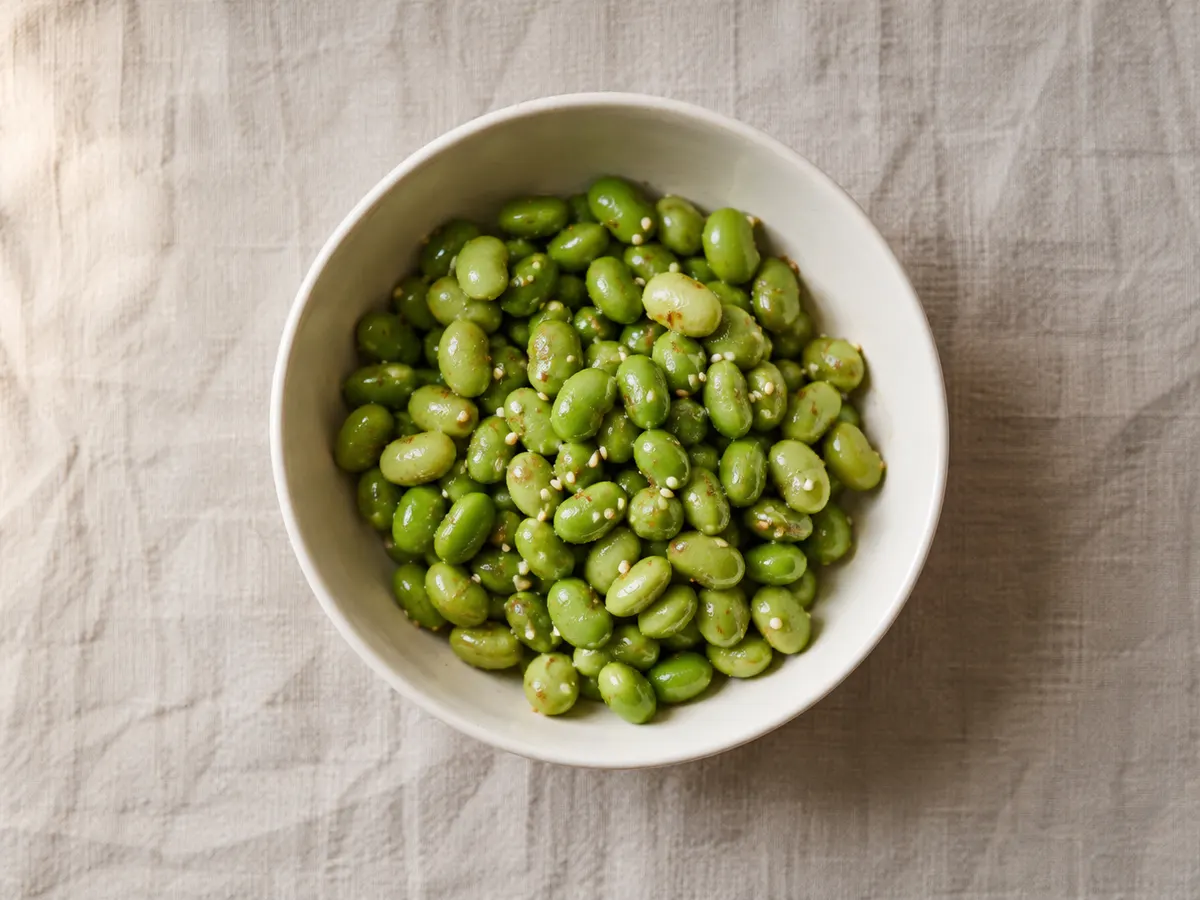 Edamame with lime and sesame12.4 g protein per serving
Satiety
The 1 to 5 score is our own estimate: it starts at 1 point, adds points for low energy density, for protein and fiber per 100 kcal, and for the water in solid foods, and subtracts points for drinks with calories. It is useful for comparing foods with each other; it is not a measurement in people.
What to keep in mind on a GLP-1 medication
Frequently asked questions about sesame seeds
How much protein is in a 9 g (0.3 oz) serving of sesame seeds?
100 g (3.5 oz) of sesame seeds has 17.7 g of protein. A typical 9 g (0.3 oz) serving has about 1.6 g of protein. That is 3.1 g of protein per 100 kcal.
How many calories does a 9 g (0.3 oz) serving of sesame seeds have?
100 g (3.5 oz) of sesame seeds has 573 kcal. A typical 9 g (0.3 oz) serving has about 52 kcal. That is a very high energy density.
Does sesame seeds have fiber?
100 g (3.5 oz) of sesame seeds has 11.8 g of fiber. A typical 9 g (0.3 oz) serving has about 1.1 g of fiber. It carries our “High in fiber” tag.
Is sesame seeds filling?
Barely filling for the calories it provides: our estimated satiety score is 1 out of 5. Calculation: 1 (base) − 2 (very high energy density: 573 kcal/100 g) + 0 (protein: 3.1 g/100 kcal) + 1 (fiber: 2.1 g/100 kcal) + 0 (solid food with 4.7 g of water, under 70) = 0; raised to the minimum of 1. It is an estimate based on its composition, not a measurement in people.
What should I know about sesame seeds on a GLP-1 medication?
Based on our tags, this is what matters about sesame seeds on a GLP-1 medication. “High in fiber”: a good amount of fiber, which helps keep you regular; it is easier to tolerate when you increase it gradually and drink enough water. “Nutritious in small servings”: a lot of nutrition in a small volume, which is practical when you eat little. “High energy density”: a lot of energy in a small volume; when your appetite is very low, a small serving can help you meet your needs. These are general guidelines, not medical advice: everyone tolerates foods differently.
What counts as a normal serving of sesame seeds?
We use 9 g (0.3 oz) as a typical serving. That amount provides about 52 kcal, 1.6 g of protein, and 1.1 g of fiber. It is a reference for calculations, not a recommendation of how much to eat.
Similar foods
Sources
Sources for the data on this page, with the access date.
- Official databaseU.S. Department of Agriculture, Agricultural Research Service.USDA FoodData Central: Seeds, sesame seeds, whole, dried (FDC ID 170150).accessed .
- Official databaseU.S. Department of Agriculture, Agricultural Research Service.USDA FoodData Central: Seeds, sesame seed kernels, toasted, without salt added (decorticated) (FDC ID 170152).accessed .
- Clinical guidelineObesity (Wiley).Mozaffarian D, et al. Nutritional priorities to support GLP-1 therapy for obesity: A joint Advisory from the American College of Lifestyle Medicine, the American Society for Nutrition, the Obesity Medicine Association, and The Obesity Society. Obesity. 2025;33(8):1475-1503. doi:10.1002/oby.24336.accessed .
- RegulatorOfficial Journal of the European Union (EUR-Lex).Regulation (EC) No 1924/2006 on nutrition and health claims made on foods (Annex).accessed .
- RegulatorOfficial Journal of the European Union (EUR-Lex).Regulation (EU) No 1169/2011 on the provision of food information to consumers (Annex II, substances causing allergies or intolerances, and Annex XIII, nutrient reference values).accessed .
- RegulatorOfficial Journal of the European Union (EUR-Lex).Commission Regulation (EU) No 432/2012 establishing a list of permitted health claims made on foods.accessed .
- RegulatorEuropean Commission.EU Register of nutrition and health claims made on foods.accessed .
- RegulatorU.S. Food and Drug Administration (FDA).Food Allergies (FASTER Act and sesame as the 9th major food allergen).accessed .
- InstitutionRoyal Spanish Academy and Association of Academies of the Spanish Language (RAE-ASALE).Diccionario de la lengua española (Dictionary of the Spanish Language, 23rd ed., online version): "ajonjolí" (in Spanish).accessed .
- InstitutionRoyal Spanish Academy and Association of Academies of the Spanish Language (RAE-ASALE).Diccionario de la lengua española (Dictionary of the Spanish Language, 23rd ed., online version): "sésamo" (in Spanish).accessed .