Nuts and seeds
Sunflower seeds
Sunflower seeds pack 582 kcal into 100 g (3.5 oz), so a typical 25 g (0.9 oz) serving already adds up to about 146 kcal.
Estimated satietyHow it is calculated
Estimated satiety: 1 out of 5
| Starting point | +1 |
|---|---|
| Very high energy density: 582 kcal/100 g | −2 |
| Protein: 3.3 g/100 kcal | 0 |
| Fiber: 1.9 g/100 kcal | 0 |
| Solid food with 1.2 g of water, under 70 | 0 |
| Sum | −1 |
| Raised to the minimum of 1 | 1 |
Our own estimate from the values per 100 g: useful for comparing foods with each other, not a measurement in people. Holt index (1995): this food was not measured.
- Prepared by
- Alex Gonzalez
- Last updated
- Next review
- Sources
- 5 primary
- Data
- USDA FDC 170563
No clinical review. No advertising from drug companies and no affiliate links.How we work
Nutrition facts
- Calories
- 146 kcal per serving
- 582 kcal per 100 g (3.5 oz)
- Protein
- 4.8 g per serving
- 19.3 g per 100 g (3.5 oz)
- Carbohydrates
- 6 g per serving
- 24.1 g per 100 g (3.5 oz)
- of which sugars
- 0.7 g per serving
- 2.7 g per 100 g (3.5 oz)
- Fiber
- 2.8 g per serving
- 11.1 g per 100 g (3.5 oz)
- Fat
- 12.5 g per serving
- 49.8 g per 100 g (3.5 oz)
- of which saturated
- 1.3 g per serving
- 5.2 g per 100 g (3.5 oz)
- Water
- 0.3 g per serving
- 1.2 g per 100 g (3.5 oz)
Source: USDA FoodData Central: Seeds, sunflower seed kernels, dry roasted, without salt (FDC ID 170563), accessed September 23, 2026.
A typical 25 g (0.9 oz) serving provides about 146 kcal, 4.8 g of protein, and 2.8 g of fiber.
What it is and how to eat it
Sunflower seeds come from the sunflower (Helianthus annuus): in Spain, where they are called pipas, they are sold mostly in the shell, roasted and often salted, to be cracked open one by one, and also shelled, raw or roasted. In Mexico, Argentina and much of Latin America they are called semillas de girasol, and in Chile, semillas de maravilla. This page covers shelled, dry-roasted, unsalted sunflower seed kernels, with 582 kcal, 19.3 g of protein, 11.1 g of fiber and 49.8 g of fat per 100 g according to USDA.
A 25 g (0.9 oz) serving, about two and a half tablespoons, provides about 146 kcal, 4.8 g of protein, 2.8 g of fiber and 12.5 g of fat: a lot of energy in little volume, which does not replace the protein part of the plate. One tablespoon, about 10 g, is enough to add texture to a high-protein dairy food, as in the Greek yogurt with fruit and seeds. The 2025 nutrition advisory on GLP-1 therapy notes that foods high in protein or fat can further slow gastric emptying and suggests avoiding fatty foods in the first few days of treatment; in those days, and after each dose increase, that single tablespoon may be enough. In the shell they are eaten more slowly, but they usually come salted, so the unsalted kind is the better choice.
What the evidence says
With 26.1 mg of vitamin E per 100 g, a 25 g serving provides 6.5 mg, 54% of the EU's 12 mg reference value, and they far exceed the 3.6 mg per 100 g required for a "high vitamin E" claim (Regulations (EC) No 1924/2006 and (EU) No 1169/2011). That means they could carry the authorized claim "vitamin E contributes to the protection of cells from oxidative stress", which only requires the food to be at least a source of vitamin E (Regulation (EU) No 432/2012). About 89% of their fatty acids are unsaturated and provide 66% of their energy, so they meet the "high unsaturated fat" condition (at least 70% of fatty acids and more than 20% of energy) that the EU requires for the claim "replacing saturated fats with unsaturated fats in the diet contributes to the maintenance of normal blood cholesterol levels"; the effect depends on replacing other fats, not on adding sunflower seeds to the diet. At 582 kcal per 100 g they are among the most calorie-dense foods in this site's database, far above the 300 kcal at which it labels a food as high in energy density, and I have not found trials showing that sunflower seeds themselves help with weight loss.
Recipes with this food
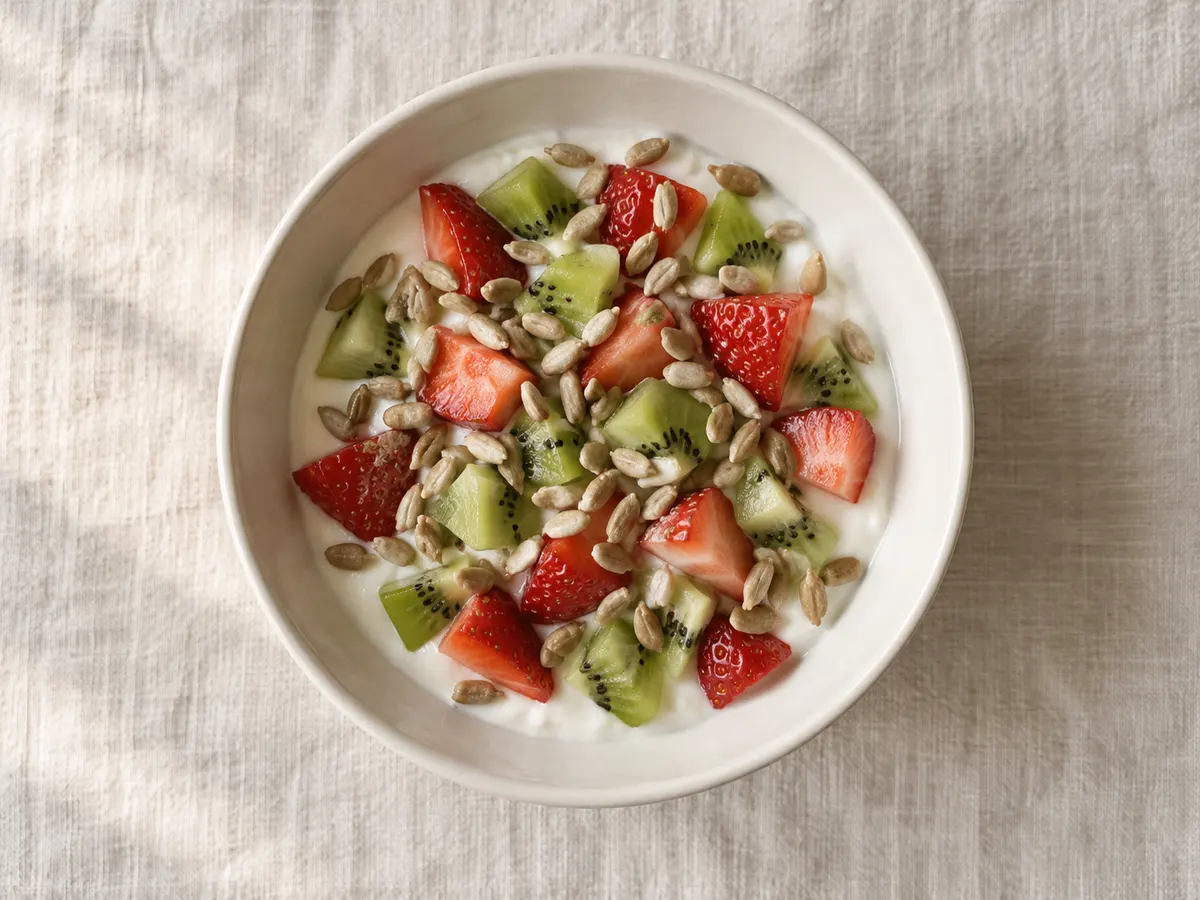 Greek yogurt with fruit and seeds16.5 g protein per serving
Satiety
The 1 to 5 score is our own estimate: it starts at 1 point, adds points for low energy density, for protein and fiber per 100 kcal, and for the water in solid foods, and subtracts points for drinks with calories. It is useful for comparing foods with each other; it is not a measurement in people.
What to keep in mind on a GLP-1 medication
Frequently asked questions about sunflower seeds
How much protein is in a small handful of sunflower seeds?
A small handful of sunflower seeds, our reference serving of 25 g (0.9 oz), has about 4.8 g of protein. 100 g (3.5 oz) of sunflower seeds has 19.3 g of protein. That is 3.3 g of protein per 100 kcal.
How many calories does a small handful of sunflower seeds have?
A small handful of sunflower seeds, our reference serving of 25 g (0.9 oz), has about 146 kcal. 100 g (3.5 oz) of sunflower seeds has 582 kcal. That is a very high energy density.
Do sunflower seeds have fiber?
A small handful of sunflower seeds, our reference serving of 25 g (0.9 oz), has about 2.8 g of fiber. 100 g (3.5 oz) of sunflower seeds has 11.1 g of fiber. They carry our “High in fiber” tag.
Are sunflower seeds filling?
Barely filling for the calories they provide: our estimated satiety score is 1 out of 5. Calculation: 1 (base) − 2 (very high energy density: 582 kcal/100 g) + 0 (protein: 3.3 g/100 kcal) + 0 (fiber: 1.9 g/100 kcal) + 0 (solid food with 1.2 g of water, under 70) = −1; raised to the minimum of 1. It is an estimate based on its composition, not a measurement in people.
What should I know about sunflower seeds on a GLP-1 medication?
Based on our tags, this is what matters about sunflower seeds on a GLP-1 medication. “High in fiber”: a good amount of fiber, which helps keep you regular; it is easier to tolerate when you increase it gradually and drink enough water. “Nutritious in small servings”: a lot of nutrition in a small volume, which is practical when you eat little. “High energy density”: a lot of energy in a small volume; when your appetite is very low, a small serving can help you meet your needs. These are general guidelines, not medical advice: everyone tolerates foods differently.
What counts as a normal serving of sunflower seeds?
We use 25 g (0.9 oz) as a typical serving, roughly a small handful of sunflower seeds. That amount provides about 146 kcal, 4.8 g of protein, and 2.8 g of fiber. It is a reference for calculations, not a recommendation of how much to eat.
Similar foods
Sources
Sources for the data on this page, with the access date.
- Official databaseU.S. Department of Agriculture, Agricultural Research Service.USDA FoodData Central: Seeds, sunflower seed kernels, dry roasted, without salt (FDC ID 170563).accessed .
- Clinical guidelineObesity (Wiley).Mozaffarian D, et al. Nutritional priorities to support GLP-1 therapy for obesity: A joint Advisory from the American College of Lifestyle Medicine, the American Society for Nutrition, the Obesity Medicine Association, and The Obesity Society. Obesity. 2025;33(8):1475-1503. doi:10.1002/oby.24336.accessed .
- RegulatorOfficial Journal of the European Union (EUR-Lex).Regulation (EC) No 1924/2006 on nutrition and health claims made on foods (Annex).accessed .
- RegulatorOfficial Journal of the European Union (EUR-Lex).Regulation (EU) No 1169/2011 on the provision of food information to consumers (Annex XIII, nutrient reference values).accessed .
- RegulatorOfficial Journal of the European Union (EUR-Lex).Commission Regulation (EU) No 432/2012 establishing a list of permitted health claims made on foods.accessed .