Dairy
Nonfat Greek yogurt
Nonfat Greek yogurt provides 10.2 g of protein for 59 kcal per 100 g (3.5 oz), or 17.3 g of protein for every 100 kcal.
Estimated satietyHow it is calculated
Estimated satiety: 5 out of 5
| Starting point | +1 |
|---|---|
| Very low energy density: 59 kcal/100 g | +2 |
| Protein: 17.3 g/100 kcal | +2 |
| Fiber: 0.0 g/100 kcal | 0 |
| Solid food with 85.1 g of water | +1 |
| Sum | 6 |
| Capped at 5 | 5 |
Our own estimate from the values per 100 g: useful for comparing foods with each other, not a measurement in people. Holt index (1995): this food was not measured.
- Prepared by
- Alex Gonzalez
- Last updated
- Next review
- Sources
- 8 primary
- Data
- USDA FDC 170894
No clinical review. No advertising from drug companies and no affiliate links.How we work
Nutrition facts
- Calories
- 74 kcal per serving
- 59 kcal per 100 g (3.5 oz)
- Protein
- 12.8 g per serving
- 10.2 g per 100 g (3.5 oz)
- Carbohydrates
- 4.5 g per serving
- 3.6 g per 100 g (3.5 oz)
- of which sugars
- 4.1 g per serving
- 3.2 g per 100 g (3.5 oz)
- Fiber
- 0 g per serving
- 0 g per 100 g (3.5 oz)
- Fat
- 0.5 g per serving
- 0.4 g per 100 g (3.5 oz)
- of which saturated
- 0.1 g per serving
- 0.1 g per 100 g (3.5 oz)
- Water
- 106.4 g per serving
- 85.1 g per 100 g (3.5 oz)
Source: USDA FoodData Central: Yogurt, Greek, plain, nonfat (Includes foods for USDA's Food Distribution Program) (FDC ID 170894), accessed September 23, 2026.
A typical 125 g (4.5 oz) serving provides about 74 kcal, 12.8 g of protein, and 0 g of fiber.
What it is and how to eat it
Greek yogurt is strained yogurt, with part of the whey removed, so it is thick and higher in protein; the nonfat version, called desnatado in Spain and descremado in Latin America, is made from fat-free milk. In Spain, the yogurt quality standard (Real Decreto 271/2014) does not define "Greek", but it does require a nonfat yogurt to contain at most 0.5% fat and its cultures to remain alive, at least 10⁷ colony-forming units per gram, unless it is sold as "pasteurized after fermentation". This page covers USDA's plain nonfat Greek yogurt, with 59 kcal, 10.2 g of protein and 0.39 g of fat per 100 g; many supermarket "Greek" yogurts are whole-milk or made with cream, so check the label.
A 125 g (4.4 oz) yogurt provides 12.8 g of protein for only 74 kcal, so it is one of the simplest ways to start a meal or snack with protein, as the 2025 nutrition advisory on GLP-1 therapy suggests. It is cold, soft and almost fat-free, so it usually sits well after a dose increase and fits the same advisory's suggestion to avoid very fatty foods in the first few days of treatment; when eating is hard it can be taken in small spoonfuls. It works as a base for the overnight oats with Greek yogurt and raspberries, or as a sauce in the mild chicken curry with yogurt and spinach and the chicken salad with apple, celery, and yogurt.
What the evidence says
About 69% of its energy comes from protein, well above the EU's 20% threshold for a "high protein" claim, so it can carry the authorized claim "protein contributes to the maintenance of muscle mass", which matters during weight loss (Regulations (EC) No 1924/2006 and (EU) No 432/2012). The only authorized claim about its cultures is that "live cultures in yoghurt or fermented milk improve lactose digestion of the product in individuals who have difficulty digesting lactose", and only if it contains at least 10⁸ colony-forming units of Lactobacillus delbrueckii subsp. bulgaricus and Streptococcus thermophilus per gram, more than the 10⁷ the Spanish standard requires (Regulation (EU) No 432/2012, based on a 2010 EFSA opinion). A 125 g yogurt contains about 3.2 g of lactose according to USDA, far below the 12 g that, according to EFSA, the vast majority of people who digest lactose poorly tolerate at once. It also provides 138 mg of calcium, but at 110 mg per 100 g it falls short of the 120 mg needed for a "source of calcium" claim (Regulation (EU) No 1169/2011).
Recipes with this food
 Greek yogurt cup with pomegranate, mandarin, and walnuts17.8 g protein per serving
 Overnight oats with Greek yogurt and raspberries20.4 g protein per serving
 Kefir bowl with mango, strawberries, and oats15.9 g protein per serving
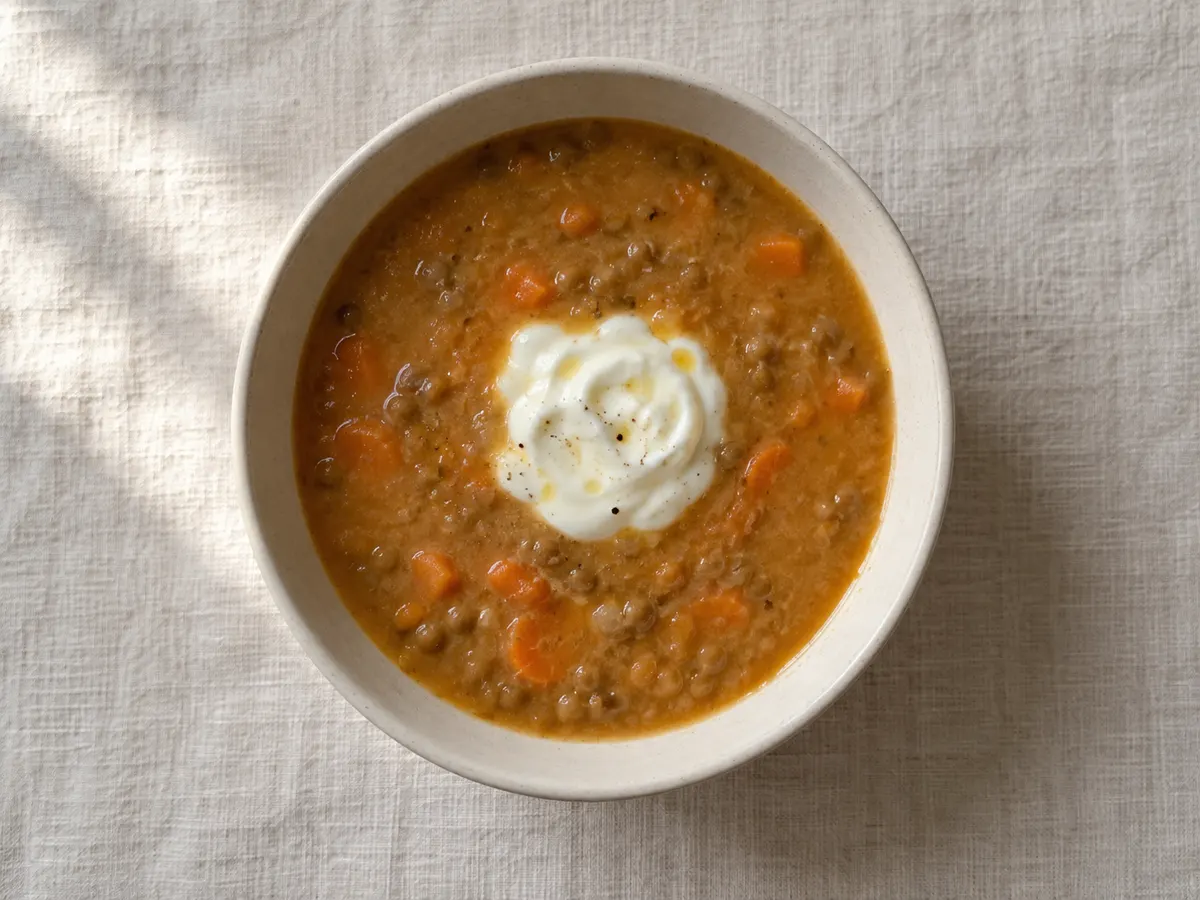 Creamy lentil and carrot soup with yogurt22.5 g protein per serving
 Chicken salad with apple, celery, and yogurt33.5 g protein per serving
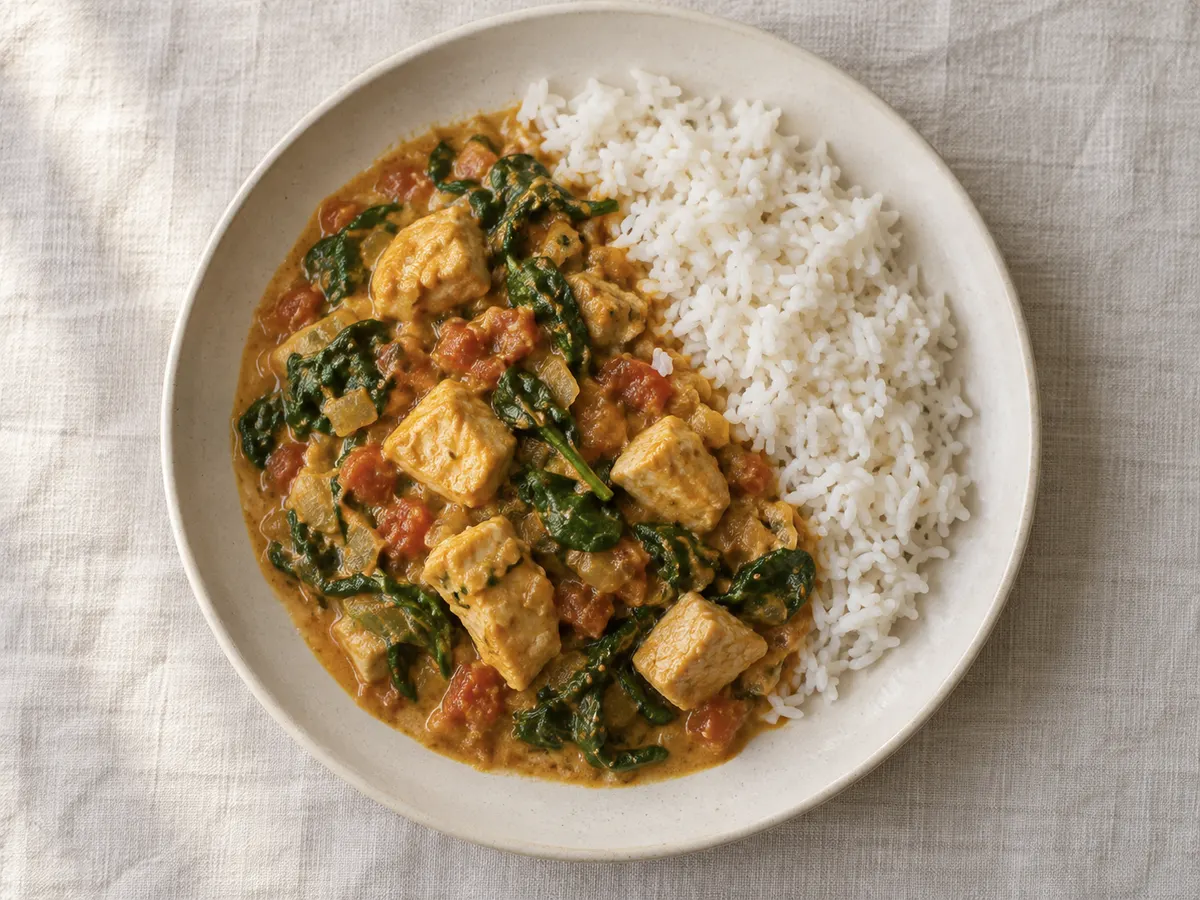 Mild chicken curry with yogurt and spinach37.3 g protein per serving
Satiety
The 1 to 5 score is our own estimate: it starts at 1 point, adds points for low energy density, for protein and fiber per 100 kcal, and for the water in solid foods, and subtracts points for drinks with calories. It is useful for comparing foods with each other; it is not a measurement in people.
What to keep in mind on a GLP-1 medication
Frequently asked questions about nonfat Greek yogurt
How many grams of protein are in a 125 g (4.5 oz) serving of nonfat Greek yogurt?
100 g (3.5 oz) of nonfat Greek yogurt has 10.2 g of protein. A typical 125 g (4.5 oz) serving has about 12.8 g of protein. That is 17.3 g of protein per 100 kcal, which is why it carries our “High in protein” tag.
How many kcal are in a 125 g (4.5 oz) serving of nonfat Greek yogurt?
100 g (3.5 oz) of nonfat Greek yogurt has 59 kcal. A typical 125 g (4.5 oz) serving has about 74 kcal. That is a very low energy density.
Does nonfat Greek yogurt keep you full?
Yes, very filling for the calories it provides: our estimated satiety score is 5 out of 5. Calculation: 1 (base) + 2 (very low energy density: 59 kcal/100 g) + 2 (protein: 17.3 g/100 kcal) + 0 (fiber: 0.0 g/100 kcal) + 1 (solid food with 85.1 g of water) = 6; capped at 5. It is an estimate based on its composition, not a measurement in people.
What should I know about nonfat Greek yogurt if I take Ozempic, Wegovy, Mounjaro, or Zepbound and feel nauseous?
Based on our tags, this is what matters about nonfat Greek yogurt on a GLP-1 medication. “High in protein”: plenty of protein per calorie; protein helps preserve muscle mass when you eat less. “Easy to digest”: a soft or low-fat food that many people tolerate well when they feel nauseous or get full quickly. “Nutritious in small servings”: a lot of nutrition in a small volume, which is practical when you eat little. “Low energy density”: plenty of volume for few calories; make sure it does not push protein foods off your plate. “Hydrating”: a lot of water, which contributes to hydration when you eat and drink less. These are general guidelines, not medical advice: everyone tolerates foods differently.
What is a typical serving of nonfat Greek yogurt?
We use 125 g (4.5 oz) as a typical serving. That amount provides about 74 kcal, 12.8 g of protein, and 0 g of fiber. It is a reference for calculations, not a recommendation of how much to eat.
Compare with…
Similar foods
Sources
Sources for the data on this page, with the access date.
- Official databaseU.S. Department of Agriculture, Agricultural Research Service.USDA FoodData Central: Yogurt, Greek, plain, nonfat (Includes foods for USDA's Food Distribution Program) (FDC ID 170894).accessed .
- RegulatorBoletín Oficial del Estado (España).Real Decreto 271/2014, de 11 de abril, por el que se aprueba la Norma de Calidad para el yogur o yoghourt.accessed .
- Clinical guidelineObesity (Wiley).Mozaffarian D, et al. Nutritional priorities to support GLP-1 therapy for obesity: A joint Advisory from the American College of Lifestyle Medicine, the American Society for Nutrition, the Obesity Medicine Association, and The Obesity Society. Obesity. 2025;33(8):1475-1503. doi:10.1002/oby.24336.accessed .
- RegulatorOfficial Journal of the European Union (EUR-Lex).Regulation (EC) No 1924/2006 on nutrition and health claims made on foods (Annex).accessed .
- RegulatorOfficial Journal of the European Union (EUR-Lex).Commission Regulation (EU) No 432/2012 establishing a list of permitted health claims made on foods.accessed .
- RegulatorEuropean Food Safety Authority (EFSA).EFSA NDA Panel. Scientific Opinion on the substantiation of health claims related to live yoghurt cultures and improved lactose digestion (ID 1143, 2976). EFSA Journal. 2010;8(10):1763.accessed .
- RegulatorEFSA Journal.EFSA NDA Panel. Scientific Opinion on lactose thresholds in lactose intolerance and galactosaemia. EFSA Journal. 2010;8(9):1777. doi:10.2903/j.efsa.2010.1777.accessed .
- RegulatorOfficial Journal of the European Union (EUR-Lex).Regulation (EU) No 1169/2011 on the provision of food information to consumers (Annex XIII, nutrient reference values).accessed .