Grains and bread
Cooked brown rice
A typical 150 g (5.5 oz) serving of cooked brown rice has about 185 kcal and 2.4 g of fiber, from 123 kcal per 100 g.
Estimated satietyHow it is calculated
Estimated satiety: 3 out of 5
| Starting point | +1 |
|---|---|
| Low energy density | +1 |
| High water content | +1 |
Our own estimate from the values per 100 g: useful for comparing foods with each other, not a measurement in people. Holt index (1995): 132 (white bread = 100).
- Prepared by
- Alex Gonzalez
- Last updated
- Next review
- Sources
- 8 primary
- Data
- USDA FDC 169704
No clinical review. No advertising from drug companies and no affiliate links.How we work
Nutrition facts
- Calories
- 185 kcal per serving
- 123 kcal per 100 g (3.5 oz)
- Protein
- 4.1 g per serving
- 2.7 g per 100 g (3.5 oz)
- Carbohydrates
- 38.4 g per serving
- 25.6 g per 100 g (3.5 oz)
- of which sugars
- 0.4 g per serving
- 0.2 g per 100 g (3.5 oz)
- Fiber
- 2.4 g per serving
- 1.6 g per 100 g (3.5 oz)
- Fat
- 1.5 g per serving
- 1 g per 100 g (3.5 oz)
- of which saturated
- 0.4 g per serving
- 0.3 g per 100 g (3.5 oz)
- Water
- 105.5 g per serving
- 70.3 g per 100 g (3.5 oz)
Source: USDA FoodData Central: Rice, brown, long-grain, cooked (Includes foods for USDA's Food Distribution Program) (FDC ID 169704), accessed September 23, 2026.
A typical 150 g (5.5 oz) serving provides about 185 kcal, 4.1 g of protein, and 2.4 g of fiber.
What it is and how to eat it
Brown rice is the whole rice grain with only the hull removed, so it keeps the bran and germ that white rice loses when it is polished. It takes longer to cook than white rice and stays firmer; it is sold as long-grain or short-grain rice, and also ready-cooked in microwavable cups. This page covers cooked long-grain brown rice, with 123 kcal and 1.6 g of fiber per 100 g according to USDA, versus 130 kcal and 0.4 g for long-grain white rice.
A 150 g (5.3 oz) serving provides 185 kcal, 2.4 g of fiber and only 4.1 g of protein, so it works as a side rather than the main part of the plate. The 2025 nutrition advisory on GLP-1 therapy lists whole grains among the foods to encourage and suggests eating the protein part of a meal first, as in the stir-fried tofu with vegetables and brown rice or the tofu with peanut sauce and vegetables. The same advisory suggests avoiding high-fiber foods in the first few days of treatment and, for constipation, increasing fiber gradually. In those days, and after each dose increase, half a serving cooked until soft, or white rice, which has less fiber, may sit better.
What the evidence says
In the 2008 international tables of glycemic index, boiled brown rice has an average index of 68 and white rice 73, a small difference, and the authors found high- and low-GI versions of both. In a crossover trial with 15 overweight adults in India, eating brown rice instead of white rice for 5 days lowered the rise in blood glucose over the day by 19.8% (Diabetes Technology & Therapeutics, 2014). A meta-analysis of 26 trials with 2,060 adults, published in 2013 in the American Journal of Clinical Nutrition, found that whole grains did not reduce body weight compared with non-whole-grain controls, although body fat fell slightly (by 0.48 percentage points). In the Holt satiety index (1995), brown rice scored 132 and white rice 138, and with 1.6 g of fiber per 100 g (1.3 g per 100 kcal) it meets neither of the EU minimums for a "source of fibre" claim, 3 g per 100 g or 1.5 g per 100 kcal (Regulation (EC) No 1924/2006).
Recipes with this food
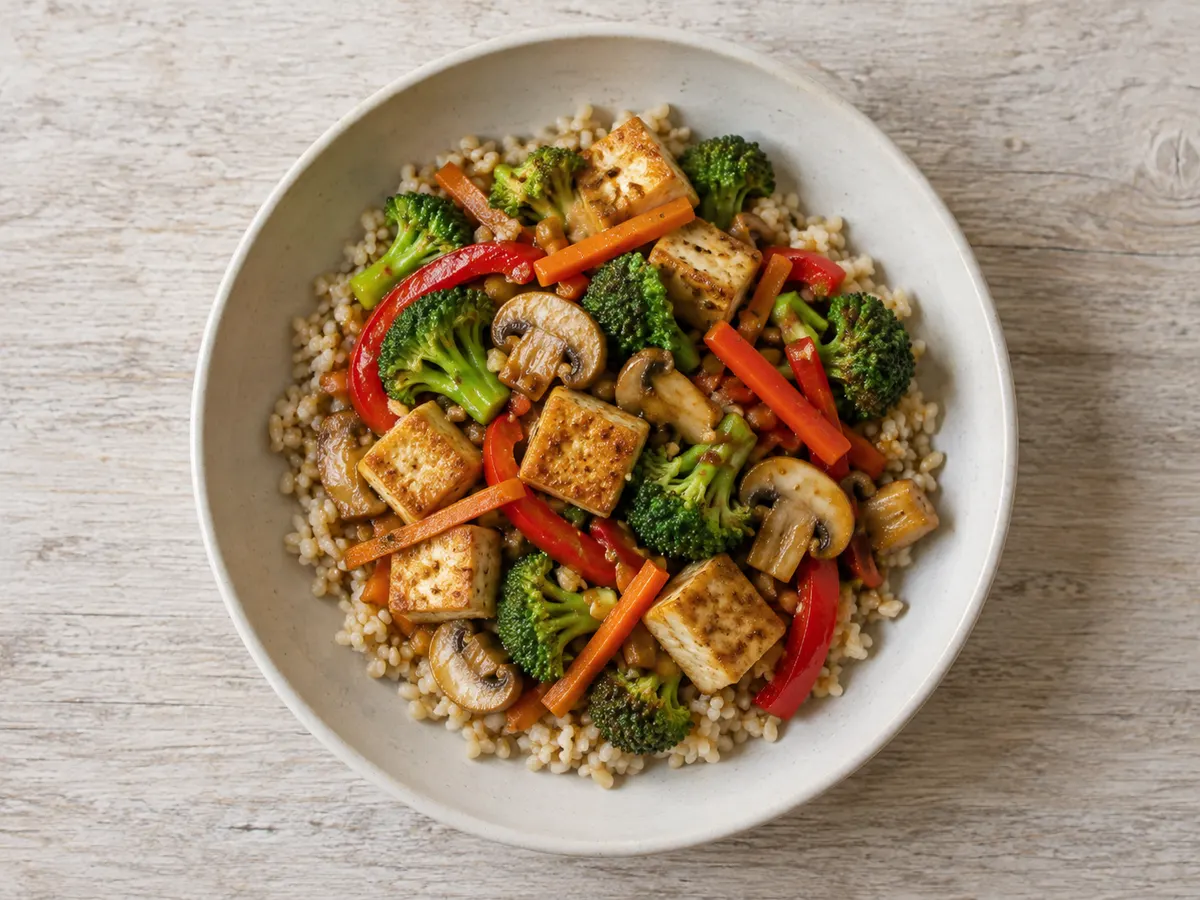 Stir-fried tofu with vegetables and brown rice18.6 g protein per serving
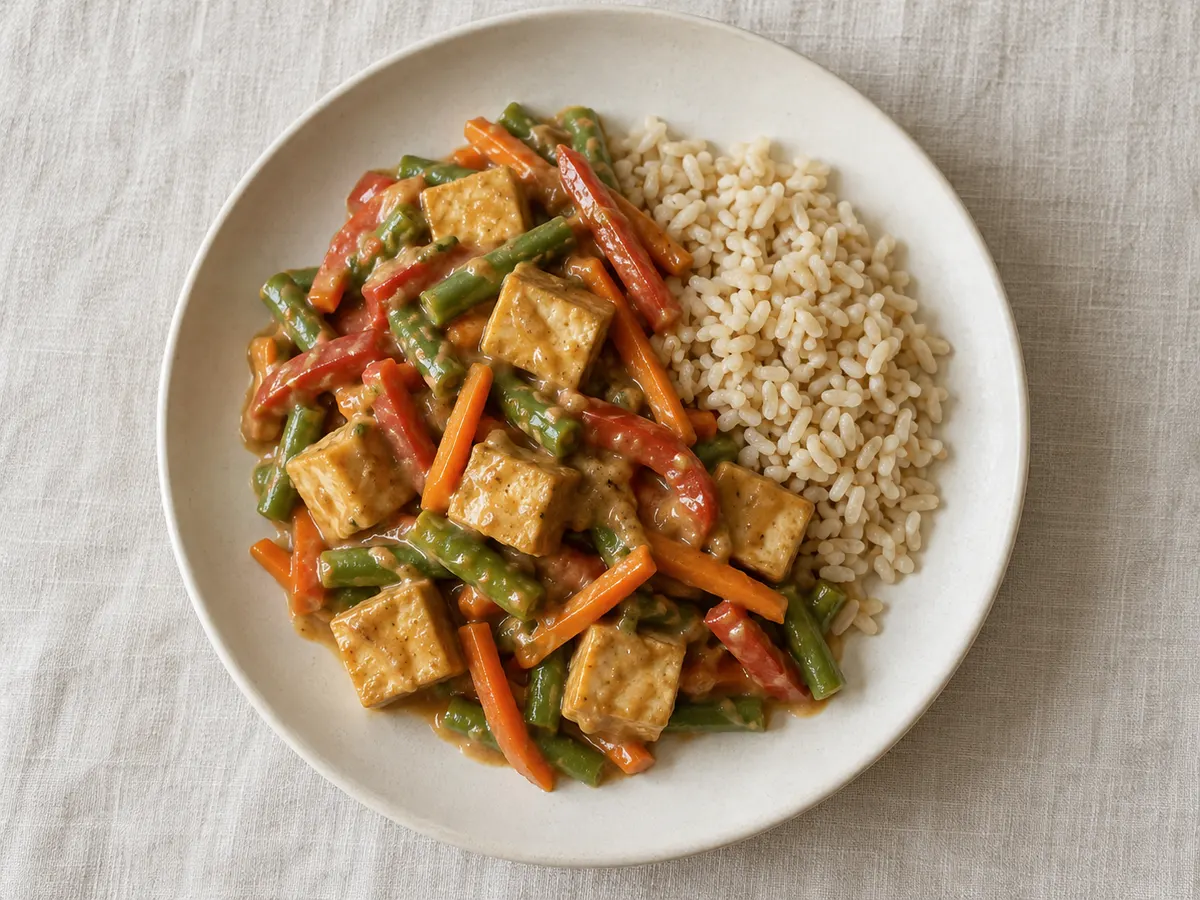 Tofu with peanut sauce and vegetables19 g protein per serving
Satiety
The 1 to 5 score is our own estimate: it starts at 1 point, adds points for low energy density, for protein and fiber per 100 kcal, and for the water in solid foods, and subtracts points for drinks with calories. It is useful for comparing foods with each other; it is not a measurement in people.
This food was measured in people: in the satiety index by Holt and colleagues (1995), which compared 240 kcal servings of 38 foods over two hours, it scored 132 versus 100 for white bread. In other words, it was more filling than the same calories of white bread. Source: Holt SH, Miller JC, Petocz P, Farmakalidis E. A satiety index of common foods. Eur J Clin Nutr. 1995;49(9):675-90.
Frequently asked questions about cooked brown rice
How much protein is in a 150 g (5.5 oz) serving of cooked brown rice?
100 g (3.5 oz) of cooked brown rice has 2.7 g of protein. A typical 150 g (5.5 oz) serving has about 4.1 g of protein. That is 2.2 g of protein per 100 kcal.
How many calories does a 150 g (5.5 oz) serving of cooked brown rice have?
100 g (3.5 oz) of cooked brown rice has 123 kcal. A typical 150 g (5.5 oz) serving has about 185 kcal. That is a low energy density.
Does cooked brown rice have fiber?
100 g (3.5 oz) of cooked brown rice has 1.6 g of fiber. A typical 150 g (5.5 oz) serving has about 2.4 g of fiber.
Is cooked brown rice filling?
Moderately: our estimated satiety score is 3 out of 5. It is based on: low energy density; high water content. It was also measured in people: in the Holt satiety index (1995), with 240 kcal servings, it scored 132 versus 100 for white bread.
What counts as a normal serving of cooked brown rice?
We use 150 g (5.5 oz) as a typical serving. That amount provides about 185 kcal, 4.1 g of protein, and 2.4 g of fiber. It is a reference for calculations, not a recommendation of how much to eat.
Compare with…
Similar foods
Sources
Sources for the data on this page, with the access date.
- Official databaseU.S. Department of Agriculture, Agricultural Research Service.USDA FoodData Central: Rice, brown, long-grain, cooked (Includes foods for USDA's Food Distribution Program) (FDC ID 169704).accessed .
- Clinical trialEuropean Journal of Clinical Nutrition.Holt SH, Miller JC, Petocz P, Farmakalidis E. A satiety index of common foods. Eur J Clin Nutr. 1995;49(9):675-90.accessed .
- Official databaseU.S. Department of Agriculture, Agricultural Research Service.USDA FoodData Central: Rice, white, long-grain, regular, enriched, cooked (FDC ID 168878).accessed .
- Clinical guidelineObesity (Wiley).Mozaffarian D, et al. Nutritional priorities to support GLP-1 therapy for obesity: A joint Advisory from the American College of Lifestyle Medicine, the American Society for Nutrition, the Obesity Medicine Association, and The Obesity Society. Obesity. 2025;33(8):1475-1503. doi:10.1002/oby.24336.accessed .
- Official databaseDiabetes Care (American Diabetes Association).Atkinson FS, Foster-Powell K, Brand-Miller JC. International tables of glycemic index and glycemic load values: 2008. Diabetes Care. 2008;31(12):2281-2283. doi:10.2337/dc08-1239.accessed .
- Clinical trialDiabetes Technology & Therapeutics.Mohan V, et al. Effect of brown rice, white rice, and brown rice with legumes on blood glucose and insulin responses in overweight Asian Indians: a randomized controlled trial. Diabetes Technol Ther. 2014;16(5):317-325. doi:10.1089/dia.2013.0259.accessed .
- Meta-analysisAmerican Journal of Clinical Nutrition.Pol K, et al. Whole grain and body weight changes in apparently healthy adults: a systematic review and meta-analysis of randomized controlled studies. Am J Clin Nutr. 2013;98(4):872-884. doi:10.3945/ajcn.113.064659.accessed .
- RegulatorOfficial Journal of the European Union (EUR-Lex).Regulation (EC) No 1924/2006 on nutrition and health claims made on foods (Annex).accessed .