Grains and bread
Cooked quinoa
A typical 150 g (5.5 oz, about 3/4 cup) serving of cooked quinoa has about 180 kcal and 4.2 g of fiber, from 120 kcal per 100 g.
Estimated satietyHow it is calculated
Estimated satiety: 4 out of 5
| Starting point | +1 |
|---|---|
| Low energy density | +1 |
| Moderate fiber per calorie | +1 |
| High water content | +1 |
Our own estimate from the values per 100 g: useful for comparing foods with each other, not a measurement in people. Holt index (1995): this food was not measured.
- Prepared by
- Alex Gonzalez
- Last updated
- Next review
- Sources
- 6 primary and 2 supporting
- Data
- USDA FDC 168917
No clinical review. No advertising from drug companies and no affiliate links.How we work
Nutrition facts
- Calories
- 180 kcal per serving
- 120 kcal per 100 g (3.5 oz)
- Protein
- 6.6 g per serving
- 4.4 g per 100 g (3.5 oz)
- Carbohydrates
- 32 g per serving
- 21.3 g per 100 g (3.5 oz)
- of which sugars
- 1.3 g per serving
- 0.9 g per 100 g (3.5 oz)
- Fiber
- 4.2 g per serving
- 2.8 g per 100 g (3.5 oz)
- Fat
- 2.9 g per serving
- 1.9 g per 100 g (3.5 oz)
- of which saturated
- 0.3 g per serving
- 0.2 g per 100 g (3.5 oz)
- Water
- 107.4 g per serving
- 71.6 g per 100 g (3.5 oz)
Source: USDA FoodData Central: Quinoa, cooked (FDC ID 168917), accessed September 23, 2026.
A typical 150 g (5.5 oz, about 3/4 cup) serving provides about 180 kcal, 6.6 g of protein, and 4.2 g of fiber.
What it is and how to eat it
Quinoa, often spelled quinua in Peru, Bolivia and Ecuador, is the seed of an Andean plant (Chenopodium quinoa) that is cooked like a grain, although botanically it is not one. It is sold as white, red or black grains, often prewashed to remove the saponins that make it taste bitter (if it is not, rinse it), and also as flakes, flour or puffed. This page covers cooked quinoa, with 120 kcal, 4.4 g of protein and 2.8 g of fiber per 100 g according to USDA.
A 150 g (5.3 oz) serving provides 180 kcal, 6.6 g of protein and 4.2 g of fiber: almost the same protein as one egg, so it works as a side and not as the protein part of the plate. The 2025 nutrition advisory on GLP-1 therapy suggests eating the protein part of a meal first, as in the pan-seared trout with quinoa and arugula, which has 100 g of quinoa per serving. The same advisory suggests avoiding very high-fiber foods in the first few days of treatment and, for constipation, increasing fiber gradually; in those days, and after each dose increase, half a serving may sit better.
What the evidence says
In 2013 the FAO recommended measuring protein quality with DIAAS, which accounts for how well each essential amino acid is digested, and proposed, as an example, treating scores of 75 to 99 as good and 100 or more as excellent. I have not found a DIAAS measured in people for cooked quinoa: in rats, the protein in raw quinoa had a true digestibility of 91.7%, and its essential amino acid content was higher than that of common cereals (Plant Foods for Human Nutrition, 1992), and a 2024 laboratory study, using an in-vitro digestion model rather than people, estimated a DIAAS of 81 to 97 for drinks made from whole quinoa or whole soybeans. Quality is not quantity: getting 20 g of protein would take about 455 g of cooked quinoa and 545 kcal. "Superfood" is not a recognized category in the EU, which only allows references to general health benefits when they come with a specific authorized claim (Article 10(3) of Regulation (EC) No 1924/2006), and the EU list of authorized claims has none for quinoa (Regulation (EU) No 432/2012).
Recipes with this food
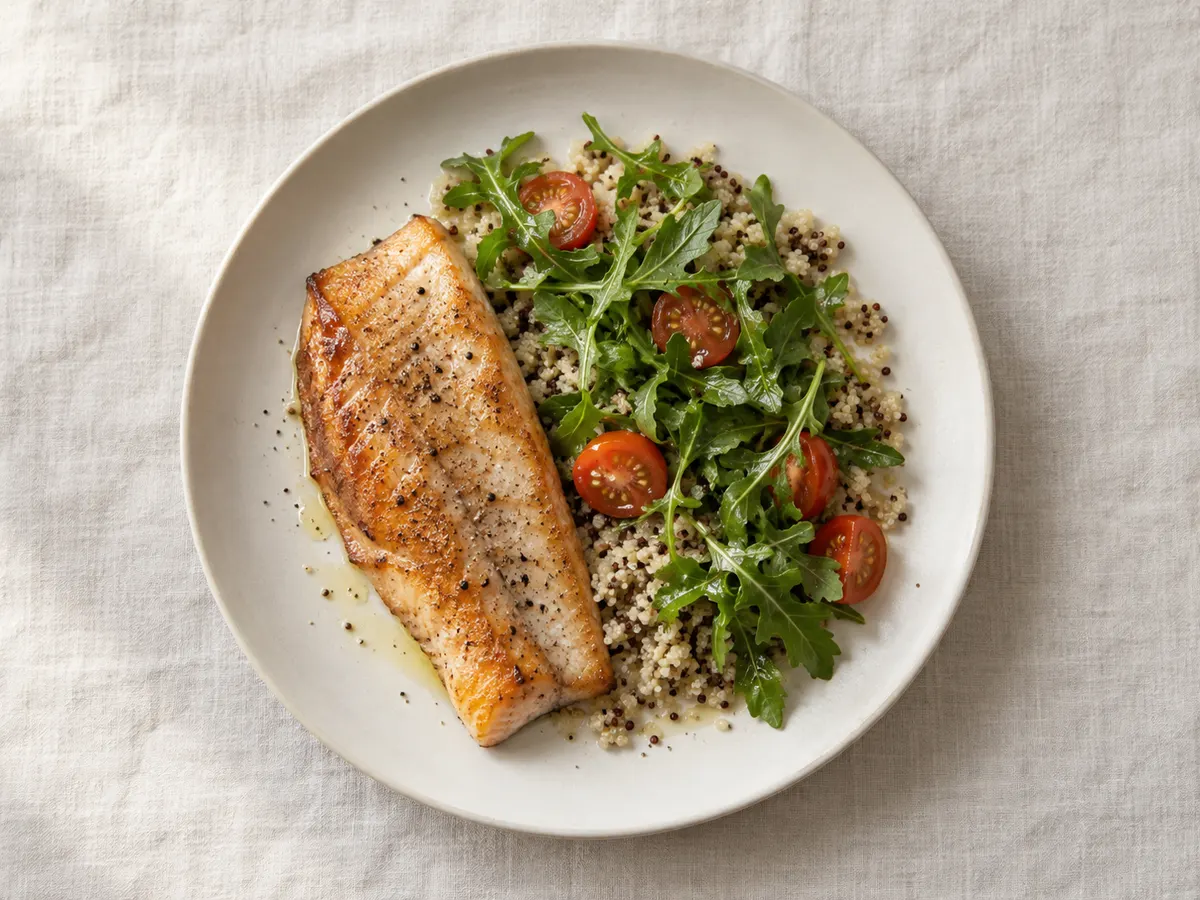 Pan-seared trout with quinoa and arugula33.7 g protein per serving
Satiety
The 1 to 5 score is our own estimate: it starts at 1 point, adds points for low energy density, for protein and fiber per 100 kcal, and for the water in solid foods, and subtracts points for drinks with calories. It is useful for comparing foods with each other; it is not a measurement in people.
Frequently asked questions about cooked quinoa
How much protein is in a 150 g (5.5 oz) serving of cooked quinoa?
100 g (3.5 oz) of cooked quinoa has 4.4 g of protein. A typical 150 g (5.5 oz) serving has about 6.6 g of protein. That is 3.7 g of protein per 100 kcal.
How many calories does a 150 g (5.5 oz) serving of cooked quinoa have?
100 g (3.5 oz) of cooked quinoa has 120 kcal. A typical 150 g (5.5 oz) serving has about 180 kcal. That is a low energy density.
Does cooked quinoa have fiber?
100 g (3.5 oz) of cooked quinoa has 2.8 g of fiber. A typical 150 g (5.5 oz) serving has about 4.2 g of fiber.
Is cooked quinoa filling?
Yes, fairly filling for the calories it provides: our estimated satiety score is 4 out of 5. It is based on: low energy density; moderate fiber per calorie; high water content. It is an estimate based on its composition, not a measurement in people.
What counts as a normal serving of cooked quinoa?
We use 150 g (5.5 oz) as a typical serving, about 3/4 cup. That amount provides about 180 kcal, 6.6 g of protein, and 4.2 g of fiber. It is a reference for calculations, not a recommendation of how much to eat.
Compare with…
Similar foods
Sources
Sources for the data on this page, with the access date.
- Official databaseU.S. Department of Agriculture, Agricultural Research Service.USDA FoodData Central: Quinoa, cooked (FDC ID 168917).accessed .
- Official databaseU.S. Department of Agriculture, Agricultural Research Service.USDA FoodData Central: Egg, whole, raw, fresh (FDC ID 171287).accessed .
- Clinical guidelineObesity (Wiley).Mozaffarian D, et al. Nutritional priorities to support GLP-1 therapy for obesity: A joint Advisory from the American College of Lifestyle Medicine, the American Society for Nutrition, the Obesity Medicine Association, and The Obesity Society. Obesity. 2025;33(8):1475-1503. doi:10.1002/oby.24336.accessed .
- InstitutionFood and Agriculture Organization of the United Nations (FAO).Dietary protein quality evaluation in human nutrition: report of an FAO Expert Consultation. FAO Food and Nutrition Paper 92. Rome: FAO; 2013.accessed .
- Other sourcePlant Foods for Human Nutrition (Springer).Ruales J, Nair BM. Nutritional quality of the protein in quinoa (Chenopodium quinoa, Willd) seeds. Plant Foods Hum Nutr. 1992;42(1):1-11. doi:10.1007/BF02196067.accessed .
- Other sourceFood Research International (Elsevier).Zhao J, Kong X, Zhang C, Hua Y, Chen Y, Li X. In vitro protein digestive properties and peptidomic characterization of five whole component plant protein beverages using a pepsin-pancreatin model. Food Res Int. 2024;196:115076. doi:10.1016/j.foodres.2024.115076.accessed .
- RegulatorOfficial Journal of the European Union (EUR-Lex).Regulation (EC) No 1924/2006 on nutrition and health claims made on foods (Article 10(3) and Annex).accessed .
- RegulatorOfficial Journal of the European Union (EUR-Lex).Commission Regulation (EU) No 432/2012 establishing a list of permitted health claims made on foods.accessed .