Ultra-processed foods and sweets
Dark chocolate
Dark chocolate packs 598 kcal into 100 g (3.5 oz), so a typical 20 g (0.7 oz) serving already adds up to about 120 kcal.
Estimated satietyHow it is calculated
Estimated satiety: 1 out of 5
| Starting point | +1 |
|---|---|
| Very high energy density: 598 kcal/100 g | −2 |
| Protein: 1.3 g/100 kcal | 0 |
| Fiber: 1.8 g/100 kcal | 0 |
| Solid food with 1.4 g of water, under 70 | 0 |
| Sum | −1 |
| Raised to the minimum of 1 | 1 |
Our own estimate from the values per 100 g: useful for comparing foods with each other, not a measurement in people. Holt index (1995): this food was not measured.
- Prepared by
- Alex Gonzalez
- Last updated
- Next review
- Sources
- 10 primary
- Data
- USDA FDC 170273
No clinical review. No advertising from drug companies and no affiliate links.How we work
Nutrition facts
- Calories
- 120 kcal per serving
- 598 kcal per 100 g (3.5 oz)
- Protein
- 1.6 g per serving
- 7.8 g per 100 g (3.5 oz)
- Carbohydrates
- 9.2 g per serving
- 45.9 g per 100 g (3.5 oz)
- of which sugars
- 4.8 g per serving
- 24 g per 100 g (3.5 oz)
- Fiber
- 2.2 g per serving
- 10.9 g per 100 g (3.5 oz)
- Fat
- 8.5 g per serving
- 42.6 g per 100 g (3.5 oz)
- of which saturated
- 4.9 g per serving
- 24.5 g per 100 g (3.5 oz)
- Water
- 0.3 g per serving
- 1.4 g per 100 g (3.5 oz)
Source: USDA FoodData Central: Chocolate, dark, 70-85% cacao solids (FDC ID 170273), accessed September 23, 2026.
A typical 20 g (0.7 oz) serving provides about 120 kcal, 1.6 g of protein, and 2.2 g of fiber.
What it is and how to eat it
Dark chocolate is made from cocoa mass, cocoa butter and sugar, usually without milk, and the percentage on the label shows how much of its weight comes from cocoa; it is called chocolate negro in Spain, amargo in Argentina, Uruguay and Chile, and amargo or oscuro in Mexico. In Spain it is sold mostly in bars divided into squares, and the drinking chocolate (chocolate de mesa) common in Mexico and Colombia usually contains more sugar and sometimes cinnamon, so it is not comparable. This page covers the 70-85% cacao dark chocolate analyzed by USDA, with 598 kcal, 42.6 g of fat, 24 g of sugars and 10.9 g of fiber per 100 g.
Two squares, about 20 g (0.7 oz), provide 120 kcal, 8.5 g of fat and 4.8 g of sugars, and barely 1.6 g of protein: a lot of energy in little volume, which fits better at the end of a meal that started with protein, as the 2025 nutrition advisory on GLP-1 therapy suggests. The same advisory suggests avoiding very fatty foods in the first few days of treatment, and the US National Institutes of Health list chocolate among the foods linked to reflux, a common side effect of these medications according to the Wegovy label. If you get heartburn, keep it to one square in those days and after a dose increase, or wait until food is well tolerated.
What the evidence says
The EU authorizes the claim "cocoa flavanols help maintain the elasticity of blood vessels, which contributes to normal blood flow", but only for cocoa beverages or dark chocolate, and since 2015 also capsules or tablets of cocoa extract, that provide at least 200 mg of cocoa flavanols a day, with that amount stated to the consumer (Regulations (EU) No 851/2013 and 2015/539, based on EFSA opinions from 2012 and 2014). According to EFSA, those 200 mg can be obtained from 10 g of a high-flavanol dark chocolate, so the claim does not apply to any dark chocolate, only to one that demonstrates that amount. Its 24 g of sugars per 100 g are added sugars, which WHO counts as free sugars and recommends keeping below 10% of daily energy, about 50 g on a 2,000 kcal diet. According to USDA it has 80 mg of caffeine per 100 g, about 16 mg per serving, far from the 200 mg per dose and 400 mg a day EFSA considers safe for healthy adults, or the 200 mg a day during pregnancy.
Recipes with this food
 Hot chocolate with ricotta and orange toast22.6 g protein per serving
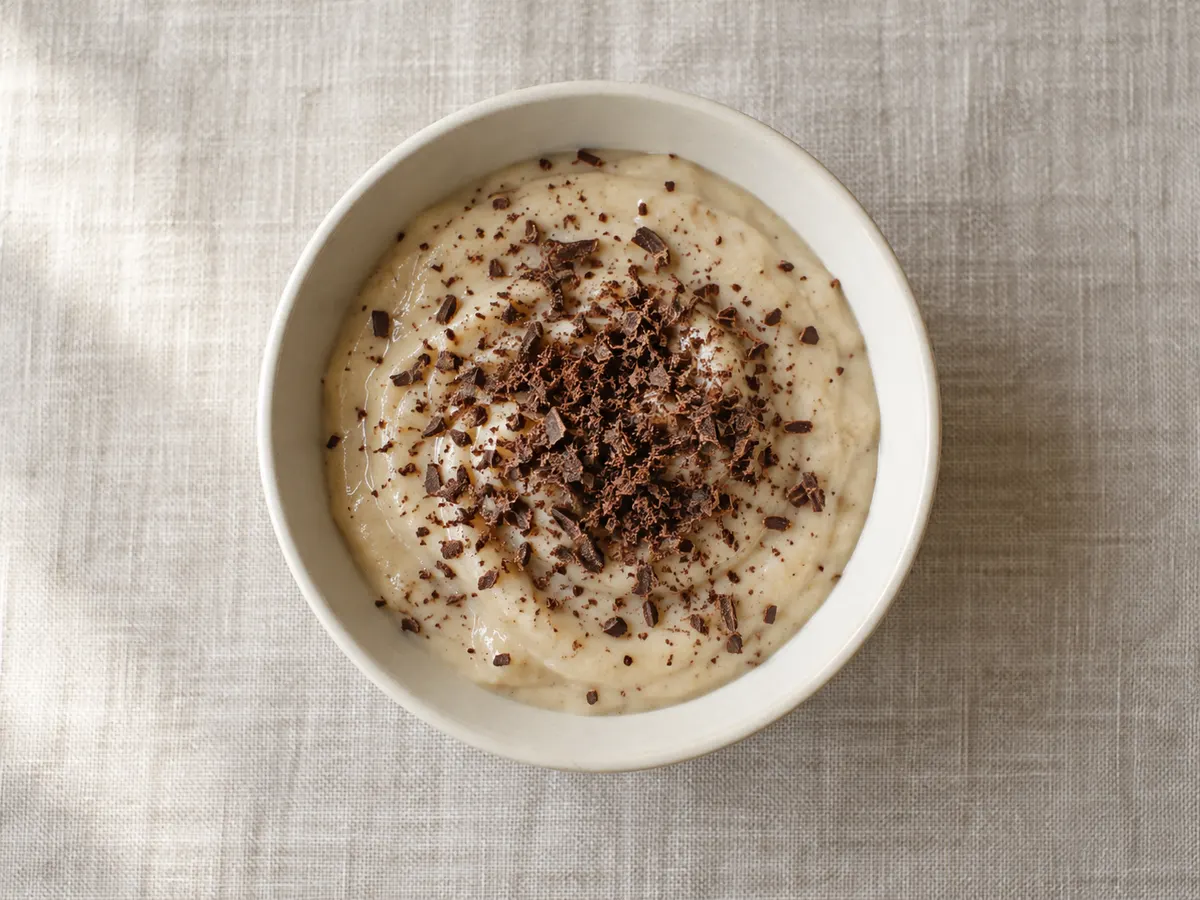 Tofu banana cream with grated dark chocolate13.4 g protein per serving
Satiety
The 1 to 5 score is our own estimate: it starts at 1 point, adds points for low energy density, for protein and fiber per 100 kcal, and for the water in solid foods, and subtracts points for drinks with calories. It is useful for comparing foods with each other; it is not a measurement in people.
What to keep in mind on a GLP-1 medication
Frequently asked questions about dark chocolate
How many grams of protein are in a 20 g (0.7 oz) serving of dark chocolate?
100 g (3.5 oz) of dark chocolate has 7.8 g of protein. A typical 20 g (0.7 oz) serving has about 1.6 g of protein. That is 1.3 g of protein per 100 kcal.
How many kcal are in a 20 g (0.7 oz) serving of dark chocolate?
100 g (3.5 oz) of dark chocolate has 598 kcal. A typical 20 g (0.7 oz) serving has about 120 kcal. That is a very high energy density.
How much fiber is in a 20 g (0.7 oz) serving of dark chocolate?
100 g (3.5 oz) of dark chocolate has 10.9 g of fiber. A typical 20 g (0.7 oz) serving has about 2.2 g of fiber. It carries our “High in fiber” tag.
Does dark chocolate keep you full?
Barely filling for the calories it provides: our estimated satiety score is 1 out of 5. Calculation: 1 (base) − 2 (very high energy density: 598 kcal/100 g) + 0 (protein: 1.3 g/100 kcal) + 0 (fiber: 1.8 g/100 kcal) + 0 (solid food with 1.4 g of water, under 70) = −1; raised to the minimum of 1. It is an estimate based on its composition, not a measurement in people.
How does dark chocolate fit into eating on Ozempic, Wegovy, Mounjaro, or Zepbound?
Based on our tags, this is what matters about dark chocolate on a GLP-1 medication. “High in fiber”: a good amount of fiber, which helps keep you regular; it is easier to tolerate when you increase it gradually and drink enough water. “High energy density”: a lot of energy in a small volume; when your appetite is very low, a small serving can help you meet your needs. These are general guidelines, not medical advice: everyone tolerates foods differently.
What is a typical serving of dark chocolate?
We use 20 g (0.7 oz) as a typical serving. That amount provides about 120 kcal, 1.6 g of protein, and 2.2 g of fiber. It is a reference for calculations, not a recommendation of how much to eat.
Compare with…
Similar foods
Sources
Sources for the data on this page, with the access date.
- Official databaseU.S. Department of Agriculture, Agricultural Research Service.USDA FoodData Central: Chocolate, dark, 70-85% cacao solids (FDC ID 170273).accessed .
- Clinical guidelineObesity (Wiley).Mozaffarian D, et al. Nutritional priorities to support GLP-1 therapy for obesity: A joint Advisory from the American College of Lifestyle Medicine, the American Society for Nutrition, the Obesity Medicine Association, and The Obesity Society. Obesity. 2025;33(8):1475-1503. doi:10.1002/oby.24336.accessed .
- InstitutionNational Institute of Diabetes and Digestive and Kidney Diseases (NIH).Eating, Diet, & Nutrition for GER & GERD.accessed .
- Drug labelEuropean Medicines Agency.Wegovy (semaglutide): EU Summary of Product Characteristics, section 4.8 (undesirable effects), current version.accessed .
- RegulatorOfficial Journal of the European Union (EUR-Lex).Commission Regulation (EU) No 851/2013 authorising certain health claims made on foods (cocoa flavanols).accessed .
- RegulatorOfficial Journal of the European Union (EUR-Lex).Commission Regulation (EU) 2015/539 authorising a health claim made on foods (cocoa flavanols).accessed .
- RegulatorEFSA Journal.EFSA NDA Panel. Scientific Opinion on the substantiation of a health claim related to cocoa flavanols and maintenance of normal endothelium-dependent vasodilation pursuant to Article 13(5) of Regulation (EC) No 1924/2006. EFSA Journal. 2012;10(7):2809. doi:10.2903/j.efsa.2012.2809.accessed .
- RegulatorEFSA Journal.EFSA NDA Panel. Scientific Opinion on the modification of the authorisation of a health claim related to cocoa flavanols and maintenance of normal endothelium-dependent vasodilation. EFSA Journal. 2014;12(5):3654. doi:10.2903/j.efsa.2014.3654.accessed .
- InstitutionWorld Health Organization.Healthy diet (fact sheet, section on free sugars).accessed .
- RegulatorEFSA Journal.EFSA NDA Panel. Scientific Opinion on the safety of caffeine. EFSA Journal. 2015;13(5):4102. doi:10.2903/j.efsa.2015.4102.accessed .