Beans and legumes
Edamame
Per 100 g (3.5 oz), edamame combines 5.2 g of fiber and 11.9 g of protein with 121 kcal, a low energy density.
Estimated satietyHow it is calculated
Estimated satiety: 5 out of 5
| Starting point | +1 |
|---|---|
| Low energy density: 121 kcal/100 g | +1 |
| Protein: 9.8 g/100 kcal | +2 |
| Fiber: 4.3 g/100 kcal | +2 |
| Solid food with 72.8 g of water | +1 |
| Sum | 7 |
| Capped at 5 | 5 |
Our own estimate from the values per 100 g: useful for comparing foods with each other, not a measurement in people. Holt index (1995): this food was not measured.
- Prepared by
- Alex Gonzalez
- Last updated
- Next review
- Sources
- 7 primary
- Data
- USDA FDC 168411
No clinical review. No advertising from drug companies and no affiliate links.How we work
Nutrition facts
- Calories
- 91 kcal per serving
- 121 kcal per 100 g (3.5 oz)
- Protein
- 8.9 g per serving
- 11.9 g per 100 g (3.5 oz)
- Carbohydrates
- 6.7 g per serving
- 8.9 g per 100 g (3.5 oz)
- of which sugars
- 1.6 g per serving
- 2.2 g per 100 g (3.5 oz)
- Fiber
- 3.9 g per serving
- 5.2 g per 100 g (3.5 oz)
- Fat
- 3.9 g per serving
- 5.2 g per 100 g (3.5 oz)
- of which saturated
- 0.5 g per serving
- 0.6 g per 100 g (3.5 oz)
- Water
- 54.6 g per serving
- 72.8 g per 100 g (3.5 oz)
Source: USDA FoodData Central: Edamame, frozen, prepared (FDC ID 168411), accessed September 23, 2026.
A typical 75 g (2.5 oz) serving provides about 91 kcal, 8.9 g of protein, and 3.9 g of fiber.
What it is and how to eat it
Edamame is soybeans harvested green, before the beans mature, and the name comes from Japanese. It is sold mostly frozen, in the pod or shelled, and cooked for a few minutes; the pods are not eaten but squeezed to pop out the beans. This page covers frozen edamame, cooked, according to USDA, with 121 kcal, 11.9 g of protein and 5.2 g of fiber per 100 g.
A 75 g (2.6 oz) serving provides 8.9 g of protein, 3.9 g of fiber and 91 kcal, and because it is eaten with your fingers, cold or warm, it makes a snack with protein, as in the edamame with lime and sesame. The 2025 nutrition advisory on GLP-1 therapy includes legumes among the proteins to encourage but suggests avoiding high-fiber foods in the first few days of treatment, and gas and bloating are common side effects of these medications according to the Wegovy label. So in those days and after a dose increase, half a serving, well cooked, may be enough.
What the evidence says
Protein provides 39% of its energy, almost twice the 20% the EU requires for a "high protein" claim, and with 4.3 g of fiber per 100 kcal it meets the "high fibre" threshold by the calorie route, 3 g per 100 kcal, though not by the weight route, which requires 6 g per 100 g against 5.2 g here (Regulation (EC) No 1924/2006). Soy isoflavones have no authorized health claim in the EU: in 2012 EFSA concluded that it had not been shown that they help maintain bone density or reduce menopausal hot flashes. On safety, EFSA reviewed food supplements with isolated isoflavones in 2015 and found no evidence of harmful effects on the breast, uterus or thyroid in post-menopausal women at the doses and durations studied. That assessment covered supplements, not foods such as edamame, and lacked enough data to assess women in the transition to menopause or those with a personal or family history of cancer.
Recipes with this food
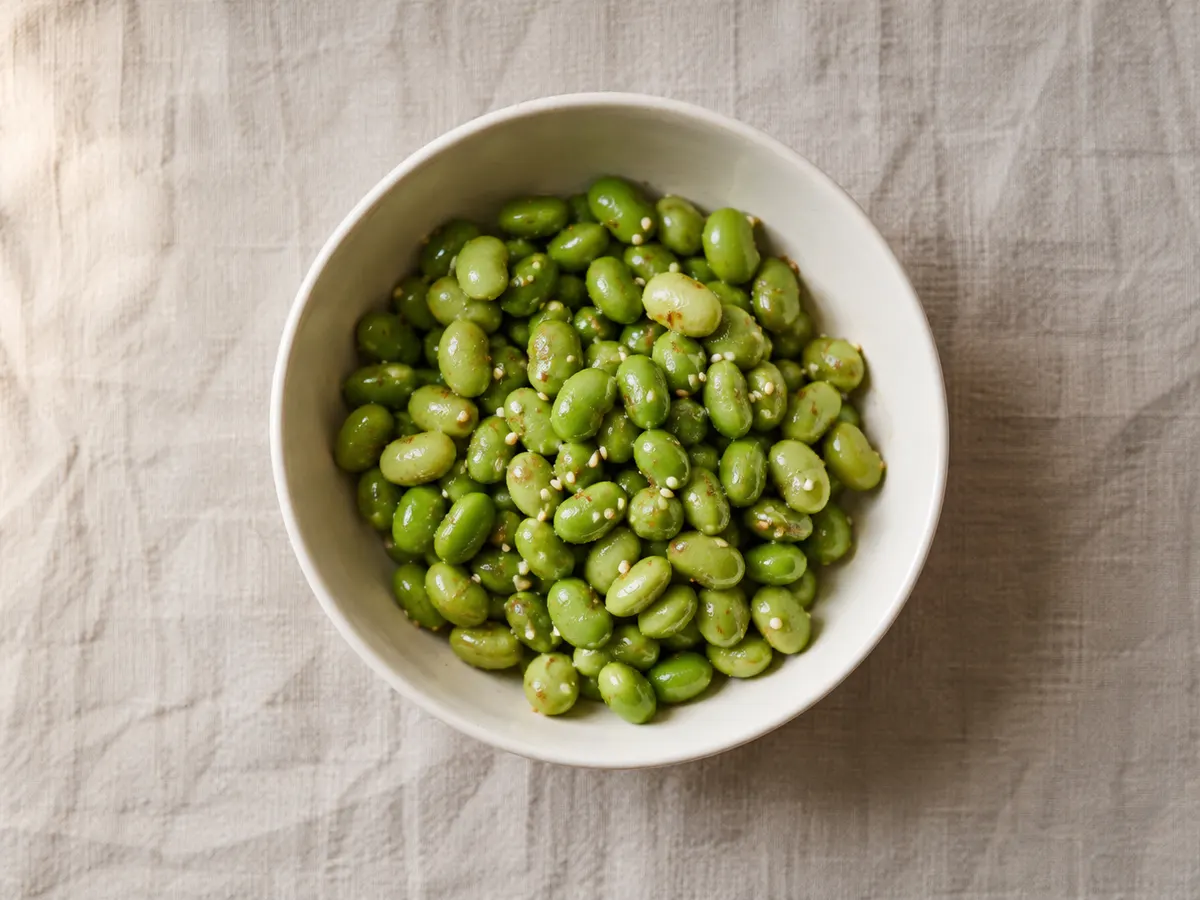 Edamame with lime and sesame12.4 g protein per serving
Satiety
The 1 to 5 score is our own estimate: it starts at 1 point, adds points for low energy density, for protein and fiber per 100 kcal, and for the water in solid foods, and subtracts points for drinks with calories. It is useful for comparing foods with each other; it is not a measurement in people.
What to keep in mind on a GLP-1 medication
Frequently asked questions about edamame
How much protein does a 75 g (2.5 oz) serving of edamame have?
100 g (3.5 oz) of edamame has 11.9 g of protein. A typical 75 g (2.5 oz) serving has about 8.9 g of protein. That is 9.8 g of protein per 100 kcal, which is why it carries our “High in protein” tag.
How many calories are in a 75 g (2.5 oz) serving of edamame?
100 g (3.5 oz) of edamame has 121 kcal. A typical 75 g (2.5 oz) serving has about 91 kcal. That is a low energy density.
How many grams of fiber are in a 75 g (2.5 oz) serving of edamame?
100 g (3.5 oz) of edamame has 5.2 g of fiber. A typical 75 g (2.5 oz) serving has about 3.9 g of fiber. It carries our “High in fiber” tag.
How filling is edamame?
Very filling for the calories it provides: our estimated satiety score is 5 out of 5. Calculation: 1 (base) + 1 (low energy density: 121 kcal/100 g) + 2 (protein: 9.8 g/100 kcal) + 2 (fiber: 4.3 g/100 kcal) + 1 (solid food with 72.8 g of water) = 7; capped at 5. It is an estimate based on its composition, not a measurement in people.
Is edamame a good choice on a GLP-1 medication?
Based on our tags, this is what matters about edamame on a GLP-1 medication. “High in protein”: plenty of protein per calorie; protein helps preserve muscle mass when you eat less. “High in fiber”: a good amount of fiber, which helps keep you regular; it is easier to tolerate when you increase it gradually and drink enough water. “May cause bloating”: it can cause gas or bloating in some people, and on a GLP-1 medication that feeling can be more noticeable. These are general guidelines, not medical advice: everyone tolerates foods differently.
How many grams or ounces are in a serving of edamame?
We use 75 g (2.5 oz) as a typical serving. That amount provides about 91 kcal, 8.9 g of protein, and 3.9 g of fiber. It is a reference for calculations, not a recommendation of how much to eat.
Compare with…
Similar foods
Sources
Sources for the data on this page, with the access date.
- Official databaseU.S. Department of Agriculture, Agricultural Research Service.USDA FoodData Central: Edamame, frozen, prepared (FDC ID 168411).accessed .
- Clinical guidelineObesity (Wiley).Mozaffarian D, et al. Nutritional priorities to support GLP-1 therapy for obesity: A joint Advisory from the American College of Lifestyle Medicine, the American Society for Nutrition, the Obesity Medicine Association, and The Obesity Society. Obesity. 2025;33(8):1475-1503. doi:10.1002/oby.24336.accessed .
- Drug labelEuropean Medicines Agency.Wegovy (semaglutide): EU Summary of Product Characteristics, section 4.8 (undesirable effects), current version.accessed .
- RegulatorOfficial Journal of the European Union (EUR-Lex).Regulation (EC) No 1924/2006 on nutrition and health claims made on foods (Annex).accessed .
- RegulatorEFSA Journal.EFSA NDA Panel. Scientific Opinion on the substantiation of health claims related to soy isoflavones and maintenance of bone mineral density (ID 1655) and reduction of vasomotor symptoms associated with menopause (ID 1654, 1704, 2140, 3093, 3154, 3590) (further assessment) pursuant to Article 13(1) of Regulation (EC) No 1924/2006. EFSA Journal. 2012;10(8):2847. doi:10.2903/j.efsa.2012.2847.accessed .
- RegulatorEFSA Journal.EFSA ANS Panel. Risk assessment for peri- and post-menopausal women taking food supplements containing isolated isoflavones. EFSA Journal. 2015;13(10):4246. doi:10.2903/j.efsa.2015.4246.accessed .
- RegulatorEuropean Food Safety Authority.Isoflavones in food supplements for post-menopausal women: no evidence of harm (21 October 2015).accessed .