Grains and bread
Cooked sweet corn
A typical 100 g (3.5 oz) serving of cooked sweet corn has about 96 kcal and 2.4 g of fiber, from 96 kcal per 100 g.
Estimated satietyHow it is calculated
Estimated satiety: 4 out of 5
| Starting point | +1 |
|---|---|
| Low energy density | +1 |
| Moderate fiber per calorie | +1 |
| High water content | +1 |
Our own estimate from the values per 100 g: useful for comparing foods with each other, not a measurement in people. Holt index (1995): this food was not measured.
- Prepared by
- Alex Gonzalez
- Last updated
- Next review
- Sources
- 12 primary
- Data
- USDA FDC 169999
No clinical review. No advertising from drug companies and no affiliate links.How we work
Nutrition facts
- Calories
- 96 kcal per serving
- 96 kcal per 100 g (3.5 oz)
- Protein
- 3.4 g per serving
- 3.4 g per 100 g (3.5 oz)
- Carbohydrates
- 21 g per serving
- 21 g per 100 g (3.5 oz)
- of which sugars
- 4.5 g per serving
- 4.5 g per 100 g (3.5 oz)
- Fiber
- 2.4 g per serving
- 2.4 g per 100 g (3.5 oz)
- Fat
- 1.5 g per serving
- 1.5 g per 100 g (3.5 oz)
- of which saturated
- 0.2 g per serving
- 0.2 g per 100 g (3.5 oz)
- Water
- 73.4 g per serving
- 73.4 g per 100 g (3.5 oz)
Source: USDA FoodData Central: Corn, sweet, yellow, cooked, boiled, drained, without salt (FDC ID 169999), accessed September 23, 2026.
A typical 100 g (3.5 oz) serving provides about 96 kcal, 3.4 g of protein, and 2.4 g of fiber.
What it is and how to eat it
The FAO lists sweet corn, together with popcorn maize, among the varieties grown mainly for food, and explains that kernels carrying sugary genes, which produce relatively high amounts of water-soluble polysaccharides, are sweet and widely used for canning; it adds that immature ordinary corn on the cob is also widely eaten, boiled or roasted. The Dictionary of the Spanish Language calls the tender ear elote in Mexico and other Central American countries and choclo in Argentina, Bolivia, Chile, Colombia, Ecuador, Paraguay and Peru, and the Diccionario de americanismos records jojoto in eastern Colombia and Venezuela. This page covers boiled yellow sweet corn according to USDA, with 96 kcal, 3.41 g of protein, 2.4 g of fiber and 4.54 g of sugars per 100 g.
A medium ear, which USDA puts at 103 g (3.6 oz), provides 99 kcal, 3.5 g of protein and 2.5 g of fiber, so it is a starchy side with a little more protein than others, but it does not replace the protein part of the plate. The 2025 nutrition advisory on GLP-1 therapy suggests eating protein first, like the tuna and egg in the tuna salad with egg and corn, which has 30 g of corn per serving, and suggests avoiding fatty or high-fiber foods in the first days of treatment. In those days a spoonful of well-cooked kernels in a soup may sit better than a whole buttered ear, and it helps to chew slowly.
What the evidence says
The FAO explains that in 16-day-old kernels sugars reach 9.4% of dry weight and then fall as the kernel matures and builds starch, and suggests that this sweetness is possibly why immature ordinary corn, and even more so sweet corn, is so well liked. The same source describes the kernel's outer layer, the pericarp, as 87% crude fiber, mostly hemicellulose and cellulose. With 2.4 g of fiber per 100 g it falls short of the 3 g for a "source of fibre" claim, but its 2.5 g per 100 kcal meet the EU's other criterion, 1.5 g per 100 kcal (Regulation (EC) No 1924/2006). The NIDDK, part of the U.S. National Institutes of Health, notes that some people have more gas when they consume too much fiber, and the Wegovy (semaglutide) SmPC lists flatulence and abdominal distension among its common adverse reactions.
Recipes with this food
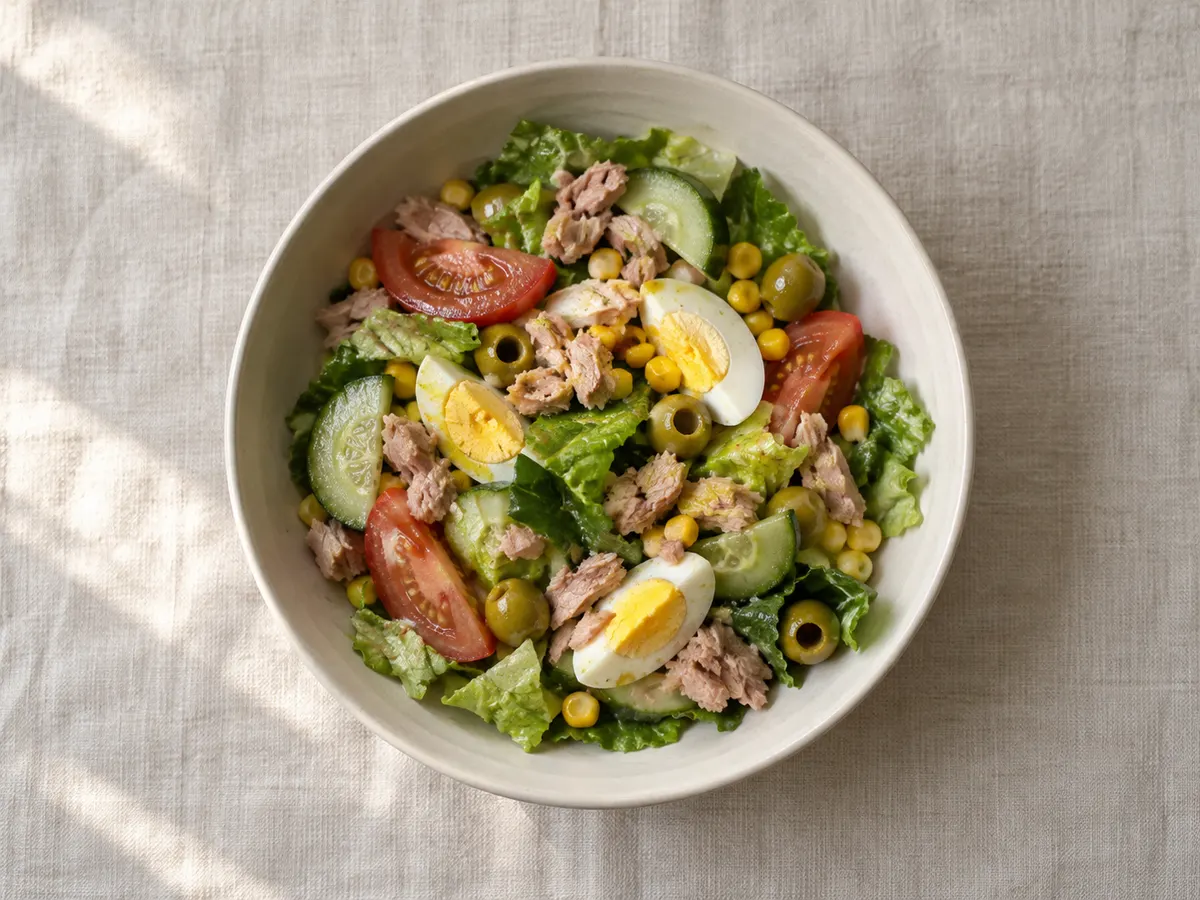 Tuna salad with egg and corn30.4 g protein per serving
Satiety
The 1 to 5 score is our own estimate: it starts at 1 point, adds points for low energy density, for protein and fiber per 100 kcal, and for the water in solid foods, and subtracts points for drinks with calories. It is useful for comparing foods with each other; it is not a measurement in people.
What to keep in mind on a GLP-1 medication
Frequently asked questions about cooked sweet corn
How much protein is in a 100 g (3.5 oz) serving of cooked sweet corn?
100 g (3.5 oz) of cooked sweet corn has 3.4 g of protein. A typical 100 g (3.5 oz) serving has about 3.4 g of protein. That is 3.6 g of protein per 100 kcal.
How many calories does a 100 g (3.5 oz) serving of cooked sweet corn have?
100 g (3.5 oz) of cooked sweet corn has 96 kcal. A typical 100 g (3.5 oz) serving has about 96 kcal. That is a low energy density.
Does cooked sweet corn have fiber?
100 g (3.5 oz) of cooked sweet corn has 2.4 g of fiber. A typical 100 g (3.5 oz) serving has about 2.4 g of fiber.
Is cooked sweet corn filling?
Yes, fairly filling for the calories it provides: our estimated satiety score is 4 out of 5. It is based on: low energy density; moderate fiber per calorie; high water content. It is an estimate based on its composition, not a measurement in people.
What should I know about cooked sweet corn on a GLP-1 medication?
Based on our tags, this is what matters about cooked sweet corn on a GLP-1 medication. “Low energy density”: plenty of volume for few calories; make sure it does not push protein foods off your plate. These are general guidelines, not medical advice: everyone tolerates foods differently.
What counts as a normal serving of cooked sweet corn?
We use 100 g (3.5 oz) as a typical serving. That amount provides about 96 kcal, 3.4 g of protein, and 2.4 g of fiber. It is a reference for calculations, not a recommendation of how much to eat.
Similar foods
Sources
Sources for the data on this page, with the access date.
- Official databaseU.S. Department of Agriculture, Agricultural Research Service.USDA FoodData Central: Corn, sweet, yellow, cooked, boiled, drained, without salt (FDC ID 169999).accessed .
- InstitutionFood and Agriculture Organization of the United Nations (FAO).Maize in human nutrition (FAO, 1992), introduction (types of maize).accessed .
- InstitutionFood and Agriculture Organization of the United Nations (FAO).Maize in human nutrition (FAO, 1992), chapter 2: chemical composition and nutritional value of maize (part I, structure of the kernel).accessed .
- InstitutionFood and Agriculture Organization of the United Nations (FAO).Maize in human nutrition (FAO, 1992), chapter 2: chemical composition and nutritional value of maize.accessed .
- InstitutionFood and Agriculture Organization of the United Nations (FAO).Maize in human nutrition (FAO, 1992), chapter 7: approaches to improving the nutritive value of maize (sugary genes).accessed .
- InstitutionRoyal Spanish Academy and Association of Academies of the Spanish Language (RAE-ASALE).Diccionario de la lengua española (Dictionary of the Spanish Language, 23rd ed., online version): "elote" (in Spanish).accessed .
- InstitutionRoyal Spanish Academy and Association of Academies of the Spanish Language (RAE-ASALE).Diccionario de la lengua española (Dictionary of the Spanish Language, 23rd ed., online version): "choclo²" (in Spanish).accessed .
- InstitutionAssociation of Academies of the Spanish Language (ASALE).Diccionario de americanismos (Dictionary of Americanisms): "jojoto" (in Spanish).accessed .
- Clinical guidelineObesity (Wiley).Mozaffarian D, et al. Nutritional priorities to support GLP-1 therapy for obesity: A joint Advisory from the American College of Lifestyle Medicine, the American Society for Nutrition, the Obesity Medicine Association, and The Obesity Society. Obesity. 2025;33(8):1475-1503. doi:10.1002/oby.24336.accessed .
- RegulatorOfficial Journal of the European Union (EUR-Lex).Regulation (EC) No 1924/2006 on nutrition and health claims made on foods (Annex).accessed .
- InstitutionNational Institute of Diabetes and Digestive and Kidney Diseases (NIH).Eating, Diet, & Nutrition for Gas in the Digestive Tract.accessed .
- Drug labelEuropean Medicines Agency.Wegovy (semaglutide): EU Summary of Product Characteristics, section 4.8 (undesirable effects), current version.accessed .