Grains and bread
Hominy
A typical 150 g (5.5 oz, about 1 cup) serving of hominy has about 108 kcal and 3.8 g of fiber, from 72 kcal per 100 g.
Estimated satietyHow it is calculated
Estimated satiety: 5 out of 5
| Starting point | +1 |
|---|---|
| Very low energy density: 72 kcal/100 g | +2 |
| Protein: 2.1 g/100 kcal | 0 |
| Fiber: 3.5 g/100 kcal | +1 |
| Solid food with 82.5 g of water | +1 |
Our own estimate from the values per 100 g: useful for comparing foods with each other, not a measurement in people. Holt index (1995): this food was not measured.
- Prepared by
- Alex Gonzalez
- Last updated
- Next review
- Sources
- 10 primary and 1 supporting
- Data
- USDA FDC 169701
No clinical review. No advertising from drug companies and no affiliate links.How we work
Nutrition facts
- Calories
- 108 kcal per serving
- 72 kcal per 100 g (3.5 oz)
- Protein
- 2.2 g per serving
- 1.5 g per 100 g (3.5 oz)
- Carbohydrates
- 21.5 g per serving
- 14.3 g per 100 g (3.5 oz)
- of which sugars
- 2.3 g per serving
- 1.5 g per 100 g (3.5 oz)
- Fiber
- 3.8 g per serving
- 2.5 g per 100 g (3.5 oz)
- Fat
- 1.3 g per serving
- 0.9 g per 100 g (3.5 oz)
- of which saturated
- 0.2 g per serving
- 0.1 g per 100 g (3.5 oz)
- Water
- 123.8 g per serving
- 82.5 g per 100 g (3.5 oz)
Source: USDA FoodData Central: Hominy, canned, white (FDC ID 169701), accessed September 23, 2026.
A typical 150 g (5.5 oz, about 1 cup) serving provides about 108 kcal, 2.2 g of protein, and 3.8 g of fiber.
What it is and how to eat it
Maíz pozolero (hominy) is the corn in pozole, which the Dictionary of Americanisms defines in Mexico as a brothy stew of cacahuacintle corn, a highland variety with rounder, whiter and softer kernels than common corn; according to a 2013 study in Revista Fitotecnia Mexicana, for pozole the corn is nixtamalized, that is, cooked with lime (calcium hydroxide), and then boiled until the kernel opens like a flower. The same dictionary calls mote, in Colombia, Ecuador, Peru and Bolivia, shelled and cooked corn, with or without the hull, used as food. This page is for USDA's canned white hominy, with 72 kcal, 1.48 g of protein, 2.5 g of fiber and 82.5 g of water per 100 g.
A 150 g (5.3 oz) serving, close to the 165 g cup USDA uses to measure it, provides 108 kcal, 2.2 g of protein and 3.8 g of fiber, so it fills by volume but provides almost no protein. The 2025 nutrition advisory on GLP-1 therapy suggests eating protein-rich foods first, so it works best in broth with chicken or lean meat, as in pozole, starting with the meat. In the first few days of treatment, when the same advisory suggests avoiding very high-fiber foods, a few spoonfuls in the broth may be enough.
What the evidence says
FAO explains that the niacin in corn is bound and the body cannot use it, that pellagra, the disease caused by niacin deficiency, has been common in populations that eat a lot of corn, and that lime treatment has been reported to destroy the pellagra-promoting effect of corn; UNESCO describes nixtamalization as a process that increases the nutritional value of corn. FAO also notes that cooking corn with lime increases the calcium in tortillas by up to 400%, but this USDA canned hominy has only 10 mg of calcium per 100 g. Because it is so low in calories, its 2.5 g of fiber per 100 g come to 3.5 g per 100 kcal, above the 3 g per 100 kcal for "high fibre" (Regulation (EC) No 1924/2006). It has 267 mg of sodium per 100 g according to USDA, about 400 mg per serving, a fifth of the 2,000 mg a day the WHO recommends not exceeding.
Recipes with this food
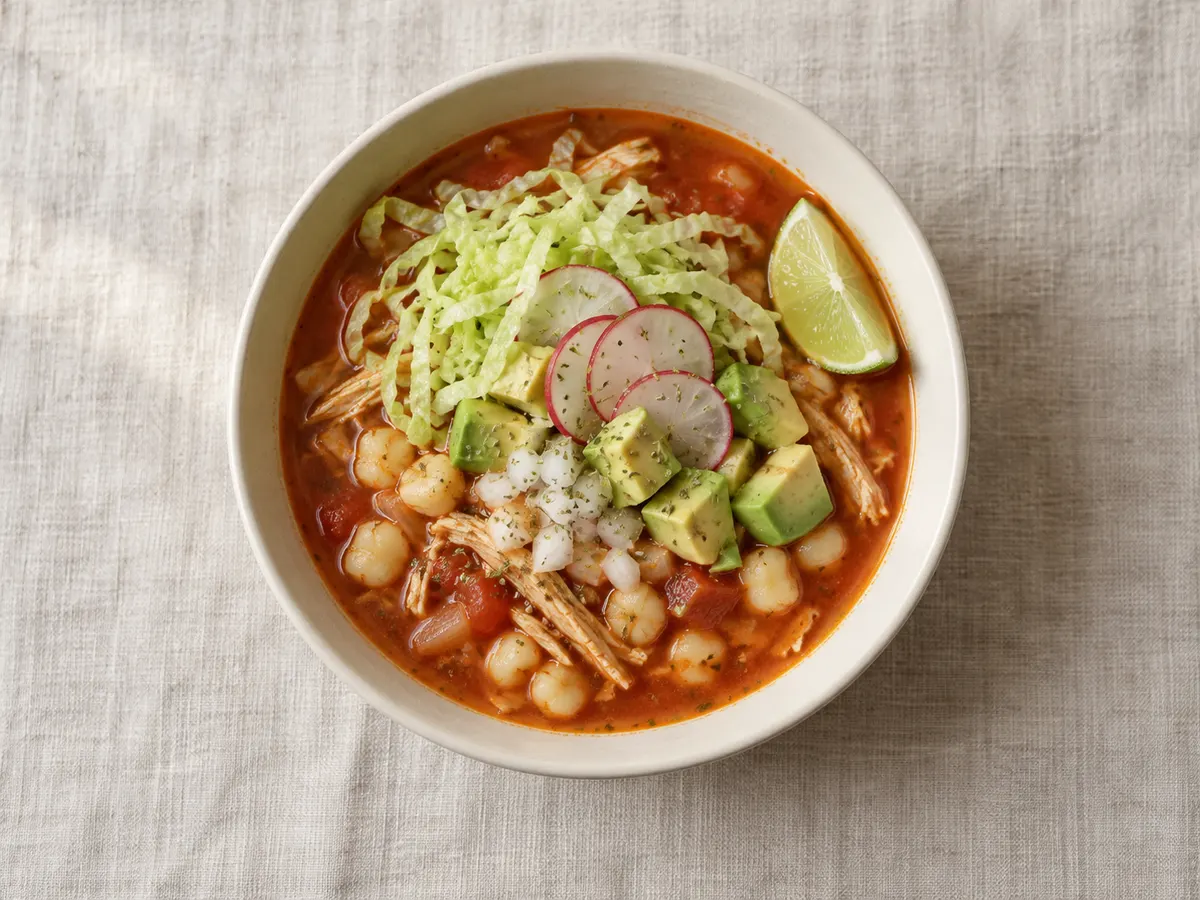 Light red pozole with chicken31.6 g protein per serving
Satiety
The 1 to 5 score is our own estimate: it starts at 1 point, adds points for low energy density, for protein and fiber per 100 kcal, and for the water in solid foods, and subtracts points for drinks with calories. It is useful for comparing foods with each other; it is not a measurement in people.
What to keep in mind on a GLP-1 medication
Frequently asked questions about hominy
How much protein is in a 150 g (5.5 oz) serving of hominy?
100 g (3.5 oz) of hominy has 1.5 g of protein. A typical 150 g (5.5 oz) serving has about 2.2 g of protein. That is 2.1 g of protein per 100 kcal.
How many calories does a 150 g (5.5 oz) serving of hominy have?
100 g (3.5 oz) of hominy has 72 kcal. A typical 150 g (5.5 oz) serving has about 108 kcal. That is a very low energy density.
Does hominy have fiber?
100 g (3.5 oz) of hominy has 2.5 g of fiber. A typical 150 g (5.5 oz) serving has about 3.8 g of fiber.
Is hominy filling?
Yes, very filling for the calories it provides: our estimated satiety score is 5 out of 5. Calculation: 1 (base) + 2 (very low energy density: 72 kcal/100 g) + 0 (protein: 2.1 g/100 kcal) + 1 (fiber: 3.5 g/100 kcal) + 1 (solid food with 82.5 g of water) = 5. It is an estimate based on its composition, not a measurement in people.
What should I know about hominy on a GLP-1 medication?
Based on our tags, this is what matters about hominy on a GLP-1 medication. “Low energy density”: plenty of volume for few calories; make sure it does not push protein foods off your plate. These are general guidelines, not medical advice: everyone tolerates foods differently.
What counts as a normal serving of hominy?
We use 150 g (5.5 oz) as a typical serving, about 1 cup. That amount provides about 108 kcal, 2.2 g of protein, and 3.8 g of fiber. It is a reference for calculations, not a recommendation of how much to eat.
Similar foods
Sources
Sources for the data on this page, with the access date.
- Official databaseU.S. Department of Agriculture, Agricultural Research Service.USDA FoodData Central: Hominy, canned, white (FDC ID 169701).accessed .
- InstitutionAssociation of Academies of the Spanish Language (ASALE).Diccionario de americanismos (Dictionary of Americanisms): "pozole" (in Spanish).accessed .
- InstitutionAssociation of Academies of the Spanish Language (ASALE).Diccionario de americanismos (Dictionary of Americanisms): "cacahuacintle" (in Spanish).accessed .
- Other sourceRevista Fitotecnia Mexicana (Sociedad Mexicana de Fitogenética).Vázquez Carrillo MG, Santiago Ramos D. Características fisicoquímicas y calidad del pozole del maíz Cacahuacintle procesado mediante tres métodos. Rev Fitotec Mex. 2013;36(Supl 3-A):357-366.accessed .
- InstitutionAssociation of Academies of the Spanish Language (ASALE).Diccionario de americanismos (Dictionary of Americanisms): "mote" (in Spanish).accessed .
- Clinical guidelineObesity (Wiley).Mozaffarian D, et al. Nutritional priorities to support GLP-1 therapy for obesity: A joint Advisory from the American College of Lifestyle Medicine, the American Society for Nutrition, the Obesity Medicine Association, and The Obesity Society. Obesity. 2025;33(8):1475-1503. doi:10.1002/oby.24336.accessed .
- InstitutionFood and Agriculture Organization of the United Nations (FAO).Maize in human nutrition (FAO, 1992), chapter 2: chemical composition and nutritional value of maize.accessed .
- InstitutionFood and Agriculture Organization of the United Nations (FAO).Maize in human nutrition (FAO, 1992), chapter 5: physical and chemical changes in maize during processing (lime-treated maize, part II).accessed .
- InstitutionUNESCO Intangible Cultural Heritage.Traditional Mexican cuisine - ancestral, ongoing community culture, the Michoacán paradigm (inscribed in 2010 on the Representative List of the Intangible Cultural Heritage of Humanity).accessed .
- RegulatorOfficial Journal of the European Union (EUR-Lex).Regulation (EC) No 1924/2006 on nutrition and health claims made on foods (Annex).accessed .
- InstitutionWorld Health Organization.Sodium reduction.accessed .