Grains and bread
Cooked whole-wheat pasta
Per 100 g (3.5 oz), cooked whole-wheat pasta combines 3.9 g of fiber and 6 g of protein with 149 kcal, a low energy density.
Estimated satietyHow it is calculated
Estimated satiety: 4 out of 5
| Starting point | +1 |
|---|---|
| Low energy density | +1 |
| Moderate protein per calorie | +1 |
| Moderate fiber per calorie | +1 |
Our own estimate from the values per 100 g: useful for comparing foods with each other, not a measurement in people. Holt index (1995): 188 (white bread = 100).
- Prepared by
- Alex Gonzalez
- Last updated
- Next review
- Sources
- 7 primary
- Data
- USDA FDC 168910
No clinical review. No advertising from drug companies and no affiliate links.How we work
Nutrition facts
- Calories
- 224 kcal per serving
- 149 kcal per 100 g (3.5 oz)
- Protein
- 9 g per serving
- 6 g per 100 g (3.5 oz)
- Carbohydrates
- 45.2 g per serving
- 30.1 g per 100 g (3.5 oz)
- of which sugars
- 1.1 g per serving
- 0.8 g per 100 g (3.5 oz)
- Fiber
- 5.9 g per serving
- 3.9 g per 100 g (3.5 oz)
- Fat
- 2.6 g per serving
- 1.7 g per 100 g (3.5 oz)
- of which saturated
- 0.4 g per serving
- 0.2 g per 100 g (3.5 oz)
- Water
- 92.7 g per serving
- 61.8 g per 100 g (3.5 oz)
Source: USDA FoodData Central: Pasta, whole-wheat, cooked (Includes foods for USDA's Food Distribution Program) (FDC ID 168910), accessed September 23, 2026.
A typical 150 g (5.5 oz) serving provides about 224 kcal, 9 g of protein, and 5.9 g of fiber.
What it is and how to eat it
Whole-wheat pasta is made from whole durum wheat semolina or flour, which keeps the bran, so it is darker and a little firmer than white pasta. It comes in the same shapes, such as spaghetti, macaroni or tagliatelle, which in Argentina, Uruguay and other countries are generally called fideos; some brands mix whole-grain and refined flour, and the ingredient list shows how much whole grain it contains. This page covers cooked whole-wheat pasta according to USDA, with 149 kcal and 3.9 g of fiber per 100 g, versus 158 kcal and 1.8 g for cooked white pasta.
A 150 g (5.3 oz) serving of cooked pasta provides 224 kcal, 9 g of protein and 5.9 g of fiber, versus 2.7 g for the same amount of white pasta. The 2025 nutrition advisory on GLP-1 therapy lists whole grains among the foods to encourage and suggests eating the protein part of a meal first, so pasta should go alongside a protein, such as tuna, chicken, eggs or legumes, rather than the other way around. The same advisory suggests avoiding high-fiber and fatty foods in the first few days of treatment; in those days, and after each dose increase, half a serving or white pasta may sit better, with a tomato or vegetable sauce instead of a cream sauce.
What the evidence says
With 3.9 g of fiber per 100 g it meets the EU minimum of 3 g for a "source of fibre" claim, but not the "high fibre" threshold of 6 g per 100 g or 3 g per 100 kcal (Regulation (EC) No 1924/2006). In the Holt satiety index (1995), whole-wheat pasta scored 188 and white pasta 119, although their glycemic index is low and almost the same: 48 and 49 in the 2008 international tables. A meta-analysis of 32 trial comparisons with 2,448 adults found that pasta eaten as part of low-glycemic-index diets did not cause weight gain but instead reduced weight by 0.63 kg more than higher-glycemic-index diets (BMJ Open, 2018). There were no trials of pasta on its own, and several authors declared support from Barilla and other food companies, although the work was funded by a Canadian public health research agency.
Recipes with this food
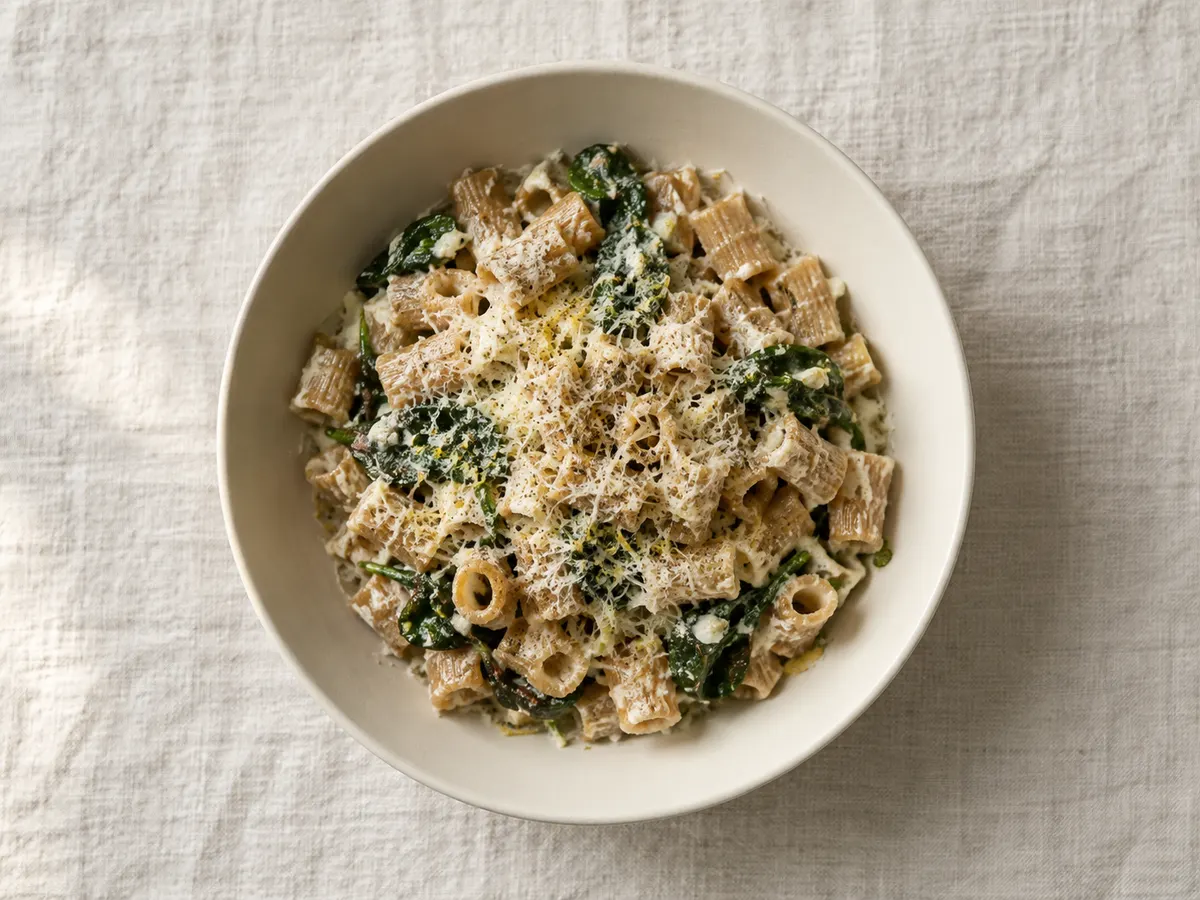 Whole-wheat pasta with ricotta, spinach, and lemon23.2 g protein per serving
Satiety
The 1 to 5 score is our own estimate: it starts at 1 point, adds points for low energy density, for protein and fiber per 100 kcal, and for the water in solid foods, and subtracts points for drinks with calories. It is useful for comparing foods with each other; it is not a measurement in people.
This food was measured in people: in the satiety index by Holt and colleagues (1995), which compared 240 kcal servings of 38 foods over two hours, it scored 188 versus 100 for white bread. In other words, it was more filling than the same calories of white bread. Source: Holt SH, Miller JC, Petocz P, Farmakalidis E. A satiety index of common foods. Eur J Clin Nutr. 1995;49(9):675-90.
What to keep in mind on a GLP-1 medication
Frequently asked questions about cooked whole-wheat pasta
How much protein is in a 150 g (5.5 oz) serving of cooked whole-wheat pasta?
100 g (3.5 oz) of cooked whole-wheat pasta has 6 g of protein. A typical 150 g (5.5 oz) serving has about 9 g of protein. That is 4 g of protein per 100 kcal.
How many calories does a 150 g (5.5 oz) serving of cooked whole-wheat pasta have?
100 g (3.5 oz) of cooked whole-wheat pasta has 149 kcal. A typical 150 g (5.5 oz) serving has about 224 kcal. That is a low energy density.
Does cooked whole-wheat pasta have fiber?
100 g (3.5 oz) of cooked whole-wheat pasta has 3.9 g of fiber. A typical 150 g (5.5 oz) serving has about 5.9 g of fiber. It carries our “High in fiber” tag.
Is cooked whole-wheat pasta filling?
Yes, fairly filling for the calories it provides: our estimated satiety score is 4 out of 5. It is based on: low energy density; moderate protein per calorie; moderate fiber per calorie. It was also measured in people: in the Holt satiety index (1995), with 240 kcal servings, it scored 188 versus 100 for white bread.
What should I know about cooked whole-wheat pasta on a GLP-1 medication?
Based on our tags, this is what matters about cooked whole-wheat pasta on a GLP-1 medication. “High in fiber”: a good amount of fiber, which helps keep you regular; it is easier to tolerate when you increase it gradually and drink enough water. These are general guidelines, not medical advice: everyone tolerates foods differently.
What counts as a normal serving of cooked whole-wheat pasta?
We use 150 g (5.5 oz) as a typical serving. That amount provides about 224 kcal, 9 g of protein, and 5.9 g of fiber. It is a reference for calculations, not a recommendation of how much to eat.
Compare with…
Similar foods
Sources
Sources for the data on this page, with the access date.
- Official databaseU.S. Department of Agriculture, Agricultural Research Service.USDA FoodData Central: Pasta, whole-wheat, cooked (Includes foods for USDA's Food Distribution Program) (FDC ID 168910).accessed .
- Clinical trialEuropean Journal of Clinical Nutrition.Holt SH, Miller JC, Petocz P, Farmakalidis E. A satiety index of common foods. Eur J Clin Nutr. 1995;49(9):675-90.accessed .
- Official databaseU.S. Department of Agriculture, Agricultural Research Service.USDA FoodData Central: Pasta, cooked, enriched, without added salt (FDC ID 169737).accessed .
- Clinical guidelineObesity (Wiley).Mozaffarian D, et al. Nutritional priorities to support GLP-1 therapy for obesity: A joint Advisory from the American College of Lifestyle Medicine, the American Society for Nutrition, the Obesity Medicine Association, and The Obesity Society. Obesity. 2025;33(8):1475-1503. doi:10.1002/oby.24336.accessed .
- RegulatorOfficial Journal of the European Union (EUR-Lex).Regulation (EC) No 1924/2006 on nutrition and health claims made on foods (Annex).accessed .
- Official databaseDiabetes Care (American Diabetes Association).Atkinson FS, Foster-Powell K, Brand-Miller JC. International tables of glycemic index and glycemic load values: 2008. Diabetes Care. 2008;31(12):2281-2283. doi:10.2337/dc08-1239.accessed .
- Meta-analysisBMJ Open.Chiavaroli L, et al. Effect of pasta in the context of low-glycaemic index dietary patterns on body weight and markers of adiposity: a systematic review and meta-analysis of randomised controlled trials in adults. BMJ Open. 2018;8(3):e019438. doi:10.1136/bmjopen-2017-019438.accessed .