Ultra-processed foods and sweets
Honey
Honey packs 304 kcal into 100 g (3.5 oz), so a typical 21 g (0.7 oz) serving already adds up to about 64 kcal.
Estimated satietyHow it is calculated
Estimated satiety: 1 out of 5
| Starting point | +1 |
|---|---|
| High energy density: 304 kcal/100 g | −1 |
| Protein: 0.1 g/100 kcal | 0 |
| Fiber: 0.1 g/100 kcal | 0 |
| Solid food with 17.1 g of water, under 70 | 0 |
| Sum | 0 |
| Raised to the minimum of 1 | 1 |
Our own estimate from the values per 100 g: useful for comparing foods with each other, not a measurement in people. Holt index (1995): this food was not measured.
- Prepared by
- Alex Gonzalez
- Last updated
- Next review
- Sources
- 10 primary and 2 supporting
- Data
- USDA FDC 169640
No clinical review. No advertising from drug companies and no affiliate links.How we work
Nutrition facts
- Calories
- 64 kcal per serving
- 304 kcal per 100 g (3.5 oz)
- Protein
- 0.1 g per serving
- 0.3 g per 100 g (3.5 oz)
- Carbohydrates
- 17.3 g per serving
- 82.4 g per 100 g (3.5 oz)
- of which sugars
- 17.2 g per serving
- 82.1 g per 100 g (3.5 oz)
- Fiber
- 0 g per serving
- 0.2 g per 100 g (3.5 oz)
- Fat
- 0 g per serving
- 0 g per 100 g (3.5 oz)
- of which saturated
- 0 g per serving
- 0 g per 100 g (3.5 oz)
- Water
- 3.6 g per serving
- 17.1 g per 100 g (3.5 oz)
Source: USDA FoodData Central: Honey (FDC ID 169640), accessed September 23, 2026.
A typical 21 g (0.7 oz) serving provides about 64 kcal, 0.1 g of protein, and 0 g of fiber.
What it is and how to eat it
Honey is the sweet substance bees make from flower nectar (blossom honey) or from secretions of living plant parts and excretions of sap-sucking insects (honeydew honey), and in the EU it may not, as a rule, contain more than 20% water (Directive 2001/110/EC). Spain has designations of origin such as Miel de La Alcarria and Miel de Granada, and in Latin America, where it is also called miel de abeja to tell it apart from cane or maple syrup (miel de caña, miel de maple), Mexico and Argentina are among the major exporters. Since June 14, 2026, honey blends from several countries sold in the EU must list the countries of origin, with their percentages, on the label (Directive (EU) 2024/1438); this page uses USDA's honey, with 304 kcal and 82.1 g of sugars per 100 g.
A 21 g (0.7 oz) tablespoon provides 64 kcal and 17.2 g of sugars, with no protein, so it does not replace any meal and at most sweetens one that already has protein, such as the ricotta with honey and walnuts. When appetite is very low, the 2025 nutrition advisory on GLP-1 therapy suggests starting meals with protein, and the calories in honey are not very filling: in this page's satiety score it gets the minimum, 1 out of 5. If you use it, measure it with a teaspoon rather than pouring it.
What the evidence says
WHO counts the sugars naturally present in honey as free sugars, just like added sugar, and recommends keeping them below 10% of daily energy, about 50 g on a 2,000 kcal diet, so a 21 g tablespoon already takes up a third of that limit. According to USDA, its sugars are mostly fructose, 40.9 g per 100 g, and glucose, 35.8 g. The Scientific Committee of the Spanish Agency for Food Safety and Nutrition (AESAN) recommends not giving honey to children under 12 months because of the risk of infant botulism, since it is the food most often identified as the source when one is found, and the US National Library of Medicine gives the same advice. EFSA also lists honey among the foods associated with infant botulism.
Recipes with this food
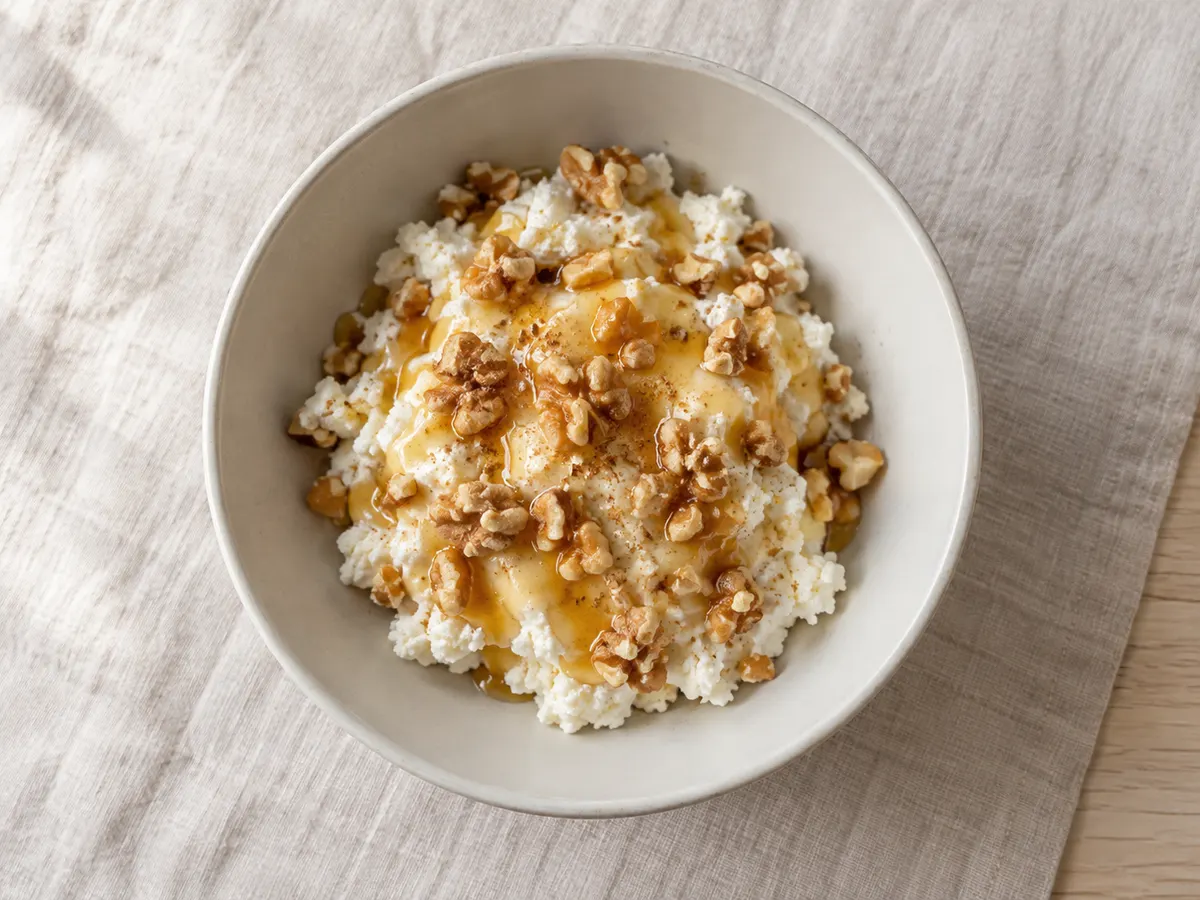 Ricotta with honey and walnuts16.4 g protein per serving
Satiety
The 1 to 5 score is our own estimate: it starts at 1 point, adds points for low energy density, for protein and fiber per 100 kcal, and for the water in solid foods, and subtracts points for drinks with calories. It is useful for comparing foods with each other; it is not a measurement in people.
What to keep in mind on a GLP-1 medication
Frequently asked questions about honey
How many grams of protein are in a 21 g (0.7 oz) serving of honey?
100 g (3.5 oz) of honey has 0.3 g of protein. A typical 21 g (0.7 oz) serving has about 0.1 g of protein. That is 0.1 g of protein per 100 kcal.
How many kcal are in a 21 g (0.7 oz) serving of honey?
100 g (3.5 oz) of honey has 304 kcal. A typical 21 g (0.7 oz) serving has about 64 kcal. That is a high energy density.
How much fiber is in a 21 g (0.7 oz) serving of honey?
100 g (3.5 oz) of honey has 0.2 g of fiber. A typical 21 g (0.7 oz) serving has about 0 g of fiber.
Does honey keep you full?
Barely filling for the calories it provides: our estimated satiety score is 1 out of 5. Calculation: 1 (base) − 1 (high energy density: 304 kcal/100 g) + 0 (protein: 0.1 g/100 kcal) + 0 (fiber: 0.1 g/100 kcal) + 0 (solid food with 17.1 g of water, under 70) = 0; raised to the minimum of 1. It is an estimate based on its composition, not a measurement in people.
How does honey fit into eating on Ozempic, Wegovy, Mounjaro, or Zepbound?
Based on our tags, this is what matters about honey on a GLP-1 medication. “High energy density”: a lot of energy in a small volume; when your appetite is very low, a small serving can help you meet your needs. These are general guidelines, not medical advice: everyone tolerates foods differently.
What is a typical serving of honey?
We use 21 g (0.7 oz) as a typical serving. That amount provides about 64 kcal, 0.1 g of protein, and 0 g of fiber. It is a reference for calculations, not a recommendation of how much to eat.
Compare with…
Similar foods
Sources
Sources for the data on this page, with the access date.
- Official databaseU.S. Department of Agriculture, Agricultural Research Service.USDA FoodData Central: Honey (FDC ID 169640).accessed .
- RegulatorOfficial Journal of the European Union (EUR-Lex).Council Directive 2001/110/EC relating to honey (Annexes I and II).accessed .
- RegulatorMinistry of Agriculture, Fisheries and Food (Spain).Denominaciones de origen e indicaciones geográficas protegidas de España registradas en la UE (Spanish PDOs and PGIs registered in the EU, by region; in Spanish).accessed .
- PressSecretariat of Agriculture and Rural Development (Mexico).México, noveno exportador global de miel: AGRICULTURA (Mexico, ninth-largest honey exporter; press release, 18 August 2026, in Spanish).accessed .
- PressGovernment of Argentina (argentina.gob.ar).Las exportaciones de miel alcanzaron récord en volumen y valor de los últimos 20 años (honey exports reach a 20-year record; in Spanish).accessed .
- RegulatorOfficial Journal of the European Union (EUR-Lex).Directive (EU) 2024/1438 of the European Parliament and of the Council amending, among others, Directive 2001/110/EC relating to honey (countries of origin).accessed .
- Clinical guidelineObesity (Wiley).Mozaffarian D, et al. Nutritional priorities to support GLP-1 therapy for obesity: A joint Advisory from the American College of Lifestyle Medicine, the American Society for Nutrition, the Obesity Medicine Association, and The Obesity Society. Obesity. 2025;33(8):1475-1503. doi:10.1002/oby.24336.accessed .
- Clinical guidelineWorld Health Organization.Guideline: sugars intake for adults and children (2015).accessed .
- InstitutionWorld Health Organization.Healthy diet (fact sheet, section on free sugars).accessed .
- RegulatorSpanish Agency for Food Safety and Nutrition (AESAN).Report of the Scientific Committee of the Spanish Agency for Food Safety and Nutrition (AESAN) on infant botulism (AESAN-2011-001).accessed .
- InstitutionMedlinePlus, US National Library of Medicine (NIH).Infant botulism (medical encyclopedia).accessed .
- RegulatorEFSA Journal.EFSA BIOHAZ Panel. Opinion of the Scientific Panel on biological hazards related to Clostridium spp in foodstuffs. EFSA Journal. 2005;3(4):199. doi:10.2903/j.efsa.2005.199.accessed .