Meat, fish, and eggs
Salmon
Salmon provides 20.4 g of protein for 208 kcal per 100 g (3.5 oz), or 9.8 g of protein for every 100 kcal.
Estimated satietyHow it is calculated
Estimated satiety: 3 out of 5
| Starting point | +1 |
|---|---|
| Moderate energy density | 0 |
| A lot of protein per calorie | +2 |
Our own estimate from the values per 100 g: useful for comparing foods with each other, not a measurement in people. Holt index (1995): this food was not measured.
- Prepared by
- Alex Gonzalez
- Last updated
- Next review
- Sources
- 5 primary
- Data
- USDA FDC 175167
No clinical review. No advertising from drug companies and no affiliate links.How we work
Nutrition facts
- Calories
- 260 kcal per serving
- 208 kcal per 100 g (3.5 oz)
- Protein
- 25.5 g per serving
- 20.4 g per 100 g (3.5 oz)
- Carbohydrates
- 0 g per serving
- 0 g per 100 g (3.5 oz)
- of which sugars
- 0 g per serving
- 0 g per 100 g (3.5 oz)
- Fiber
- 0 g per serving
- 0 g per 100 g (3.5 oz)
- Fat
- 16.8 g per serving
- 13.4 g per 100 g (3.5 oz)
- of which saturated
- 3.8 g per serving
- 3.1 g per 100 g (3.5 oz)
- Water
- 81.1 g per serving
- 64.9 g per 100 g (3.5 oz)
Source: USDA FoodData Central: Fish, salmon, Atlantic, farmed, raw (FDC ID 175167), accessed September 23, 2026.
A typical 125 g (4.5 oz) serving provides about 260 kcal, 25.5 g of protein, and 0 g of fiber.
What it is and how to eat it
Most salmon sold is farmed Atlantic salmon; wild salmon, almost always from the Pacific, is less common. It is sold fresh as fillets or steaks, frozen or smoked, and this page covers raw farmed salmon, with 13.4 g of fat and 20.4 g of protein per 100 g according to USDA.
A 125 g (4.4 oz) serving provides 25.5 g of protein and 260 kcal. The 2025 nutrition advisory on GLP-1 therapy lists fish among the low-volume protein foods to prioritize, but notes that foods high in protein or fat can further slow gastric emptying and suggests avoiding fatty foods in the first few days of treatment. In those days, and during dose increases, when digestive symptoms are more likely, half a serving baked or steamed, without frying or rich sauces, may sit better, as in the baked salmon with broccoli and potato.
What the evidence says
The salmon on this page has 1.96 g of EPA and DHA per 100 g, so a 125 g serving provides about 2.5 g, roughly ten times the 250 mg a day that EFSA considers an adequate intake for adults. The EU authorizes the claim that EPA and DHA contribute to the normal function of the heart, provided consumers are told the effect comes with 250 mg a day (Regulation (EU) No 432/2012). The FDA and EPA list salmon among the "best choices" in their mercury advice for pregnant and breastfeeding people and children.
Recipes with this food
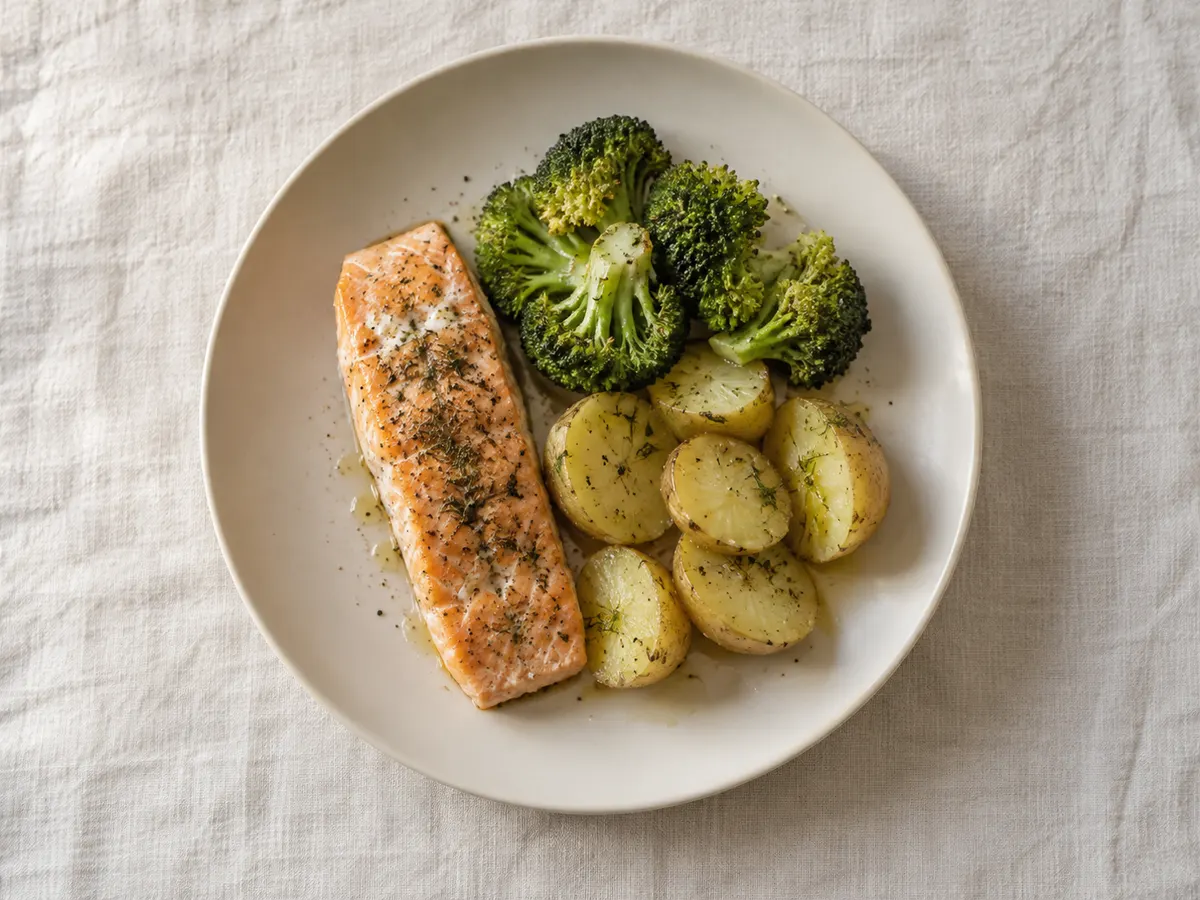 Baked salmon with broccoli and potato30.6 g protein per serving
Satiety
The 1 to 5 score is our own estimate: it starts at 1 point, adds points for low energy density, for protein and fiber per 100 kcal, and for the water in solid foods, and subtracts points for drinks with calories. It is useful for comparing foods with each other; it is not a measurement in people.
What to keep in mind on a GLP-1 medication
Frequently asked questions about salmon
How much protein is in a 125 g (4.5 oz) serving of salmon?
100 g (3.5 oz) of salmon has 20.4 g of protein. A typical 125 g (4.5 oz) serving has about 25.5 g of protein. That is 9.8 g of protein per 100 kcal, which is why it carries our “High in protein” tag.
How many calories does a 125 g (4.5 oz) serving of salmon have?
100 g (3.5 oz) of salmon has 208 kcal. A typical 125 g (4.5 oz) serving has about 260 kcal. That is a moderate energy density.
Is salmon filling?
Moderately: our estimated satiety score is 3 out of 5. It is based on: moderate energy density; a lot of protein per calorie. It is an estimate based on its composition, not a measurement in people.
What should I know about salmon on a GLP-1 medication?
Based on our tags, this is what matters about salmon on a GLP-1 medication. “High in protein”: plenty of protein per calorie; protein helps preserve muscle mass when you eat less. “Nutritious in small servings”: a lot of nutrition in a small volume, which is practical when you eat little. These are general guidelines, not medical advice: everyone tolerates foods differently.
What counts as a normal serving of salmon?
We use 125 g (4.5 oz) as a typical serving. That amount provides about 260 kcal, 25.5 g of protein, and 0 g of fiber. It is a reference for calculations, not a recommendation of how much to eat.
Compare with…
Similar foods
Sources
Sources for the data on this page, with the access date.
- Official databaseU.S. Department of Agriculture, Agricultural Research Service.USDA FoodData Central: Fish, salmon, Atlantic, farmed, raw (FDC ID 175167).accessed .
- Clinical guidelineObesity (Wiley).Mozaffarian D, et al. Nutritional priorities to support GLP-1 therapy for obesity: A joint Advisory from the American College of Lifestyle Medicine, the American Society for Nutrition, the Obesity Medicine Association, and The Obesity Society. Obesity. 2025;33(8):1475-1503. doi:10.1002/oby.24336.accessed .
- RegulatorEuropean Food Safety Authority (EFSA).EFSA NDA Panel. Scientific Opinion on Dietary Reference Values for fats, including saturated fatty acids, polyunsaturated fatty acids, monounsaturated fatty acids, trans fatty acids, and cholesterol. EFSA Journal. 2010;8(3):1461.accessed .
- RegulatorOfficial Journal of the European Union (EUR-Lex).Commission Regulation (EU) No 432/2012 establishing a list of permitted health claims made on foods.accessed .
- RegulatorU.S. Food and Drug Administration (FDA) and U.S. Environmental Protection Agency (EPA).Advice about Eating Fish: For Those Who Might Become or Are Pregnant or Breastfeeding and Children Ages 1-11 Years.accessed .