Grains and bread
Flour tortilla
Flour tortilla packs 306 kcal into 100 g (3.5 oz), so a typical 45 g (1.5 oz) serving already adds up to about 138 kcal.
Estimated satietyHow it is calculated
Estimated satiety: 1 out of 5
| Starting point | +1 |
|---|---|
| High energy density: 306 kcal/100 g | −1 |
| Protein: 2.7 g/100 kcal | 0 |
| Fiber: 1.1 g/100 kcal | 0 |
| Solid food with 32.0 g of water, under 70 | 0 |
| Sum | 0 |
| Raised to the minimum of 1 | 1 |
Our own estimate from the values per 100 g: useful for comparing foods with each other, not a measurement in people. Holt index (1995): this food was not measured.
- Prepared by
- Alex Gonzalez
- Last updated
- Next review
- Sources
- 10 primary
- Data
- USDA FDC 175037
No clinical review. No advertising from drug companies and no affiliate links.How we work
Nutrition facts
- Calories
- 138 kcal per serving
- 306 kcal per 100 g (3.5 oz)
- Protein
- 3.7 g per serving
- 8.2 g per 100 g (3.5 oz)
- Carbohydrates
- 22.2 g per serving
- 49.4 g per 100 g (3.5 oz)
- of which sugars
- 1.7 g per serving
- 3.7 g per 100 g (3.5 oz)
- Fiber
- 1.6 g per serving
- 3.5 g per 100 g (3.5 oz)
- Fat
- 3.6 g per serving
- 8 g per 100 g (3.5 oz)
- of which saturated
- 1.3 g per serving
- 2.9 g per 100 g (3.5 oz)
- Water
- 14.4 g per serving
- 32 g per 100 g (3.5 oz)
Source: USDA FoodData Central: Tortillas, ready-to-bake or -fry, flour, refrigerated (FDC ID 175037), accessed September 23, 2026.
A typical 45 g (1.5 oz) serving provides about 138 kcal, 3.7 g of protein, and 1.6 g of fiber.
What it is and how to eat it
The Dictionary of the Spanish Language records the tortilla de harina (flour tortilla) in Guatemala, Honduras and Mexico as a round, flat cake made with wheat flour, and the Dictionary of Americanisms records it in Mexico and Paraguay. Unlike the corn tortilla, which FAO describes as made from nixtamalized corn, that is, corn cooked with lime, its dough is wheat; this page uses USDA's refrigerated flour tortillas, ready to bake or fry, with 306 kcal, 8.2 g of protein, 3.5 g of fiber and 7.99 g of fat per 100 g. USDA's corn tortilla without added salt has 222 kcal, 5.2 g of fiber and 2.5 g of fat per 100 g.
A 45 g (1.6 oz) tortilla provides 138 kcal, 3.7 g of protein and 3.6 g of fat, and a 30 g (1.1 oz) corn tortilla 67 kcal, so the filling is what decides how filling it is. The 2025 nutrition advisory on GLP-1 therapy suggests starting with protein, so it is best filled with chicken, egg, beans or fresh cheese with vegetables, as in the chicken wrap with cottage cheese and vegetables, rather than melted cheese or fatty meats. In the first few days of treatment, when the same advisory suggests avoiding fatty foods, it usually sits better warmed on a griddle (comal) or in a pan without oil than fried, and when hunger is low half a well-filled tortilla may be enough.
What the evidence says
FAO explains that cooking corn with lime increases the calcium in corn tortillas by up to 400%; even so, USDA's flour tortilla has 146 mg of calcium per 100 g, against 175 mg for the corn tortilla without added salt, and both exceed the 120 mg for a "source of calcium" (Regulations (EC) No 1924/2006 and (EU) No 1169/2011). With 3.5 g of fiber per 100 g it is a "source of fibre", which requires 3 g, but protein supplies only about 11% of its energy, below the 12% for a "source of protein". It has 736 mg of sodium per 100 g according to USDA, about 331 mg per 45 g tortilla, a sixth of the 2,000 mg a day the WHO recommends not exceeding, against 11 mg per 100 g for the corn tortilla without added salt.
Recipes with this food
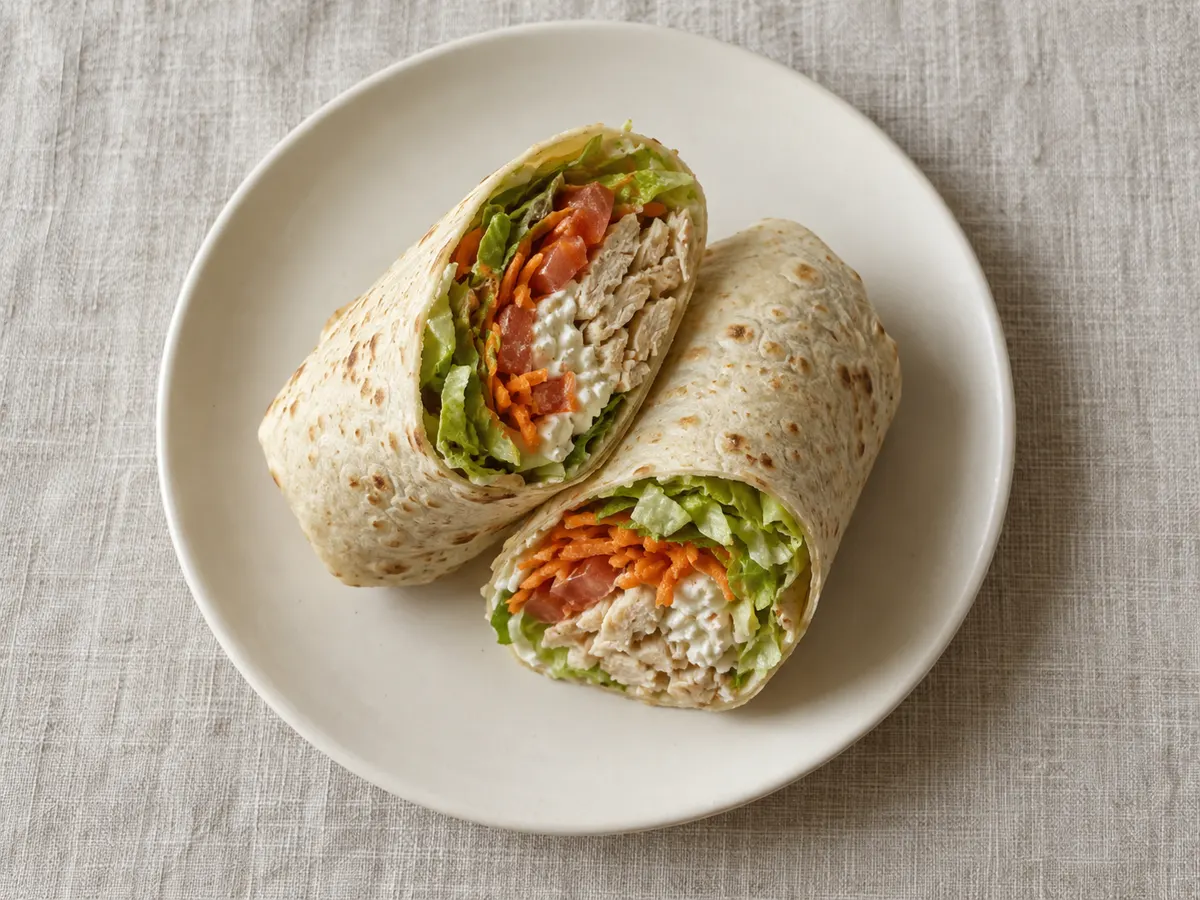 Chicken wrap with cottage cheese and vegetables35.3 g protein per serving
Satiety
The 1 to 5 score is our own estimate: it starts at 1 point, adds points for low energy density, for protein and fiber per 100 kcal, and for the water in solid foods, and subtracts points for drinks with calories. It is useful for comparing foods with each other; it is not a measurement in people.
What to keep in mind on a GLP-1 medication
Frequently asked questions about flour tortilla
How much protein is in a 45 g (1.5 oz) serving of flour tortilla?
100 g (3.5 oz) of flour tortilla has 8.2 g of protein. A typical 45 g (1.5 oz) serving has about 3.7 g of protein. That is 2.7 g of protein per 100 kcal.
How many calories does a 45 g (1.5 oz) serving of flour tortilla have?
100 g (3.5 oz) of flour tortilla has 306 kcal. A typical 45 g (1.5 oz) serving has about 138 kcal. That is a high energy density.
Does flour tortilla have fiber?
100 g (3.5 oz) of flour tortilla has 3.5 g of fiber. A typical 45 g (1.5 oz) serving has about 1.6 g of fiber. It carries our “High in fiber” tag.
Is flour tortilla filling?
Barely filling for the calories it provides: our estimated satiety score is 1 out of 5. Calculation: 1 (base) − 1 (high energy density: 306 kcal/100 g) + 0 (protein: 2.7 g/100 kcal) + 0 (fiber: 1.1 g/100 kcal) + 0 (solid food with 32.0 g of water, under 70) = 0; raised to the minimum of 1. It is an estimate based on its composition, not a measurement in people.
What should I know about flour tortilla on a GLP-1 medication?
Based on our tags, this is what matters about flour tortilla on a GLP-1 medication. “High in fiber”: a good amount of fiber, which helps keep you regular; it is easier to tolerate when you increase it gradually and drink enough water. “High energy density”: a lot of energy in a small volume; when your appetite is very low, a small serving can help you meet your needs. These are general guidelines, not medical advice: everyone tolerates foods differently.
What counts as a normal serving of flour tortilla?
We use 45 g (1.5 oz) as a typical serving. That amount provides about 138 kcal, 3.7 g of protein, and 1.6 g of fiber. It is a reference for calculations, not a recommendation of how much to eat.
Compare with…
Similar foods
Sources
Sources for the data on this page, with the access date.
- Official databaseU.S. Department of Agriculture, Agricultural Research Service.USDA FoodData Central: Tortillas, ready-to-bake or -fry, flour, refrigerated (FDC ID 175037).accessed .
- InstitutionRoyal Spanish Academy and Association of Academies of the Spanish Language (RAE-ASALE).Diccionario de la lengua española (Dictionary of the Spanish Language, 23rd ed., online version): "tortilla (tortilla de harina)" (in Spanish).accessed .
- InstitutionAssociation of Academies of the Spanish Language (ASALE).Diccionario de americanismos (Dictionary of Americanisms): "tortilla (tortilla de harina)" (in Spanish).accessed .
- Official databaseU.S. Department of Agriculture, Agricultural Research Service.USDA FoodData Central: Tortillas, ready-to-bake or -fry, corn, without added salt (FDC ID 173241).accessed .
- Clinical guidelineObesity (Wiley).Mozaffarian D, et al. Nutritional priorities to support GLP-1 therapy for obesity: A joint Advisory from the American College of Lifestyle Medicine, the American Society for Nutrition, the Obesity Medicine Association, and The Obesity Society. Obesity. 2025;33(8):1475-1503. doi:10.1002/oby.24336.accessed .
- InstitutionFood and Agriculture Organization of the United Nations (FAO).Maize in human nutrition (FAO, 1992), chapter 4: post-harvest technology, processing.accessed .
- InstitutionFood and Agriculture Organization of the United Nations (FAO).Maize in human nutrition (FAO, 1992), chapter 5: physical and chemical changes in maize during processing (lime-treated maize, part II).accessed .
- RegulatorOfficial Journal of the European Union (EUR-Lex).Regulation (EC) No 1924/2006 on nutrition and health claims made on foods (Annex).accessed .
- RegulatorOfficial Journal of the European Union (EUR-Lex).Regulation (EU) No 1169/2011 on the provision of food information to consumers (Annex XIII, nutrient reference values).accessed .
- InstitutionWorld Health Organization.Sodium reduction.accessed .