Grains and bread
Brown rice cakes
Brown rice cakes packs 387 kcal into 100 g (3.5 oz), so a typical 18 g (0.6 oz) serving already adds up to about 70 kcal.
Estimated satietyHow it is calculated
Estimated satiety: 1 out of 5
| Starting point | +1 |
|---|---|
| High energy density: 387 kcal/100 g | −1 |
| Protein: 2.1 g/100 kcal | 0 |
| Fiber: 1.1 g/100 kcal | 0 |
| Solid food with 5.8 g of water, under 70 | 0 |
| Sum | 0 |
| Raised to the minimum of 1 | 1 |
Our own estimate from the values per 100 g: useful for comparing foods with each other, not a measurement in people. Holt index (1995): this food was not measured.
- Prepared by
- Alex Gonzalez
- Last updated
- Next review
- Sources
- 5 primary
- Data
- USDA FDC 170250
No clinical review. No advertising from drug companies and no affiliate links.How we work
Nutrition facts
- Calories
- 70 kcal per serving
- 387 kcal per 100 g (3.5 oz)
- Protein
- 1.5 g per serving
- 8.2 g per 100 g (3.5 oz)
- Carbohydrates
- 14.7 g per serving
- 81.5 g per 100 g (3.5 oz)
- of which sugars
- 0.2 g per serving
- 0.9 g per 100 g (3.5 oz)
- Fiber
- 0.8 g per serving
- 4.2 g per 100 g (3.5 oz)
- Fat
- 0.5 g per serving
- 2.8 g per 100 g (3.5 oz)
- of which saturated
- 0.1 g per serving
- 0.6 g per 100 g (3.5 oz)
- Water
- 1 g per serving
- 5.8 g per 100 g (3.5 oz)
Source: USDA FoodData Central: Snacks, rice cakes, brown rice, plain, unsalted (FDC ID 170250), accessed September 23, 2026.
A typical 18 g (0.6 oz) serving provides about 70 kcal, 1.5 g of protein, and 0.8 g of fiber.
What it is and how to eat it
They are very light discs of puffed, pressed rice: according to USDA, one cake weighs about 9 g. This page covers unsalted brown rice cakes, with 387 kcal, 8.2 g of protein, 4.2 g of fiber and 2.8 g of fat per 100 g. They contain almost no water, only 5.8 g per 100 g, so although they weigh little, they pack a lot of energy per gram.
A 9 g (0.3 oz) cake provides 35 kcal, 0.7 g of protein, 0.4 g of fiber and 0.3 g of fat: it is crunchy and bulky, but on its own it provides very little. The reference serving on this page is two cakes, about 18 g (0.6 oz), which provide 70 kcal, 1.5 g of protein and 0.8 g of fiber. The 2025 nutrition advisory on GLP-1 therapy lists brown rice among the whole grains to encourage and suggests eating protein-rich foods first, so they work better as a base for ricotta, queso fresco, hummus or turkey, as in the rice cakes with ricotta, cucumber, and dill. Since they are low in fat, they fit the same advisory's suggestion to avoid fatty or high-fiber foods in the first days of treatment.
What the evidence says
The EU sets a maximum of 0.30 mg of inorganic arsenic per kilogram for rice waffles, wafers, crackers and cakes, compared with 0.15 mg for white rice and 0.25 mg for husked (brown) rice (Regulation (EU) 2023/915). In its 2024 assessment, EFSA concluded that adults' dietary exposure to inorganic arsenic raises a health concern despite the uncertainties, and recalled that, according to its 2021 report, rice and rice-based products are among the main contributors. With 4.2 g of fiber per 100 g they are a "source of fibre", above the 3 g the EU requires, although one cake provides only 0.4 g, and protein provides 8% of their energy, below the 12% for "source of protein" (Regulation (EC) No 1924/2006).
Recipes with this food
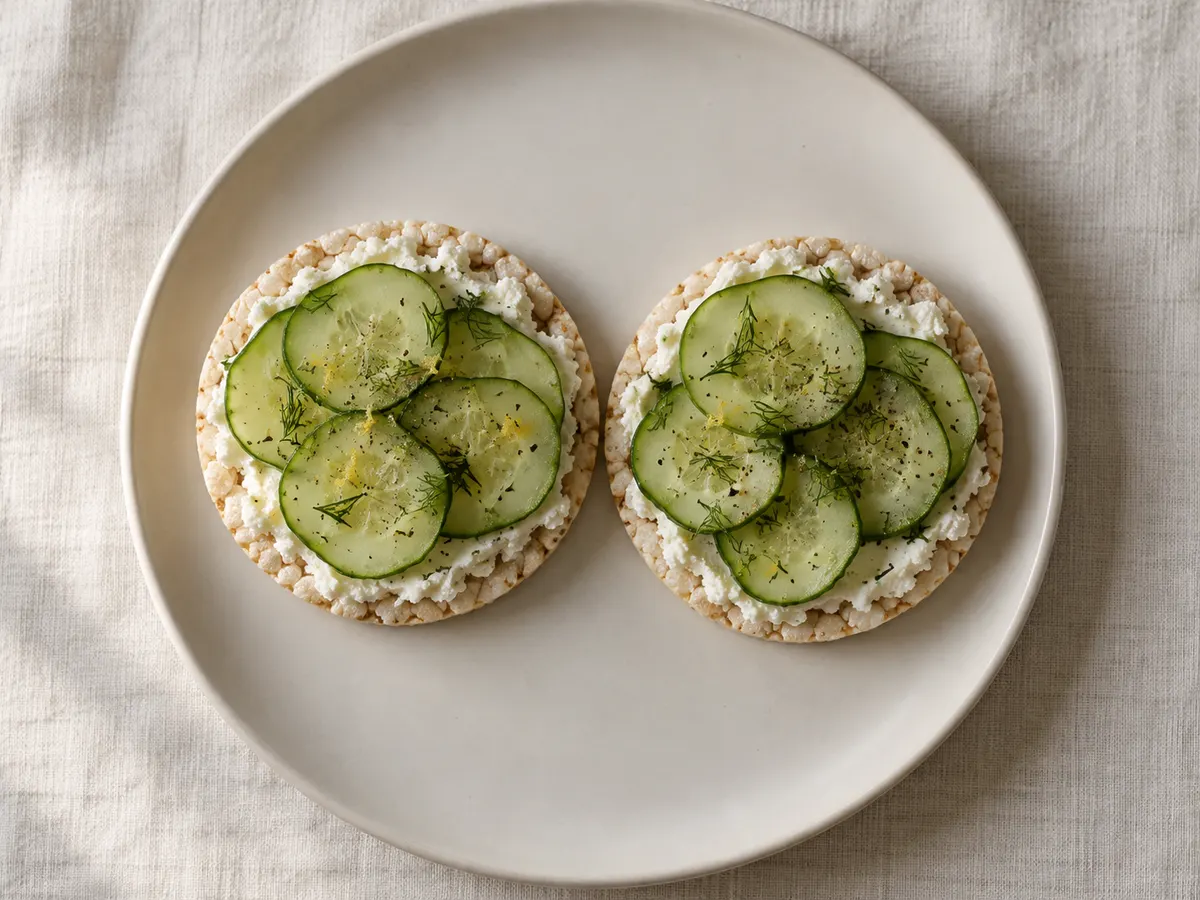 Rice cakes with ricotta, cucumber, and dill13.2 g protein per serving
Satiety
The 1 to 5 score is our own estimate: it starts at 1 point, adds points for low energy density, for protein and fiber per 100 kcal, and for the water in solid foods, and subtracts points for drinks with calories. It is useful for comparing foods with each other; it is not a measurement in people.
What to keep in mind on a GLP-1 medication
Frequently asked questions about brown rice cakes
How much protein is in a 18 g (0.6 oz) serving of brown rice cakes?
100 g (3.5 oz) of brown rice cakes has 8.2 g of protein. A typical 18 g (0.6 oz) serving has about 1.5 g of protein. That is 2.1 g of protein per 100 kcal.
How many calories does a 18 g (0.6 oz) serving of brown rice cakes have?
100 g (3.5 oz) of brown rice cakes has 387 kcal. A typical 18 g (0.6 oz) serving has about 70 kcal. That is a high energy density.
Does brown rice cakes have fiber?
100 g (3.5 oz) of brown rice cakes has 4.2 g of fiber. A typical 18 g (0.6 oz) serving has about 0.8 g of fiber. It carries our “High in fiber” tag.
Is brown rice cakes filling?
Barely filling for the calories it provides: our estimated satiety score is 1 out of 5. Calculation: 1 (base) − 1 (high energy density: 387 kcal/100 g) + 0 (protein: 2.1 g/100 kcal) + 0 (fiber: 1.1 g/100 kcal) + 0 (solid food with 5.8 g of water, under 70) = 0; raised to the minimum of 1. It is an estimate based on its composition, not a measurement in people.
What should I know about brown rice cakes on a GLP-1 medication?
Based on our tags, this is what matters about brown rice cakes on a GLP-1 medication. “High in fiber”: a good amount of fiber, which helps keep you regular; it is easier to tolerate when you increase it gradually and drink enough water. “High energy density”: a lot of energy in a small volume; when your appetite is very low, a small serving can help you meet your needs. These are general guidelines, not medical advice: everyone tolerates foods differently.
What counts as a normal serving of brown rice cakes?
We use 18 g (0.6 oz) as a typical serving. That amount provides about 70 kcal, 1.5 g of protein, and 0.8 g of fiber. It is a reference for calculations, not a recommendation of how much to eat.
Compare with…
Similar foods
Sources
Sources for the data on this page, with the access date.
- Official databaseU.S. Department of Agriculture, Agricultural Research Service.USDA FoodData Central: Snacks, rice cakes, brown rice, plain, unsalted (FDC ID 170250).accessed .
- Clinical guidelineObesity (Wiley).Mozaffarian D, et al. Nutritional priorities to support GLP-1 therapy for obesity: A joint Advisory from the American College of Lifestyle Medicine, the American Society for Nutrition, the Obesity Medicine Association, and The Obesity Society. Obesity. 2025;33(8):1475-1503. doi:10.1002/oby.24336.accessed .
- RegulatorOfficial Journal of the European Union (EUR-Lex).Commission Regulation (EU) 2023/915 on maximum levels for certain contaminants in food (Annex I, point 3.4, inorganic arsenic).accessed .
- RegulatorEFSA Journal.EFSA CONTAM Panel. Update of the risk assessment of inorganic arsenic in food. EFSA Journal. 2024;22(1):8488. doi:10.2903/j.efsa.2024.8488.accessed .
- RegulatorOfficial Journal of the European Union (EUR-Lex).Regulation (EC) No 1924/2006 on nutrition and health claims made on foods (Annex).accessed .