Grains and bread
Arepa
A typical 90 g (3 oz) serving of arepas has about 197 kcal and 2.3 g of fiber, from 219 kcal per 100 g.
Estimated satietyHow it is calculated
Estimated satiety: 1 out of 5
| Starting point | +1 |
|---|---|
| Moderate energy density: 219 kcal/100 g | 0 |
| Protein: 2.5 g/100 kcal | 0 |
| Fiber: 1.2 g/100 kcal | 0 |
| Solid food with 50.8 g of water, under 70 | 0 |
Our own estimate from the values per 100 g: useful for comparing foods with each other, not a measurement in people. Holt index (1995): this food was not measured.
- Prepared by
- Alex Gonzalez
- Last updated
- Next review
- Sources
- 3 primary and 2 supporting
- Data
- USDA FDC 168070
No clinical review. No advertising from drug companies and no affiliate links.How we work
Nutrition facts
- Calories
- 197 kcal per serving
- 219 kcal per 100 g (3.5 oz)
- Protein
- 4.9 g per serving
- 5.5 g per 100 g (3.5 oz)
- Carbohydrates
- 33.4 g per serving
- 37.1 g per 100 g (3.5 oz)
- of which sugars
- 0.8 g per serving
- 0.9 g per 100 g (3.5 oz)
- Fiber
- 2.3 g per serving
- 2.6 g per 100 g (3.5 oz)
- Fat
- 4.8 g per serving
- 5.4 g per 100 g (3.5 oz)
- of which saturated
- 2.6 g per serving
- 2.9 g per 100 g (3.5 oz)
- Water
- 45.7 g per serving
- 50.8 g per 100 g (3.5 oz)
Source: USDA FoodData Central: Restaurant, Latino, arepa (unleavened cornmeal bread) (FDC ID 168070), accessed September 23, 2026.
A typical 90 g (3 oz) serving provides about 197 kcal, 4.9 g of protein, and 2.3 g of fiber.
What it is and how to eat it
The arepa is a round corn-dough cake, griddled on a budare or flat pan, baked or fried, and it is the base of everyday eating in Venezuela and Colombia; today it is almost always made with precooked white or yellow corn flour, sold packaged throughout Latin America and in Latin American grocery stores in Spain. There are many variants, such as the arepa de huevo from Colombia's Caribbean coast, fried and filled with egg, or the arepa de choclo, made from fresh corn and sweeter. This page uses the unfilled restaurant arepa analyzed by USDA, with 219 kcal, 5.5 g of protein and 2.6 g of fiber per 100 g; homemade ones vary with the fat and salt they contain.
A 90 g (3.2 oz) arepa provides 197 kcal, 4.9 g of protein and 2.3 g of fiber, so, like bread, it fills you up mainly through what goes inside. The 2025 nutrition advisory on GLP-1 therapy suggests starting with protein, and in an arepa that is the filling: egg, as in the small arepa with perico scrambled eggs, chicken, as in the arepa stuffed with shredded chicken and avocado, queso fresco or caraotas (black beans). In the first few days of treatment, when the same advisory suggests avoiding very fatty foods, and after a dose increase, it usually sits better griddled on a budare or in a pan without oil than fried, and half a well-filled arepa may be enough.
What the evidence says
According to a 2014 review in the Annals of the New York Academy of Sciences, precooked corn flour for arepas is made from dehulled, degermed kernels whose endosperm is cooked, flaked, dried and milled, a different process from nixtamalization, the cooking with lime (calcium hydroxide) used for Mexican tortilla dough. In 1993 Venezuela began adding iron, vitamin A and B vitamins to precooked corn flour, and iron and B vitamins to wheat flour, and between 1992 and 1994 iron deficiency among children and adolescents in Caracas fell from 37% to 15% (American Journal of Clinical Nutrition, 1996). With 2.6 g of fiber per 100 g and 1.2 g per 100 kcal, this arepa does not reach the 3 g per 100 g or the 1.5 g per 100 kcal the EU requires for a "source of fibre" claim (Regulation (EC) No 1924/2006).
Recipes with this food
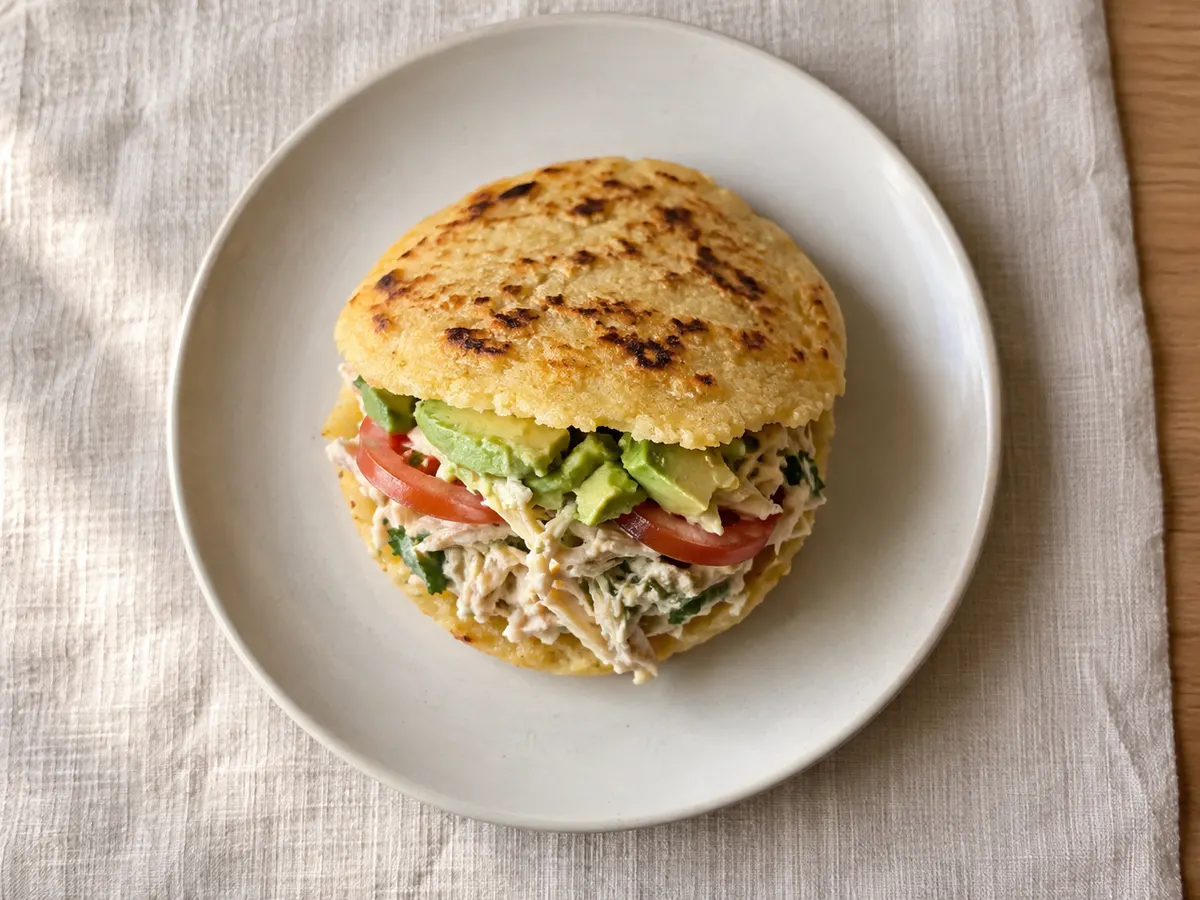 Arepa stuffed with shredded chicken and avocado27 g protein per serving
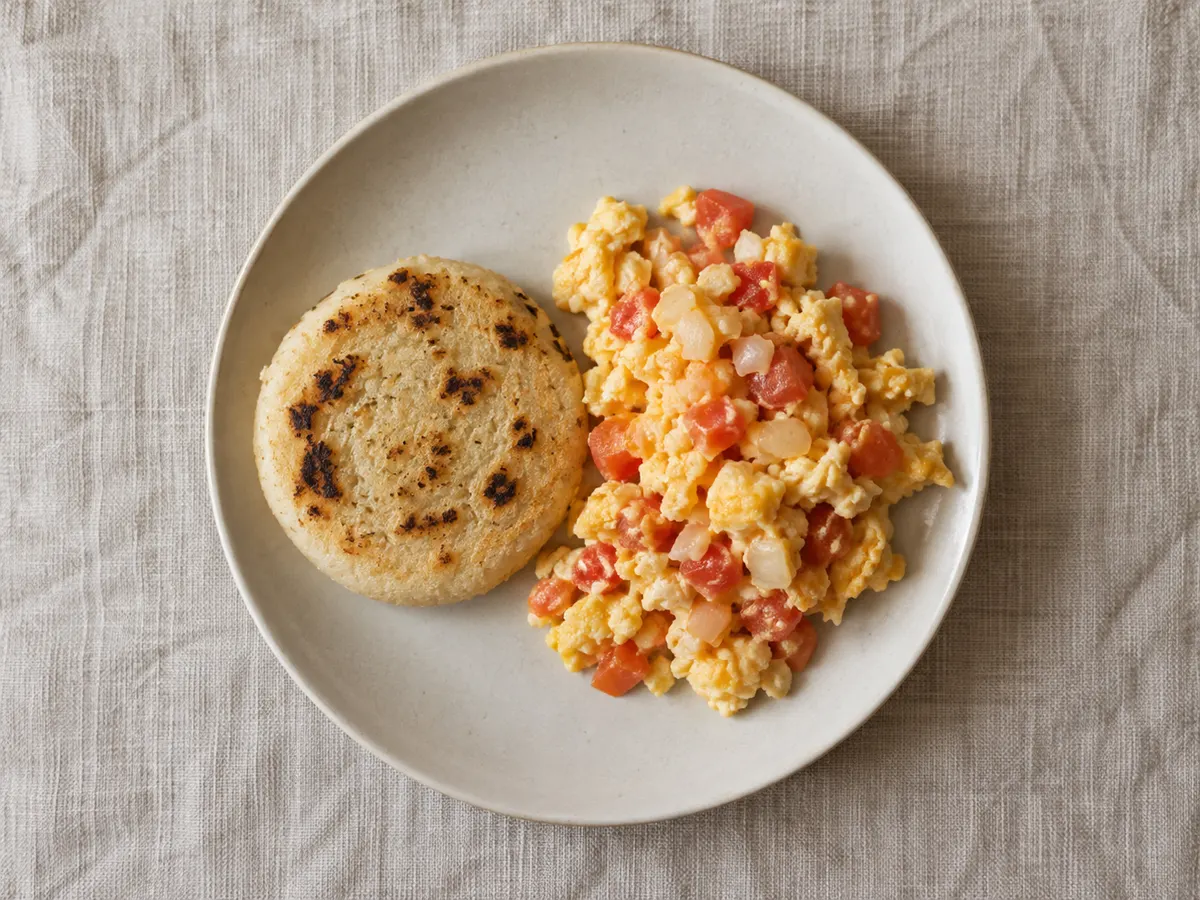 Small arepa with perico scrambled eggs17.9 g protein per serving
Satiety
The 1 to 5 score is our own estimate: it starts at 1 point, adds points for low energy density, for protein and fiber per 100 kcal, and for the water in solid foods, and subtracts points for drinks with calories. It is useful for comparing foods with each other; it is not a measurement in people.
Frequently asked questions about arepas
How much protein is in a medium arepa?
A medium arepa, our reference serving of 90 g (3 oz), has about 4.9 g of protein. 100 g (3.5 oz) of arepas has 5.5 g of protein. That is 2.5 g of protein per 100 kcal.
How many calories does a medium arepa have?
A medium arepa, our reference serving of 90 g (3 oz), has about 197 kcal. 100 g (3.5 oz) of arepas has 219 kcal. That is a moderate energy density.
Do arepas have fiber?
A medium arepa, our reference serving of 90 g (3 oz), has about 2.3 g of fiber. 100 g (3.5 oz) of arepas has 2.6 g of fiber.
Are arepas filling?
Barely filling for the calories they provide: our estimated satiety score is 1 out of 5. Calculation: 1 (base) + 0 (moderate energy density: 219 kcal/100 g) + 0 (protein: 2.5 g/100 kcal) + 0 (fiber: 1.2 g/100 kcal) + 0 (solid food with 50.8 g of water, under 70) = 1. It is an estimate based on its composition, not a measurement in people.
What counts as a normal serving of arepas?
We use 90 g (3 oz) as a typical serving, roughly a medium arepa. That amount provides about 197 kcal, 4.9 g of protein, and 2.3 g of fiber. It is a reference for calculations, not a recommendation of how much to eat.
Compare with…
Similar foods
Sources
Sources for the data on this page, with the access date.
- Official databaseU.S. Department of Agriculture, Agricultural Research Service.USDA FoodData Central: Restaurant, Latino, arepa (unleavened cornmeal bread) (FDC ID 168070).accessed .
- Clinical guidelineObesity (Wiley).Mozaffarian D, et al. Nutritional priorities to support GLP-1 therapy for obesity: A joint Advisory from the American College of Lifestyle Medicine, the American Society for Nutrition, the Obesity Medicine Association, and The Obesity Society. Obesity. 2025;33(8):1475-1503. doi:10.1002/oby.24336.accessed .
- Other sourceAnnals of the New York Academy of Sciences (Wiley).Gwirtz JA, Garcia-Casal MN. Processing maize flour and corn meal food products. Ann N Y Acad Sci. 2014;1312:66-75. doi:10.1111/nyas.12299.accessed .
- Other sourceAmerican Journal of Clinical Nutrition.Layrisse M, et al. Early response to the effect of iron fortification in the Venezuelan population. Am J Clin Nutr. 1996;64(6):903-907. doi:10.1093/ajcn/64.6.903.accessed .
- RegulatorOfficial Journal of the European Union (EUR-Lex).Regulation (EC) No 1924/2006 on nutrition and health claims made on foods (Annex).accessed .